1.10e–1.10g - Position vectors, distances and vector problems
Turn positions into displacements, distances and points along a segment. Use scalar multiples to prove geometric relationships, then interpret a vector sum as the resultant of forces on one particle.
From positions to displacements
A straight cable joins to . A marker must be two-thirds of the way from to . Where should it go? First we need the movement from one endpoint to the other, rather than either endpoint's position from the origin.
You already know
Subtract and scale vectors component by component. A vector's magnitude is the square root of the sum of its squared perpendicular components. Non-zero scalar multiples have parallel directions.
A position vector runs from a chosen origin to a point: , . The displacement instead starts at and ends at .
With unit vectors , each of magnitude , write . The two terms are its component vectors, and their sum is the resultant . Equal vectors have matching components, wherever their arrows are drawn; the unit vector in the direction of a non-zero is . These meanings also apply when the arrow represents displacement rather than position.
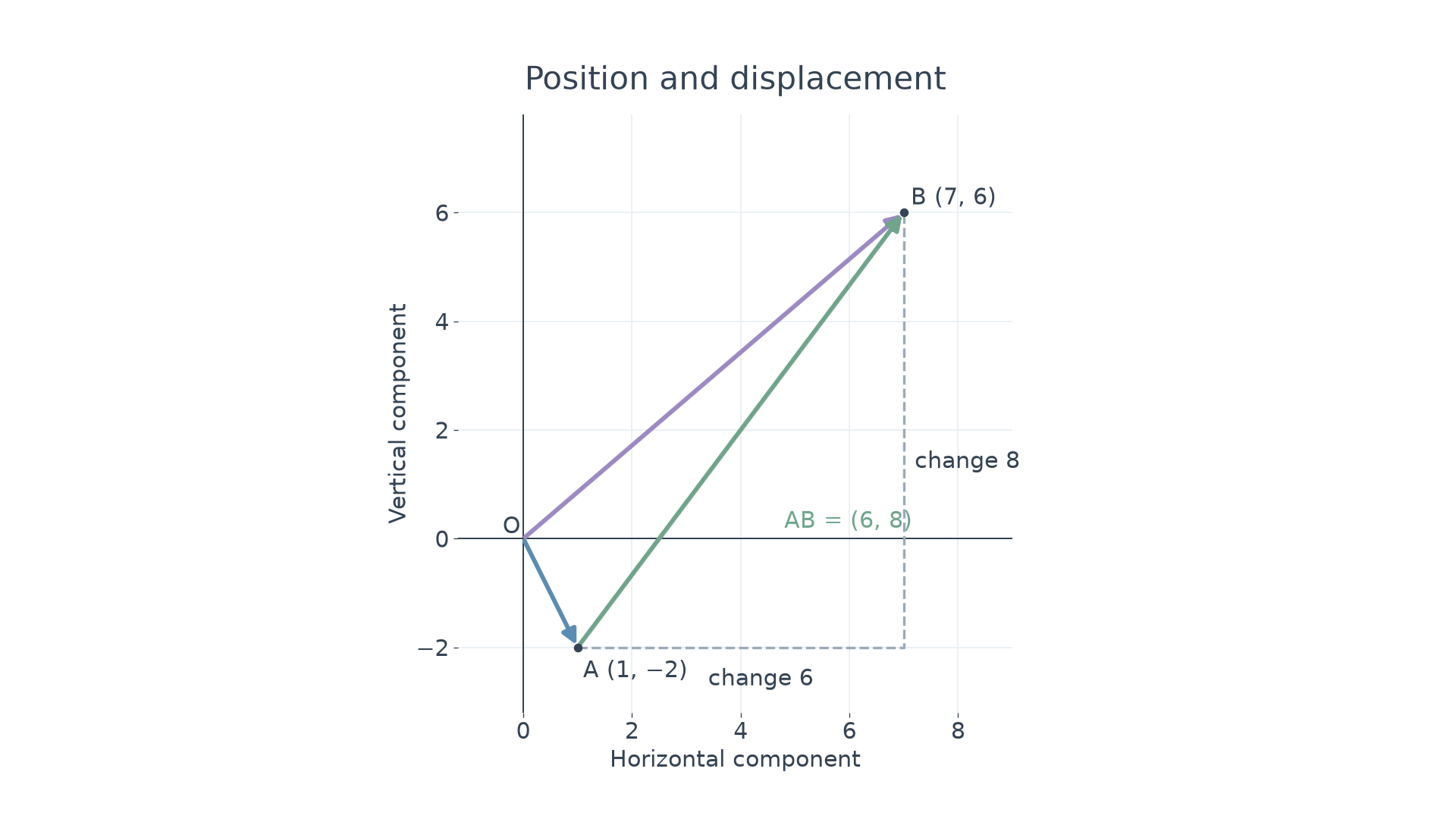
The position arrows start at . The displacement starts at ; its horizontal and vertical changes are and .
The route gives . The order of subtraction follows the arrow, not the alphabetical order of the labels.
Displacement and distance
For points with position vectors and :
In two dimensions, . Distance is a scalar and is the same in both directions.
Not in the formula sheet: learn it.
The subtraction also reveals a useful surprise: changing the origin changes both positions, but leaves the displacement unchanged. For any common shift , . The journey between the points cannot depend on where you draw your origin.
Worked example 1: a displacement and its length
Question. Find and for , .
Plan. Subtract the start from the finish, then find the length of that displacement.
Why this step? The right triangle uses changes in coordinates, not the coordinates of alone.
Answer. , and .
Check. Adding to reaches .
Change only the direction of the journey. Its vector changes sign; its distance does not.
Worked example 2: reversing a displacement
Question. For the same points, find and .
Plan. Use as the start and as the finish.
Why this step? An arrow has a direction; the length of a segment does not.
Answer. , and .
Check. .
Both endpoint positions contain information about the origin that should cancel before you calculate a connecting length.
Watch out
Wrong: . Those are distances from the origin. Right: . Only in special aligned cases can subtracting the two separate lengths happen to work.
Try a reversed arrow with different coordinates.
Locating points along a segment
A fraction of the displacement tells you how far to move. To locate the final point, add that movement to the starting position.
A point a fraction along a segment
If is a fraction of the way from to , then
For , is inside the segment. The endpoints use ; values outside extend beyond an endpoint. In particular, the midpoint has position .
Not in the formula sheet: learn it.
This is a calculation of a specified point, not a new equation-of-a-line method. For an internal ratio , the fraction measured from is : the denominator counts all the equal shares.
Worked example 3: the cable marker
Question. For , , find when internally.
Plan. Take two of the three shares of , then add them to .
Why this step? Two-thirds of the displacement begins at the origin unless you add the actual starting position.
Answer. The marker belongs at .
Check. .
Change only the internal ratio from to . The point now lies nearer .
Worked example 4: reversing the shares
Question. For the same and , find when .
Plan. Travel one-third, rather than two-thirds, of the displacement from .
Why this step? The ratio names first, so its first number sets the fraction measured from .
Answer. .
Check. , as required.
The formula also works with letters. The midpoint is because its two weights are equal, not because every ratio uses a simple average.
Watch out
Wrong: gives . Right: . The ratio compares two pieces; the fraction compares one piece with the whole.
Use the same ratio with a fresh segment.
Continue this lesson.
You’re previewing NovaLearn without an account. Create a free account to read the rest.
Create free account