3.02d - Constant acceleration formulae
Derive and use the five constant-acceleration equations for motion along a line. Choose signs and intervals carefully to solve staged journeys and vertical motion, including the instant when a particle turns.
When the formulae apply
At the top of a ball's flight, its velocity is zero. Has its acceleration also stopped? Imagine a ball launched upwards at : gravity changes its upward velocity by every second, even as it passes through rest.
You already know
Velocity is signed; speed is its magnitude. A velocity-time gradient gives acceleration and signed area gives displacement. Algebraic roots still need checking against the physical interval.
The formulae below describe a particle on a line over an interval with constant signed acceleration. Fix a positive direction. Use for velocity at the start of that interval, for velocity after elapsed time , and for displacement during it.
Constant acceleration
Velocity changes by equal signed amounts in equal times. The velocity-time graph is a straight line, including a horizontal line when acceleration is zero. Constant acceleration does not require increasing speed.
For , velocity falls by each second, so . For , its rate of change is , so acceleration varies. One constant-acceleration interval cannot describe the latter motion. Substituting an average acceleration generally does not repair a displacement calculation.
Use consistent units, normally metres and seconds. The variable means displacement; upright means seconds. If acceleration changes, or a collision or bounce occurs, start a new interval with a new initial velocity and elapsed time.
Key idea
The equations apply to one straight-line interval with constant acceleration. Reversal alone need not end that interval; a change of acceleration does.
Check the graph shape before selecting an equation.
Deriving the five relationships
The five equations are different views of one straight velocity-time line, so you can rebuild them rather than memorise unrelated rules.
[DIAGRAM: asset_name: Constant acceleration velocity graph; asset_slug: suvat_derivation; description: Straight velocity-time line from initial velocity u to final velocity v over elapsed time t, with rectangle ut and triangular area one half (v-u)t; caption: Constant acceleration velocity graph]
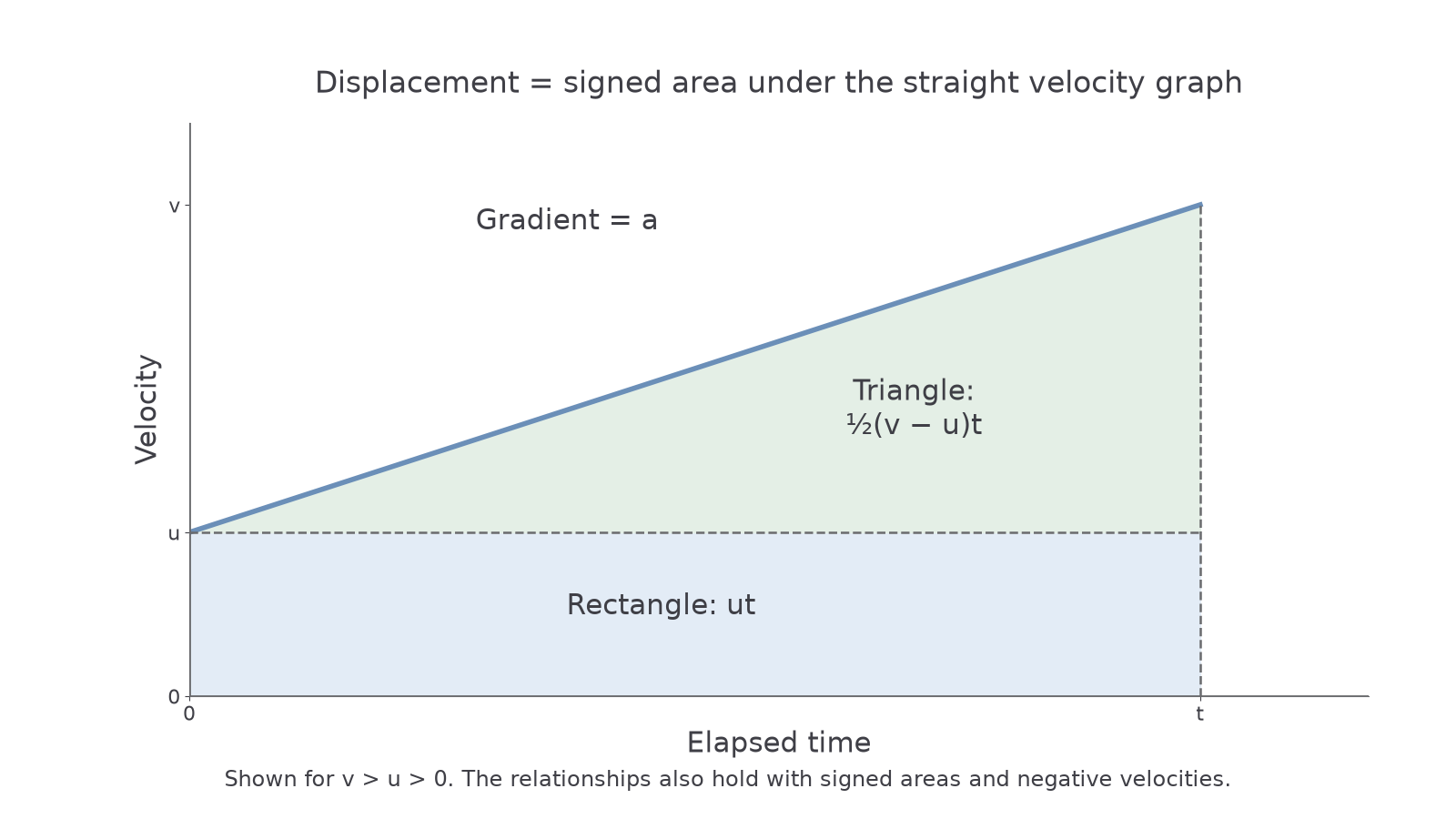
The gradient is , giving . The signed trapezium area is . These remain true when velocity crosses zero: area below the time axis subtracts from displacement.
Five scalar constant-acceleration equations
For constant on one line over elapsed time ,
Here is displacement, not automatically distance travelled.
In the formula sheet.
Substitution connects the area formula to both displacement forms.
Worked example 1: eliminating final velocity
Question. Starting from and , derive an equation for using .
Plan. Replace the final velocity in the area formula.
Why eliminate ? The requested equation must use the initial velocity instead.
Answer. , for constant acceleration.
Check. If , this reduces to constant-velocity displacement .
Change only the endpoint velocity retained: now use , eliminating .
Worked example 2: eliminating initial velocity
Question. Starting from and , derive an equation for using .
Plan. Rearrange the velocity equation and substitute for .
Why does the acceleration term now subtract? Final velocity exceeds the interval's average velocity when acceleration is positive.
Answer. , for constant acceleration.
Check. Replace by ; the result becomes , agreeing with the first derivation.
For the squared-velocity equation, factor rather than divide by acceleration:
This route also covers . Calculus supplies another required derivation. With a temporary time variable , constant acceleration gives
Taking outside the integral uses its constancy. The integration starts from zero displacement; for an absolute position add the initial coordinate. These derivation methods are not printed in the formula sheet.
Watch out
Wrong: “The area formula always gives distance.” Correct: it gives signed displacement. If velocity changes sign, the two parts of the route must be counted separately for distance.
Eliminate a different variable from the same starting relationships.
Choose the equation and interval
Choose the equation missing the quantity you do not need, then make sure every value belongs to the same interval.
| Equation | Quantity absent |
|---|---|
The table uses the supplied equations. A squared velocity gives a magnitude first: if , use the motion direction to choose between and .
Continue this lesson.
You’re previewing NovaLearn without an account. Create a free account to read the rest.
Create free account