1.03d, 1.03e - Circle equations, centres and radii
Read a circle equation as a statement about distance. You will construct equations from geometric information, uncover centres and radii by completing squares, and draw circles with the correct position, size and scale.
A circle as a distance locus
Where is the centre of , and why will its radius be , rather than ? Start with a circle whose geometry is visible: every point units from belongs to one circumference.
You already know
The distance from to is . Complete a square by adding and subtracting the same number, for example .
The centre is fixed, while a point on the circumference moves.
Circle
A circle is the set, or locus, of points at a fixed positive distance from a fixed point , its centre. The distance is its radius. The centre itself is inside the circle, rather than on its circumference.
The distance formula gives . Both sides are non-negative, so squaring is reversible.
Centre–radius equation
A circle with centre and radius has equation
For centre , this becomes .
Not in the formula sheet: learn it.
Substitution tests a point's distance without requiring a sketch.
Worked example 1: a point on a circle
Question. Write the equation of the circle with centre , radius , and decide whether lies on it.
Plan. Substitute the centre and squared radius, then calculate the point's squared distance.
Why is the first bracket ? You subtract the centre's coordinate .
Answer. ; the point is on the circumference.
Check. The point is exactly units horizontally from the centre.
Change only the radius, from to . Keep the centre and test point fixed.
Worked example 2: the same point is now inside
Question. Write the equation with centre , radius , and classify .
Plan. Change the squared radius and compare the same squared distance with it.
Why is comparison of squares enough? Both the distance and radius are non-negative, so the ordering is preserved.
Answer. ; is inside.
Check. Its distance is , less than the new radius .
In general, a squared distance less than is inside, equality is on the circumference, and greater than is outside. These comparisons follow directly from distance; they are not extra formula-sheet results.
Watch out
Wrong: centre , radius , gives . Right: subtract the centre coordinates and square the radius, giving .
Use a new centre, then give a calculation for the point decision.
Recovering the centre by completing squares
An expanded equation hides two completed squares. Recover them separately for and , then collect the constants on the right.
Completing the two squares
For real constants ,
can be written
A positive right side gives a circle; zero gives one point; a negative value gives no real points.
Not in the formula sheet: learn it.
You need not memorise the expanded constant expression if you can complete the squares reliably. A radius is the square root of the resulting positive number.
Worked example 3: uncovering the opening circle
Question. Find the centre and radius of .
Plan. Complete each square and balance the constants.
Why is the centre ? The brackets subtract those coordinates: .
Answer. Centre , radius .
Check. Expanding gives , hence the given equation.
Change only the common scale of the equation: multiply every term by . The geometric set must stay the same.
Worked example 4: a common squared-term coefficient
Question. Find the centre and radius of .
Plan. Divide the entire equation by , then complete the squares.
Why divide first? The standard circle form has coefficient on each squared variable.
Answer. Centre , radius , unchanged by the nonzero common factor.
Check. Multiplying the completed equation by and expanding returns the question's equation.
For another common-factor example, gives , centre , radius . Divide every term, rather than only the squared terms. Unequal squared coefficients cannot be read directly as this circle form.
There is a striking boundary case: changing only a constant can shrink a whole circle to one point or erase it. In , the completed right side is . At , only remains; at , there are no real points. Similarly gives , so it is not a real circle.
Watch out
Wrong: the right side is the radius. Right: it is , so the radius is . A negative right side has no real square-root radius.
Complete both squares before reading off the centre and radius.
Constructing and drawing a circle
To construct a circle equation, identify a centre and one radius. A point on the circumference gives the radius if the centre is known; diameter endpoints give the centre as well.
Worked example 5: centre and one point
Question. Find the circle with centre passing through .
Plan. Calculate the squared centre-to-point distance and use it as .
Why calculate directly? The circle equation needs that value, so a square root and later squaring are unnecessary.
Answer. .
Check. Substitution of gives .
Change only how the centre is supplied: replace it by the opposite diameter endpoint, retaining on the circle.
Worked example 6: endpoints of a diameter
Question. Find the circle with diameter endpoints and .
Plan. Find the diameter's midpoint, then its squared radius from one endpoint.
Why use the midpoint? A diameter passes through the centre and has its endpoints one radius away on opposite sides.
Answer. , the same circle as before.
Check. The diameter length is , twice the radius .
For diameter endpoints , , the same construction gives centre , diameter and equation . A single point without a centre or other restrictions would not determine one circle.
[DIAGRAM: asset_name: A circle recovered from completed squares; caption: Equal scales preserve the circle's shape and show its centre and radius; asset_slug: h240-centre-radius; description: Equal-scale axes show the circle centred at 3 comma minus 2 with radius 5. The four extreme points are minus 2 comma minus 2, 8 comma minus 2, 3 comma 3, and 3 comma minus 7. A horizontal radius and the centre are labelled.]
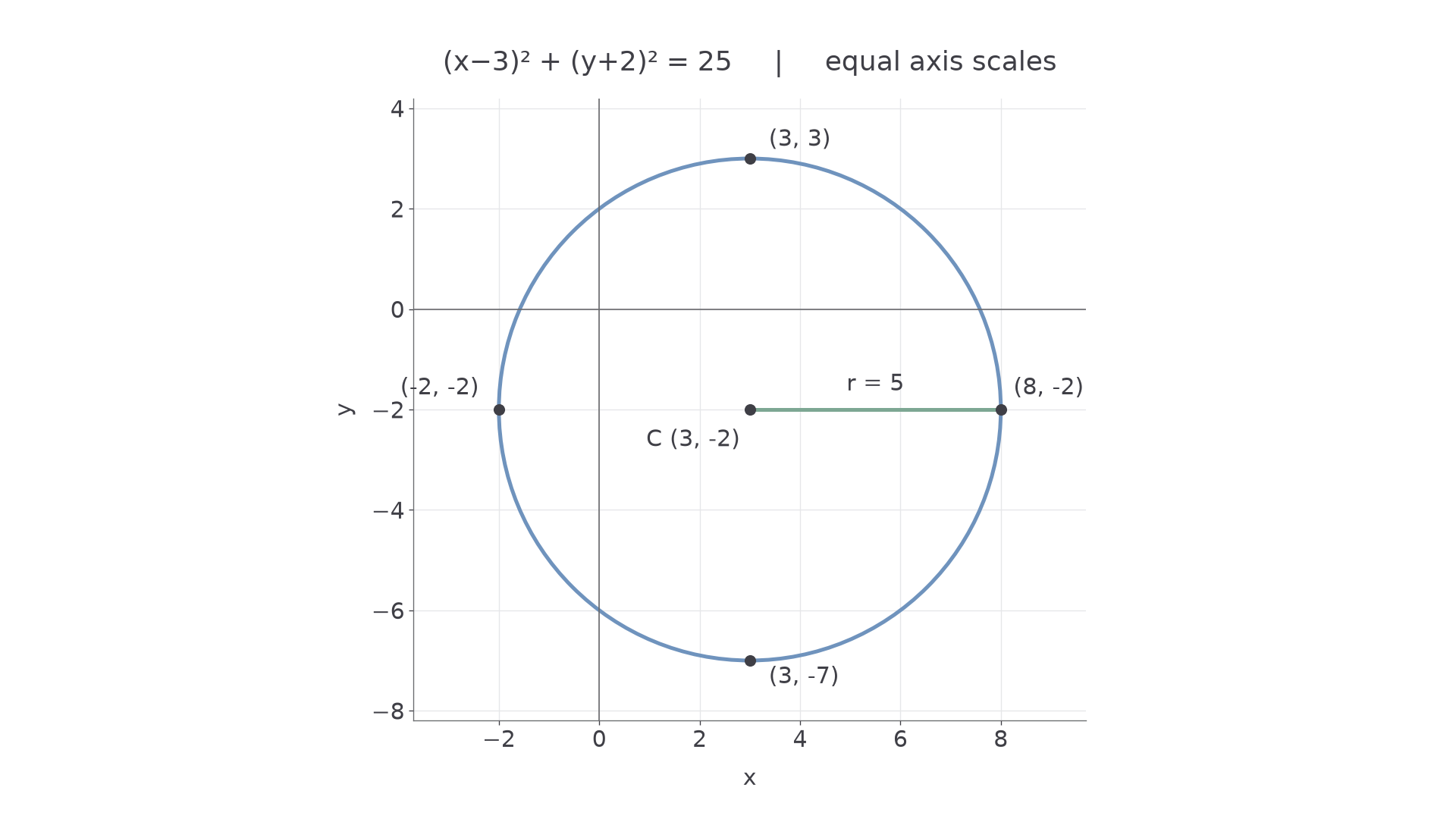
To draw the opening circle, mark its centre and points one radius left, right, up and down: , , , . Use equal physical scales on the axes, then a smooth circle through those points. Unequal scales make a circle appear elliptical. For an accurate drawing, use a compass where the scale permits.
Find intercepts by substitution rather than guessing them from a sketch. Setting gives , so . Setting gives , so . Some circles do not cross an axis at all. These constructions and intercept calculations are not in the formula sheet; derive them from the equation.
Watch out
Wrong: use the whole endpoint distance as the radius of a diameter-defined circle. Right: halve the diameter, or calculate the distance from its midpoint to an endpoint.
Use a fresh diameter. Give a complete equation rather than only the centre and radius.
Quick Recap
- A circle is a fixed positive distance from its centre; square that radius in its equation.
- Complete the and squares separately to reveal the centre and squared radius.
- A zero squared-radius value gives one point; a negative value gives no real points.
- Diameter endpoints give a midpoint centre and a radius equal to half their distance.
- Draw with equal axis scales and calculate intercepts by setting one coordinate to zero.
The opening equation becomes : its centre is and its radius is .