1.02c - Simultaneous equations and intersections
Two equations can describe the same pair of unknowns, but only their common solutions satisfy both. Learn elimination and substitution, handle brackets and fractions, and explain why a line and a quadratic curve can meet twice, once or not at all.
Eliminating a variable
Can two perfectly valid equations have no common solution? The equations and do: doubling the first would require , which cannot also equal . We will connect that algebraic clash to the graphs, then see how a quadratic changes the possibilities.
You already know
Multiplying an equation by a non-zero constant preserves its solutions. Substituting a value back into an equation checks whether it satisfies that equation.
The important word is “both”. Satisfying just one equation is not enough.
Simultaneous solution
A simultaneous solution is a set of values satisfying every equation in a system at once. For two unknowns, give an ordered pair . A linear equation has no products or powers of unknowns beyond the first power: is linear; is not.
Elimination removes one variable by adding or subtracting equations with matching coefficients. Keep an equation for back-substitution: the new equation alone usually describes many pairs.
Worked example 1: adding opposite coefficients
Question. Solve and .
Plan. Make the coefficients of opposite, add, then recover .
Why this step? Opposite coefficients cancel on addition, leaving an equation in one unknown.
Answer. .
Check. and .
Change the second equation so the matched coefficients have the same sign. Subtract rather than add.
Worked example 2: subtracting matching coefficients
Question. Solve and .
Plan. Match the positive coefficients of , subtract and back-substitute.
Why this step? Subtraction cancels equal coefficients. Addition would double them instead.
Answer. .
Check. and .
A surprising boundary case: changing the opening system's second right side from to changes no solutions into infinitely many. Both equations then describe ; every point on that line works. A contradiction such as means no solution; an identity such as means the two equations have supplied the same condition, not that .
Watch out
Wrong: multiply by to get . The right side must also double: .
Try a system whose coefficients already cancel.
Substitution and fractional equations
Substitution replaces a variable with an equal expression from another equation. If a variable already has coefficient , this can be quicker than matching coefficients.
Substituting an equal expression
If , then solving it with reduces to
followed by , with the given domains retained.
Not in the formula sheet: learn it.
Brackets protect the whole substituted expression, especially after a minus sign.
Worked example 3: a ready-made substitution
Question. Solve and .
Plan. Replace in the second equation, solve for , then recover .
Why this step? Each common solution has , so replacing by that expression preserves the condition.
Answer. .
Check. and .
The next system changes the presentation: fractions and brackets hide an equally simple substitution. Simplify each whole equation first.
Worked example 4: clearing fractions before substituting
Question. Solve and .
Plan. Clear the constant denominator and bracket coefficient, then express in terms of .
Why this step? Clearing a constant denominator changes every term in that equation; it creates no domain exclusion.
Answer. .
Check. and .
Elimination would work too. Choose the route with less algebra; no method has priority merely because of the order the equations are printed. A variable denominator, unlike the constant , would need a non-zero restriction retained throughout.
Watch out
Wrong: replace by when . The correct substitution is .
Clear the fraction and use the equation that makes a subject easily.
Linear and quadratic systems
The same substitution works when one equation is quadratic. The resulting one-variable quadratic may give two roots, each needing its own partner.
You already know
A product equal to zero gives alternative roots. Solve every real branch of the quadratic, then substitute each root into the linear equation.
A quadratic in two unknowns may contain , or . It need not already look like .
Worked example 5: a line and a sum of squares
Question. Solve and .
Plan. Replace , solve the quadratic in , then pair each root with its own .
Why this step? The roots are alternatives; values from different branches cannot be mixed into new pairs.
Answer. and .
Check. and ; both also satisfy the line.
Now change the quadratic's form to include a mixed term. The linear equation still supplies the substitution.
Worked example 6: a mixed quadratic term
Question. Solve and .
Plan. Write to leave a quadratic in .
Why this step? Choosing keeps the square already in , so the expansion stays short.
Answer. and .
Check. and ; both pairs sum to .
A negative coordinate is allowed in an unrestricted algebra problem. Reject it only if a stated context or domain excludes it. Neither the substitution method nor these solution-pair rules are supplied on the formula sheet.
Watch out
Wrong: list and without making the pairing clear. Write , or explicitly connect each to its .
Try the sum-of-squares structure with a new line and new radius value.
Intersections and solution counts
A simultaneous solution is a common point of the two graphs. Count distinct common points, so a repeated quadratic root represents one intersection.
For the curve and line , substitution gives . The picture shows how changing alters the number of intersections.
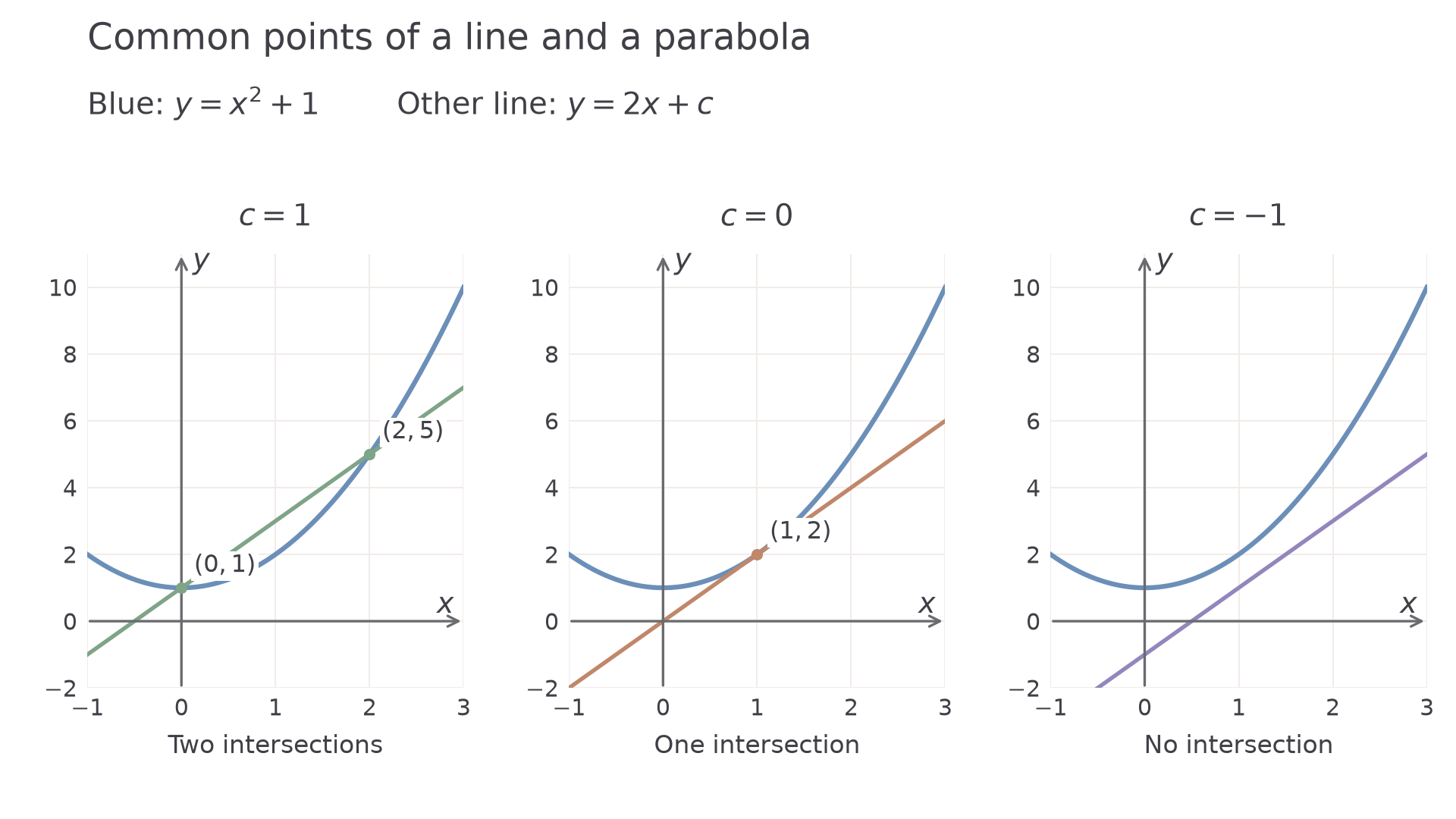
At , a non-negative square would have to equal : there is no common point. The two graphs still exist, just as both opening equations exist without sharing a solution.
Worked example 7: two exact intersections
Question. Find the intersections of and .
Plan. Equate the outputs, solve for and recover the common heights.
Why this step? Equating the two outputs finds exactly the horizontal coordinates where both graphs agree.
Answer. and .
Check. The plotted crossings match; and .
Change only the line's constant, from to . The two intersection points now merge.
Worked example 8: one distinct intersection
Question. Determine the intersection of and .
Plan. Complete the square after equating the outputs.
Why this step? A square equals zero only when its base is zero. The repeated root gives one common point, where the line touches the curve.
Answer. One intersection, .
Check. Both equations give height at ; the square is positive at every other .
More generally, has two roots for , one for , and none for . This classification is not in the formula sheet: learn the reasoning. For a restricted domain, discard intersections outside it and retain allowed endpoints.
Exam tip
A calculator sketch can suggest tangency. To determine it, show a repeated root or an equivalent exact argument; apparent touching at screen resolution is not enough.
Vary the curve's constant and make the complete classification yourself.
Quick Recap
- Eliminate matching coefficients, or substitute an equal expression.
- Clear constant denominators across whole equations; keep variable-denominator restrictions.
- A quadratic can supply two branches: recover and check each ordered pair.
- Intersections correspond to common solutions; repeated roots count once.
Yes, both opening equations are valid yet have no common solution: their parallel lines demand different values for the same expression. A line and a quadratic can instead have zero, one or two common points.