1.07j, 1.07l - Differentiating exponential and logarithmic functions
Find gradients of natural and other positive-base exponentials with linear exponents (1.07j), and of the natural logarithm on its real domain (1.07l). You will combine these rules in sums and distinguish an instantaneous rate from a change over a whole time interval.
The natural exponential and its rate factor
If an amount decreases at one quarter of its current amount per hour, does it lose exactly a quarter during the next hour? For , the answer is no. Differentiation will explain the difference between a rate now and a loss over an hour.
First consider . At , its value and gradient are both 1. At , both are . This remarkable equality holds at every point, not just at those two inputs.
You already know
is the natural exponential, and its inverse. Distinguish , with a constant exponent, from , with a constant base. Differentiate sums and constant multiples term by term.
The difference quotient makes the special gradient property visible:
For , set in the same limiting argument: the extra factor is , not the whole exponent . The first-principles definition is in the formula sheet; the exponential limit and derivative below are not.
Natural exponential derivative
For a real constant :
The domain is all real . For , the function is constant and the formula gives zero.
Not in the formula sheet: learn it.
Think of the factor as the speed at which the input changes. General composite functions come later; here the input is linear.
Worked example 1: a negative input rate
Question. Differentiate and find .
Plan. Retain the coefficient 5 and multiply by the exponent's constant rate .
Why this step? Lowering the exponent would apply a power rule to the wrong kind of function.
Answer. , with gradient at zero.
Check. The function is positive and decreasing, matching the negative derivative.
Change only the exponent's sign. The height remains positive, but its direction reverses.
Worked example 2: a positive input rate
Question. Differentiate and find .
Plan. Multiply by the input rate 2, then substitute zero.
Why this step? Changing to changes the derivative's sign as well as the exponent.
Answer. , with gradient 10 at zero.
Check. The gradient is positive for every real input, consistent with exponential growth.
Keep the power rule and exponential rule distinct.
Watch out
Wrong: . The exponent is variable, so this is not the power rule. Multiply by the constant input rate 2 and retain the exponential: .
A fractional input rate works in the same way: for example, has derivative . The constant disappears.
Other bases introduce a logarithm factor
For another positive base, use the natural exponential as a bridge: . Its input rate is .
Derivative for a positive base
For and real constant :
This includes , where . A negative base does not give a real exponential for all real inputs.
Not in the formula sheet: learn it.
The logarithm belongs to the base. It is a fixed number, even though the input varies.
Worked example 3: a base above one
Question. Differentiate and find its exact gradient at zero.
Plan. Rewrite with base , then use the input rate.
Why this step? Rewriting the exponent shows exactly where the factor comes from.
Answer. , with gradient at zero.
Check. , consistent with an increasing exponential.
Change only the base to its reciprocal. The logarithm factor should reverse sign.
Worked example 4: a base below one
Question. Differentiate and find its exact gradient at zero.
Plan. Use the same rule and simplify the logarithm of the base.
Why this step? A positive exponential value multiplied by a negative logarithm gives a negative gradient everywhere.
Answer. , with gradient at zero.
Check. gives the same derivative directly.
The two examples have the same base-logarithm magnitude but opposite signs.
Watch out
The extra factor is , not . The base is fixed, so its logarithm is a constant. Missing that factor gives the wrong gradient even when the exponential part is correct.
In general, it is the sign of that controls direction. For example, has derivative . Do not confuse with : their derivatives are and .
The natural logarithm and its real domain
The logarithm's reciprocal gradient comes from its inverse relationship with the exponential. Reflection in exchanges horizontal and vertical changes, so corresponding tangent gradients are reciprocals.
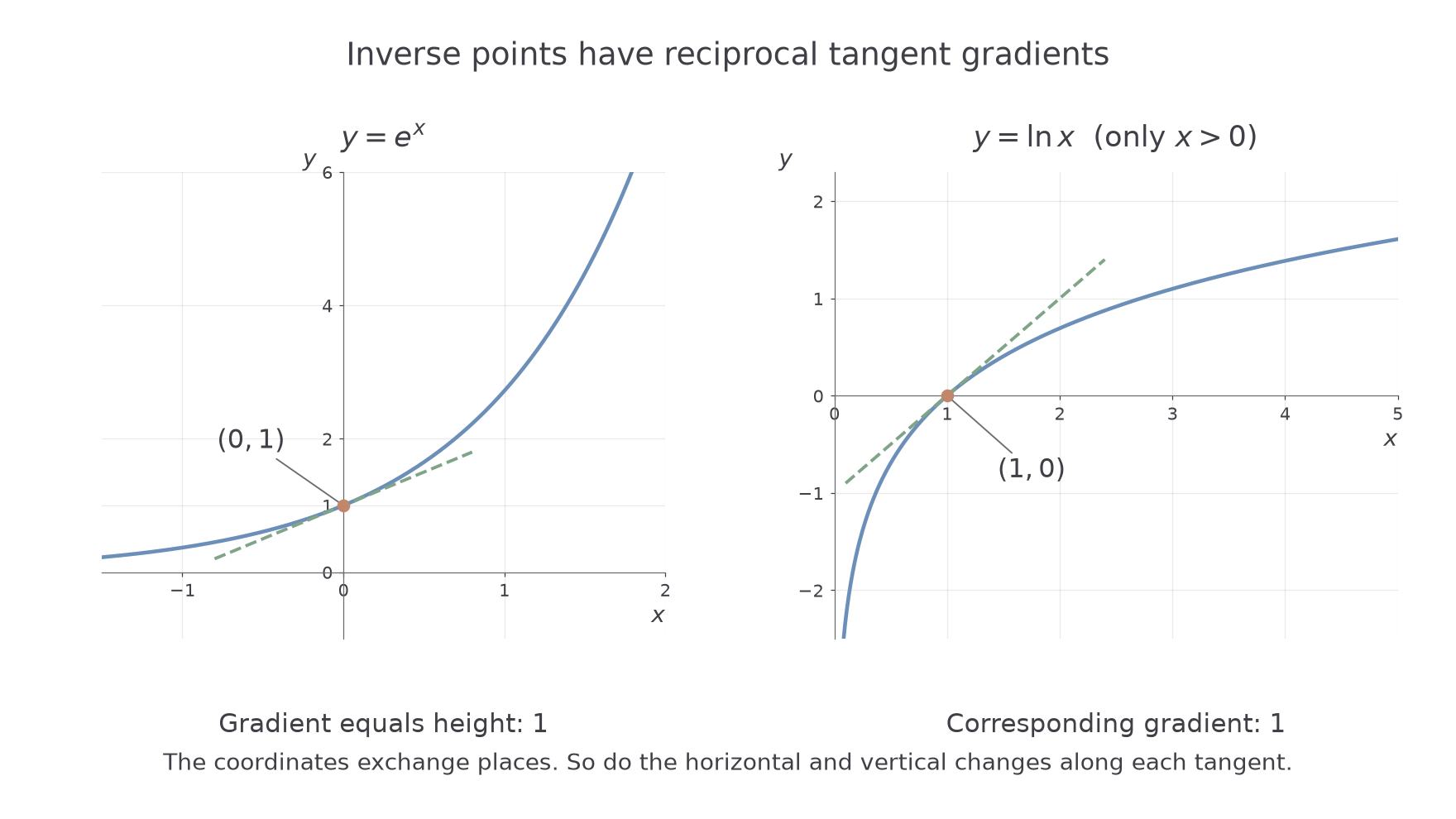
The exponential has gradient at the point ; the logarithm therefore has gradient at .
Natural logarithm derivative
For positive constant , on , so its derivative is also .
Not in the formula sheet: learn it.
The expression exists for negative , but that does not extend the real domain of . On its actual domain, the logarithm increases while its gradient becomes smaller.
Continue this lesson.
You’re previewing NovaLearn without an account. Create a free account to read the rest.
Create free account