1.05l, 1.05m - Compound and double angle formulae
Build angle-addition formulae from a geometric picture, derive double-angle identities, and choose the right form for exact values, simplification and bounded equations.
A geometric proof of angle addition
How can familiar angles give the exact value of ? Start with the easier question of what happens when a unit direction turns through two angles, one after the other. Turning through , then , must reach the same point as turning through .
You already know
A unit direction at angle has components . A right-angle anticlockwise turn sends to . Components add even when they are negative.
Take those perpendicular directions as the starting point. A further turn has signed components along the first direction and along the perpendicular one.
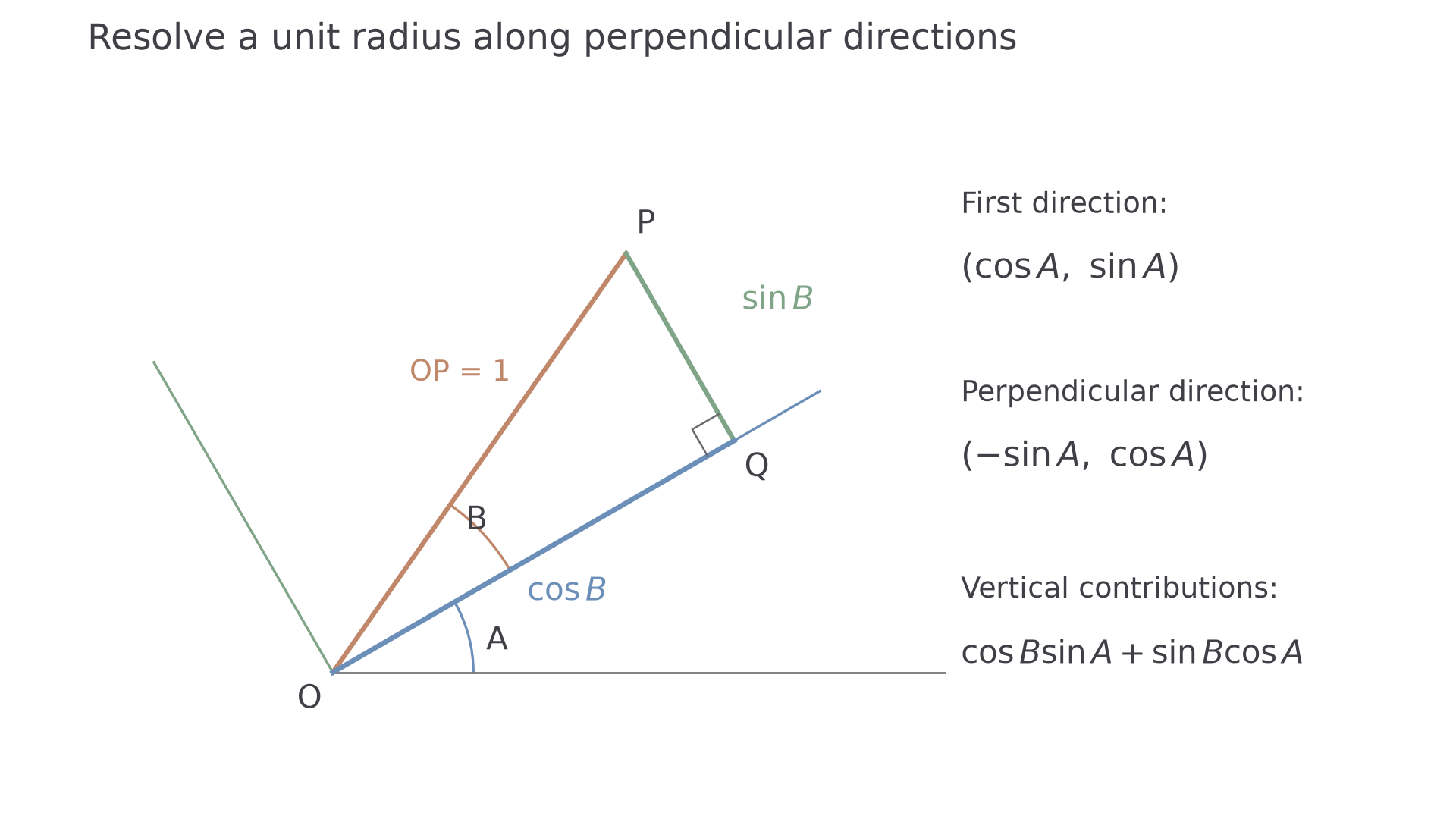
The picture shows acute angles so the projection triangle is easy to see. Signed components make the same argument work in every quadrant.
Compound-angle identity
A compound-angle identity expresses a trigonometric function of a sum or difference using functions of the individual angles. It holds for every input in its stated domain; an equation such as instead holds only at particular inputs.
Read each coordinate separately to see why these identities have different signs.
Worked example 1: recover the vertical component
Question. Use the perpendicular unit directions and to establish the sine-addition identity.
Plan. Add the vertical contributions to the final unit direction.
Why this step? The final direction is built from two perpendicular components; sine reads off their combined vertical component.
Answer. , for real .
Check. At , the right side is .
Change only the component being read: the horizontal contribution from the perpendicular direction has a minus sign.
Worked example 2: recover the horizontal component
Question. Establish the cosine-addition identity from the same directions.
Plan. Add horizontal contributions rather than vertical ones.
Why this step? The perpendicular direction points left when is acute, which explains the subtraction.
Answer. , for real .
Check. At , the right side is .
Here are the two results together. The geometric argument proves them; quoting them would not prove their geometric origin.
Sine and cosine addition
For all real angles , in the same units,
In the formula sheet.
Sine does not distribute over addition: , whereas . The missing product terms make a spectacular difference.
Difference formulae and tangent domains
A subtraction formula is an addition formula with a negative second angle. Use and .
Difference and tangent identities
For all real ,
Also,
provided the individual tangents exist and the displayed denominator is nonzero.
In the formula sheet.
To see the tangent restriction, divide the sine-addition identity by the cosine-addition identity, then divide both numerator and denominator by . That last division requires both factors to be nonzero; the first requires .
Worked example 3: a tangent sum
Question. Given and , find .
Plan. Substitute into the sum identity and inspect its denominator.
Why this step? The sign in the denominator is opposite to the sign of the angle combination.
Answer. .
Check. Choosing the acute representatives gives angles about and , whose sum is .
Change only the angle combination from a sum to a difference; both signs must change together.
Worked example 4: a tangent difference
Question. With and , find .
Plan. Use the difference identity with a plus in its denominator.
Why this step? The denominator is ; copying the sum denominator would change the result.
Answer. .
Check. For acute representatives, the difference is positive and small, as is .
An undefined representation does not always mean an undefined target.
Watch out
At , , but the tangent-addition fraction cannot be used because is undefined. Use sine and cosine addition instead. At , the final tangent really is undefined: the denominator is zero.
Keep that domain check even when the arithmetic looks straightforward.
Exact values from familiar angles
The opening question now has a route: . Exact values for familiar angles can manufacture exact values for unfamiliar ones.
You already know
, , and . Exact surds stay exact throughout a calculation.
Choose the angle decomposition before choosing the identity.
Continue this lesson.
You’re previewing NovaLearn without an account. Create a free account to read the rest.
Create free account