1.02v - Composite and inverse functions
Putting two functions together is sensitive to order; reversing one needs a carefully chosen domain. Learn to compose rules, check both stages and find inverses algebraically and by reflection in a graph.
Following the order of a composite function
Does “double, then subtract one” followed by “square” give the same result as doing those instructions backwards? Start with : the first route gives ; the reverse gives . The operations are familiar, but their order changes the answer.
You already know
A function assigns one output to each permitted input. Substituting an expression means replacing the whole input slot, using brackets when necessary.
Think of composition as a two-stage machine: the first machine's output must fit into the second machine's input slot.
Composite function
means apply first, then . The function nearest the input acts first. It is not the product , and usually .
The notation also distinguishes repeating a function from squaring an output.
Repeated composition
Each composition is defined only when both stages allow the input they receive.
Not in the formula sheet: learn it.
Write the inner function first, then feed its entire expression into the outer function.
Worked example 1: square after a linear rule
Question. and , both on . Determine , and .
Plan. Replace the input slot of each outer function by the complete inner rule.
Why this step? Brackets preserve the complete inner output; squaring only would change the rule.
Answer. , and .
Check. At , the first two outputs are and , matching the opening routes.
Change only 's exponent from to . The composition order stays exactly the same.
Worked example 2: cube after a linear rule
Question. and , both on . Determine , and .
Plan. Substitute each complete inner expression into its outer rule.
Why this step? Changing affects the first two composites, but cannot affect a route that uses only .
Answer. , and , respectively.
Check. At , the first two routes give and ; repeating gives .
Order can occasionally make no difference: “add ” and “add ” commute, since both orders give . The opening pair does not. Equality must be established for the particular functions, rather than assumed.
Watch out
Wrong: . Right: , while .
Try all three notations with a new pair of linear rules.
Checking both stages of the domain
A valid first calculation does not guarantee a valid second one. The first image might hit a forbidden denominator or lie outside the next function's stated domain.
Domain of a composite
Keep both the stated domain of the inner function and the requirement on its image.
Not in the formula sheet: learn it.
For example, if is defined only on , a composite beginning with cannot acquire inputs outside , even if its simplified formula could accept them.
Worked example 3: exclude a second-stage pole
Question. , with , and , with . Determine and its domain.
Plan. Retain the root's domain, then prevent its output from becoming .
Why this step? The excluded input of is , but the input of the whole composite that produces it is .
Answer. , with domain .
Check. gives , then , so the root endpoint is permitted.
Change only the order of the same two functions. The same conditions now act on different expressions.
Worked example 4: a rational expression inside a root
Question. For the same functions and domains, determine and its domain.
Plan. Exclude the first denominator zero, then require the outer root's argument to be non-negative.
The numerator changes sign at ; the denominator changes sign at . Both are negative for , opposite in sign for , and both positive for . At , the numerator is zero.
Why this step? Multiplying by without knowing its sign could reverse an inequality unnoticed. A sign check keeps both intervals.
Answer. , with domain .
Check. gives output ; gives a negative root argument, so it is correctly excluded.
The restrictions belong to the input of each stage, not merely to the letters that happen to appear in the formula.
Watch out
Wrong: exclude only in Worked example 4. Right: also exclude , where the outer root is not real.
Keep the order , but move the pole and the root endpoint.
Making reversal a function
Reversing a function means recovering its input from its output. That works as a function only when the output identifies one input uniquely.
Inverse function
For a one-to-one function , its inverse maps each image back to the input that produced it. Its domain is the range of , and its range is the domain of . A many-to-one function must first be restricted to a suitable one-to-one domain.
A horizontal line meeting a graph twice reveals two candidate inputs for one inverse output. The vertical-line test only checks the forward relation. The inverse notation and this existence condition are not in the formula sheet: learn them.
Worked example 5: choosing the right branch
Question. . Explain why it has no inverse function on , then find its inverse when restricted to .
Plan. Identify a repeated image, then solve the output equation using the permitted sign of .
Why this step? The domain selects the positive-root branch; using both signs would fail to define an inverse function.
Answer. There is no inverse on . On , , with domain and range .
Check. , and .
Change only the domain to the left-hand branch. The inverse formula must now choose the other sign.
Worked example 6: choosing the left branch
Question. . Explain why it has no inverse function on , then find its inverse when restricted to .
Plan. Use the same repeated image and solve with .
Why this step? The negative sign describes a non-positive distance from ; choosing the positive sign would return an input outside the domain.
Answer. On , , with domain and range .
Check. , and the new inverse sends back to .
The inverse is also different from the reciprocal. For , solving gives inverse , while the reciprocal is . Only the former undoes the linear rule.
Watch out
Wrong: . Right: the superscript on a function name denotes reversal; solve for the input instead of taking a reciprocal.
Choose a branch for a new quadratic, giving the reason as well as the restriction.
Finding and checking an inverse
To find an inverse algebraically, make the input the subject of the output equation. The change of letters comes last; it is the rearrangement that does the mathematics.
Checking inverse functions
The inverse has domain and range .
Not in the formula sheet: learn it.
For a rational rule, collect all terms involving the input before dividing. The value excluded from the inverse domain often emerges in that division.
Worked example 7: reversing a rational function
Question. , with . Determine its inverse, including domain and range.
Plan. Solve for , then exchange the roles of input and output.
Why this step? Dividing by requires . Indeed, would give , so that output is impossible. Every other gives a permitted input.
Answer. , with domain and range .
Check. and . Also, substituting into the inverse gives .
Change only the constant term in the numerator from to . The shape of the rearrangement stays the same.
Worked example 8: the same rearrangement with a new numerator
Question. , with . Determine its inverse, including domain and range.
Plan. Collect the input terms after clearing the denominator.
Why this step? The forbidden output is still , but the numerator of the inverse has changed. Reusing the previous inverse would miss that change.
Answer. , with domain and range .
Check. , and . Substitution simplifies to .
A graph shows the same reversal. A point becomes , reflecting in . The quadratic branch , , has points , , ; its inverse has , , .
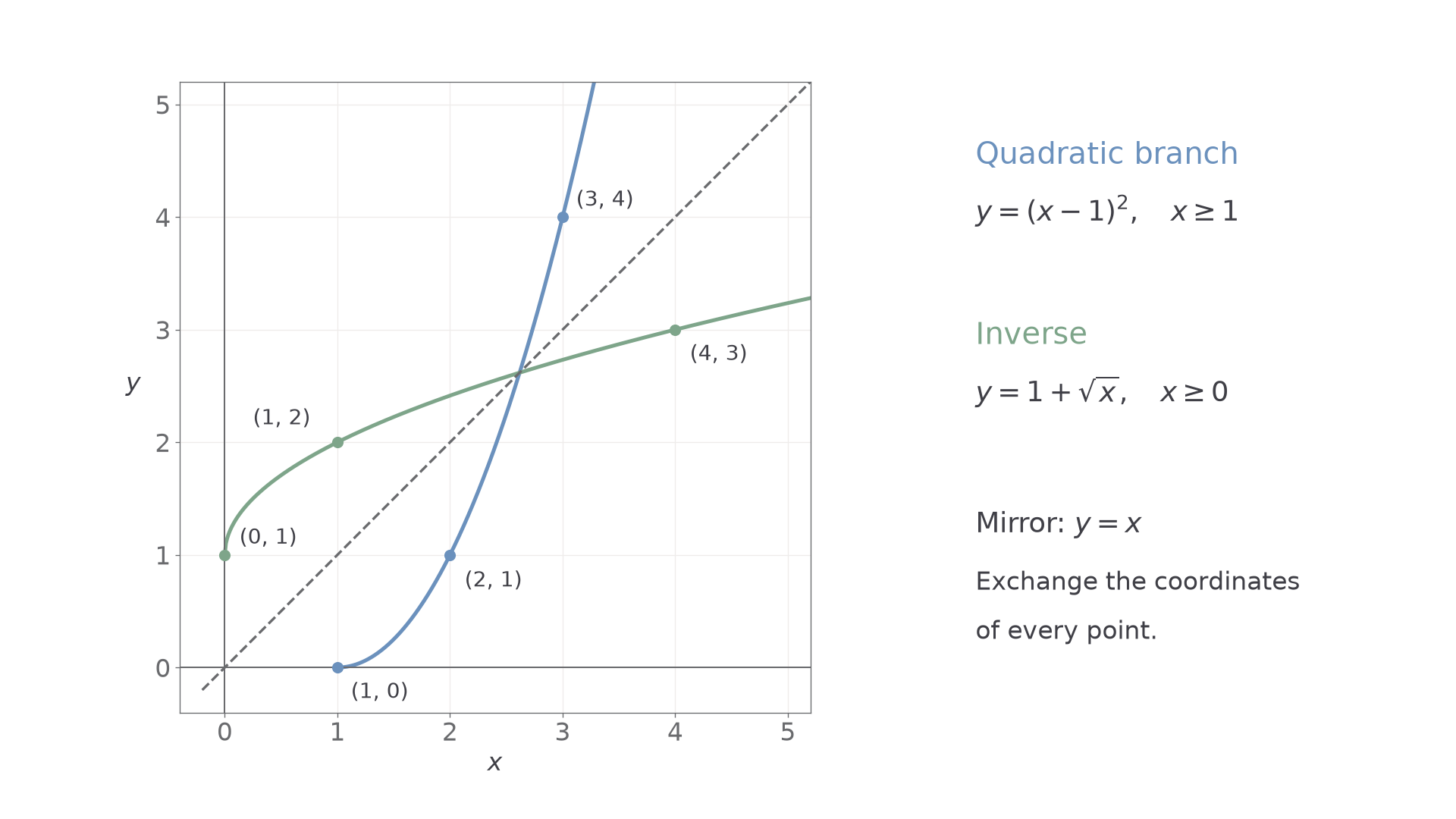
Reflect the whole one-to-one branch, retaining open or closed endpoints. Intercepts exchange roles, and vertical asymptotes become horizontal asymptotes. For the rational example, and become and .
A function can even be its own inverse without being the identity: on gives . A second trip through the same rule undoes the first.
Exam tip
An inverse answer includes any requested restrictions. The inverse's input values are the forward function's attained outputs, not automatically the forward domain.
The opening operations can now be undone in reverse order: to undo “double, then subtract one”, add one, then halve. Finish with a fresh rational rule.
Quick Recap
- In , apply first; composition generally changes when its order changes.
- A composite input must survive the first domain and feed an allowed input to the second function.
- An inverse exists on a one-to-one domain; a branch restriction decides which root to choose.
- Find inverses by rearranging, exchange domain and range, and reflect graphs in .
The opening routes give and , so order matters; undoing a route means reversing both its operations and their order.