3.03u - Static and limiting equilibrium on rough surfaces
Find the friction needed to keep a particle at rest, then decide whether the surface can provide it. Solve limiting cases, allow for a force that changes normal contact, and find complete ranges of forces that permit equilibrium.
Testing a proposed static equilibrium
Why can a crate stay still under a small pull, yet move when you pull harder? A rough floor supplies the friction needed for equilibrium, up to a limit. It does not supply maximum friction all the time.
A crate, with and , has normal reaction and friction capacity . A pull needs only opposing friction. A pull asks too much of this contact.
You already know
Equilibrium means zero resultant force. Resolve parallel and perpendicular to the surface. The normal contact force acts perpendicular to it; friction acts along it.
Model the crate as a particle, so we investigate sliding without rotation or toppling. Calculate the friction required by balance before testing its capacity.
Limiting equilibrium
A particle is in limiting equilibrium when it is still at rest but friction has reached its maximum magnitude . It is on the point of sliding. Rest with friction smaller than this limit is non-limiting equilibrium.
A signed component can represent either friction direction; its absolute value is the magnitude.
Testing static equilibrium
For a particle remaining in rough contact,
Here is the required friction magnitude. Equality describes a limiting case.
Not in the formula sheet: learn it.
Start with the smaller pull on the crate.
Worked example 1: friction below its limit
Question. A particle is on rough horizontal ground with . A horizontal force of pulls right. Take . Find the required friction and decide whether equilibrium is possible and limiting.
Plan. Balance vertically and horizontally, then compare friction demand and capacity.
Why this comparison? The equality gives the limit, rather than the actual friction in every equilibrium.
Answer. Friction is left. Equilibrium is possible and non-limiting.
Check. The horizontal resultant is , and the vertical resultant is , in newtons.
Change only the pull, from to . The capacity stays the same.
Worked example 2: friction demand beyond the limit
Question. The same particle has coefficient , but the pull is now right. Take . Find the required friction and decide whether equilibrium is possible and limiting.
Plan. Test the larger demand against the unchanged capacity.
Why say “required”? A static friction force is unavailable. It is a failed equilibrium proposal, not the actual force.
Answer. Equilibrium would require friction left, so it is impossible. There is no static equilibrium to classify as limiting.
Check. Even maximum friction leaves unbalanced rightwards.
Several applied forces can partly cancel. Friction balances their resultant, rather than the largest force separately.
Watch out
Wrong: use in Worked example 1. That leaves a non-zero resultant. Right: use , then check .
Try two competing pulls.
An angled pull changes the limiting force
Pulling upwards partly supports the weight. Pushing downwards presses the particle harder against the ground. Both actions change normal contact and the friction capacity.
[DIAGRAM: asset_name: An angled force changes normal contact; asset_slug: angled_contact_forces; caption: An upward pull reduces R, while a downward push increases R; description: Two force diagrams on rough horizontal ground show weight downward, normal reaction upward, friction left and an applied force rightward, upwards in the pull panel and downwards in the push panel.]
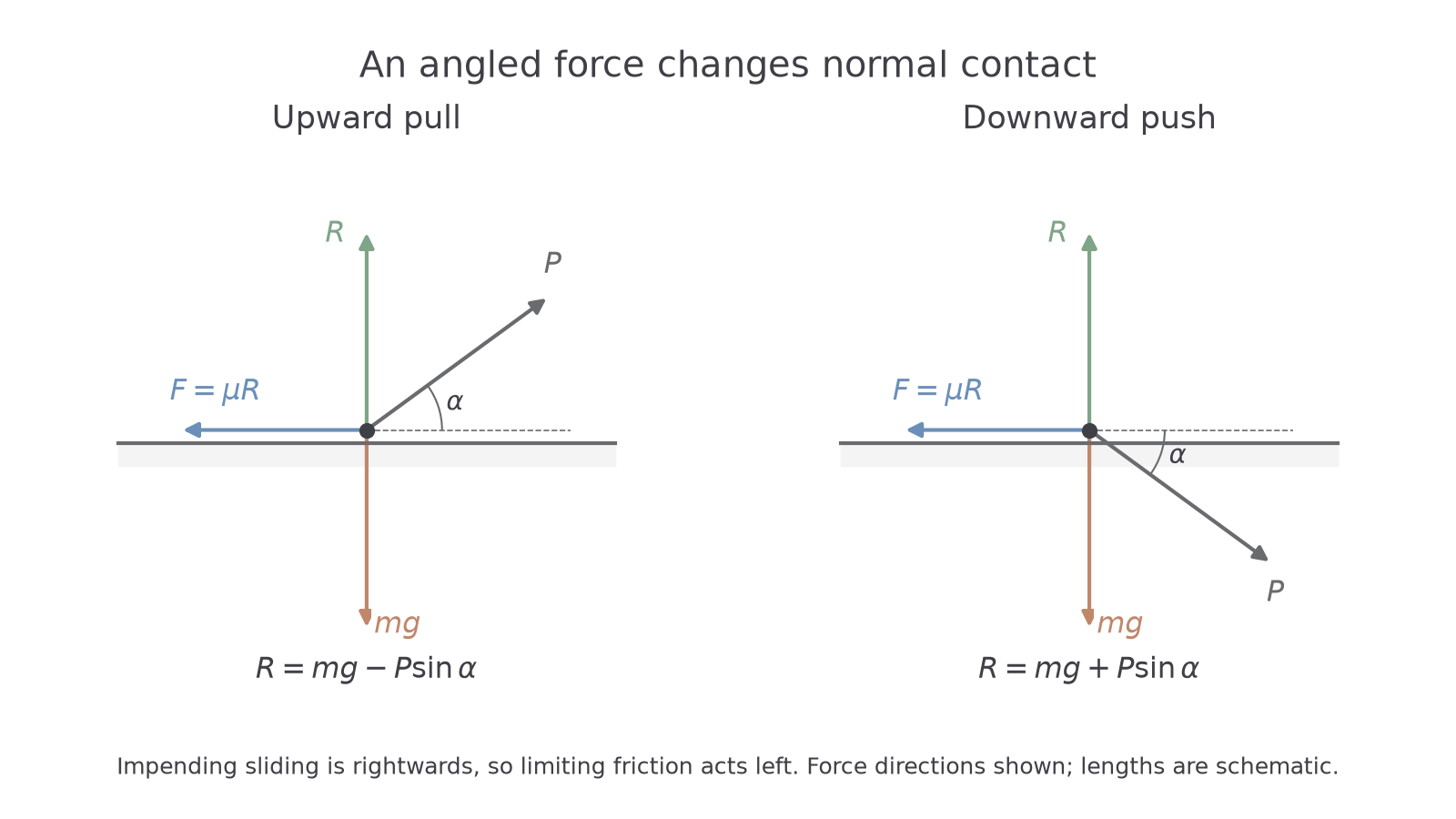
At an acute angle to the horizontal, the applied horizontal component is . Give the vertical component its correct direction.
Normal balance with an angled force
While contact with horizontal ground is maintained,
For impending motion rightwards, friction acts left and . Require and .
Not in the formula sheet: learn it.
Use the same force in both component equations.
Worked example 3: an upward limiting pull
Question. A particle on rough horizontal ground has . A force pulls right and up, with and . It is on the point of sliding right. Take . Find and exactly.
Plan. Find the reduced reaction, then substitute it into limiting horizontal balance.
Why simultaneous equations? Using would ignore the lifting effect of the force being found.
Answer. and .
Check. Both are positive, and , in newtons.
Change only the vertical sense of the force: its angle is now below the horizontal. Find the same quantities exactly.
Worked example 4: a downward limiting push
Question. The particle has and . The force acts right and down, with and . It is on the point of sliding right. Find and exactly.
Plan. Add the downward force component to the weight when finding the reaction.
Why is more force needed? Increasing this push increases both the forward component and the maximum opposing friction.
Answer. and .
Check. The forward component is , equal to ; contact is maintained.
An extreme upward pull may lift a particle away from the ground. A negative calculated reaction is not an admissible contact solution.
Watch out
Wrong: whenever the surface is horizontal. Right: resolve all perpendicular forces first. Zero vertical acceleration does not mean the applied force has no vertical component.
Use that normal-first approach with a different pushing angle.
Continue this lesson.
You’re previewing NovaLearn without an account. Create a free account to read the rest.
Create free account