1.05h, 1.05i, 1.05k - Reciprocal and inverse trigonometric functions
Distinguish a reciprocal value from an inverse function. The definitions in 1.05h lead to the graphs, domains and principal branches in 1.05i; the identities in 1.05k then connect exact reciprocal values without losing their signs.
Reciprocal functions and their domains
Does mean or an angle? The notation looks like a negative power, but on a calculator it asks for an inverse function. Compare with . One answer is a reciprocal value; the other is an angle. We will make that distinction precise.
You already know
Sine and cosine are signed unit-circle coordinates. Tangent is when . Reciprocating a nonzero number keeps its sign.
The new reciprocal functions have their own names, which remove the ambiguity of the inverse notation.
Reciprocal trigonometric functions
Where the indicated denominators are nonzero,
Secant is undefined at ; cosecant and cotangent are undefined at , for integer . In degrees these are and . These definitions are not in the formula sheet: learn them.
Where tangent is defined and nonzero, . Surprisingly, cotangent is also defined at : it equals , even though tangent is undefined there. The cosine-over-sine definition keeps that valid input.
Worked example 1: a quadrant-II angle
Question. Find , and exactly when .
Plan. Find the signed sine and cosine, then apply the three definitions.
Why this step? Finding signed coordinates first prevents a correct magnitude being given the wrong quadrant sign.
Answer. , , .
Check. , and .
Move to quadrant III without changing the reference angle. Only the signs of the relevant coordinates change.
Worked example 2: the same reference angle in quadrant III
Question. Find the same three values when .
Plan. Use the same definitions with the quadrant-III coordinates.
Why this step? Cotangent is positive when sine and cosine have the same sign.
Answer. , and , respectively.
Check. None of the denominators is zero, and multiplying each reciprocal by its defining denominator recovers the required numerator.
The exponent in means a square. The conventional notation , however, means arcsine, not cosecant.
Watch out
Wrong: declare undefined because is undefined. Right: use . Check the denominator in the defining expression.
Try a third quadrant location with the same reference angle.
Reading reciprocal graphs
Build reciprocal graphs from zeros, signs and the values and , rather than trying to join calculator points across missing inputs.
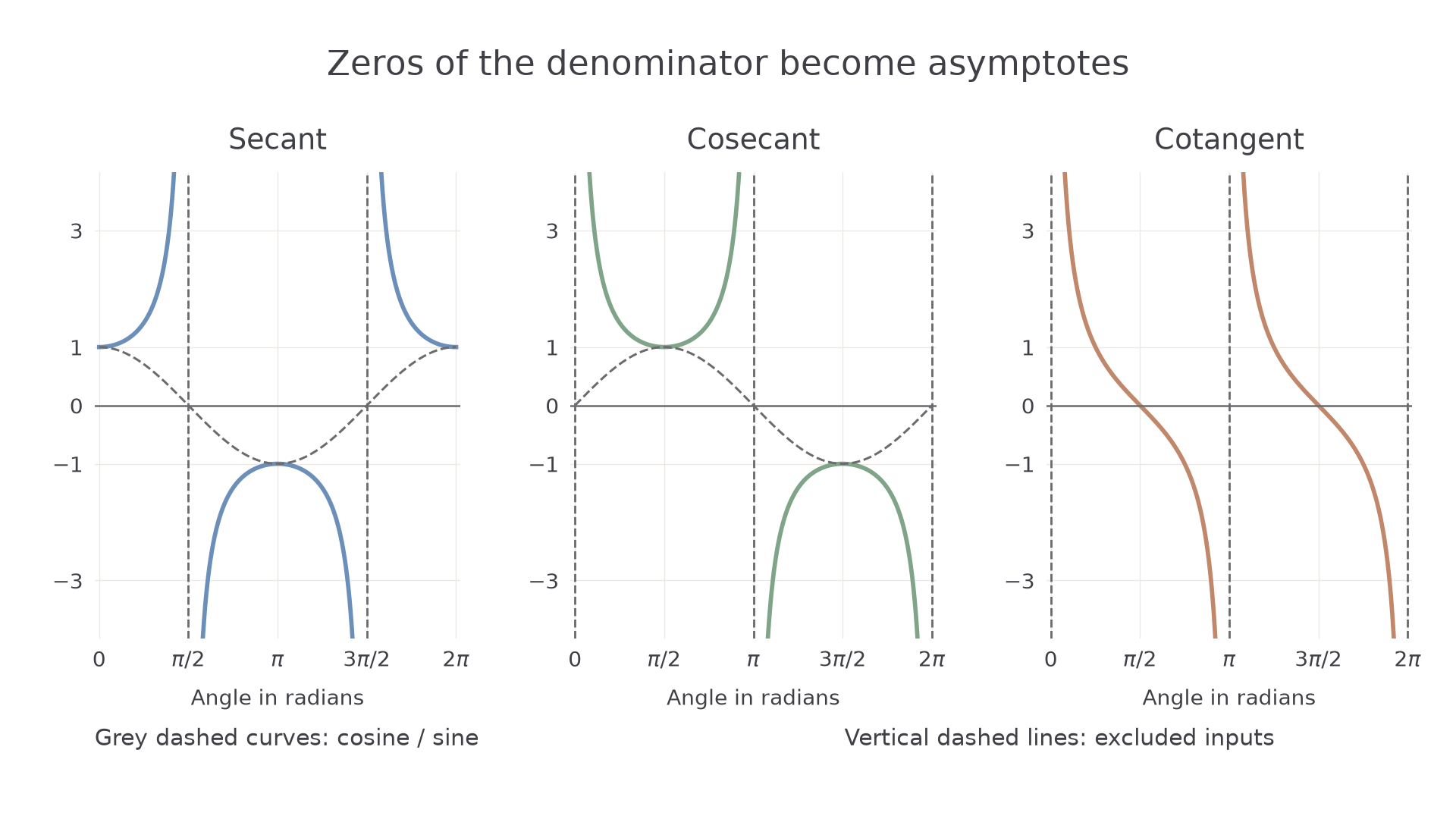
A nonzero sine or cosine has magnitude at most ; its reciprocal therefore has magnitude at least . Their zeros become vertical asymptotes, while values and stay fixed.
| Function | Range | Period | Symmetry | Vertical asymptotes |
|---|---|---|---|---|
| even | ||||
| odd | ||||
| odd |
Here is any integer; each domain excludes its asymptote inputs. On , cosecant has minimum at . On , it has maximum at . Cotangent decreases from arbitrarily large positive to arbitrarily large negative values on , crossing zero at . Its zeros repeat at . These graph facts are not in the formula sheet: learn them through the definitions.
Worked example 3: a compressed cosecant graph
Question. State the vertical asymptotes and period of , and describe its branches on .
Plan. Find zeros of the denominator and map the sine's extrema.
Why this step? The zeros of the sine, rather than the zeros of cosecant, locate the asymptotes; cosecant itself has no zero.
Answer. On the interval the asymptotes are . The first branch is positive with minimum at ; the second is negative with maximum at . The period is .
Check. At , , so the reciprocal equals .
Change only the argument multiplier to . More branches now fit into the same interval.
Worked example 4: fitting an extra branch
Question. Give the corresponding features for on .
Plan. Solve , then use successive sine extrema.
Why this step? Map the arguments before sketching, so the middle negative branch is not missed.
Answer. Asymptotes: . The three branches have vertices , , ; the period is .
Check. Their signs alternate positive, negative, positive, matching .
A sketch should show separate branches and dashed asymptotes. Never draw a connecting segment through an excluded input.
Watch out
Wrong: give a reciprocal sine graph range . Right: the values between and are excluded, except the endpoints; reciprocating small nonzero values produces large magnitudes.
Change the multiplier once more.
Identities with reciprocal functions
The unit-circle identity produces two reciprocal identities when you divide by an allowed squared denominator.
Divide by to obtain the first, and by to obtain the second.
Reciprocal identities
Not in the formula sheet: learn it.
The derivation explains both the identities and their restrictions. An identity agrees throughout its common domain; it does not supply a missing value at an excluded angle. It also shows why a real secant or cosecant cannot equal : its square must be at least .
Continue this lesson.
You’re previewing NovaLearn without an account. Create a free account to read the rest.
Create free account