1.05j - Fundamental trigonometric identities
Derive the two fundamental identities in 1.05j from unit-circle coordinates. You will recover exact values with the correct signs, prove equalities on their allowed domains and solve equations without dividing away valid solutions.
Two identities from coordinates
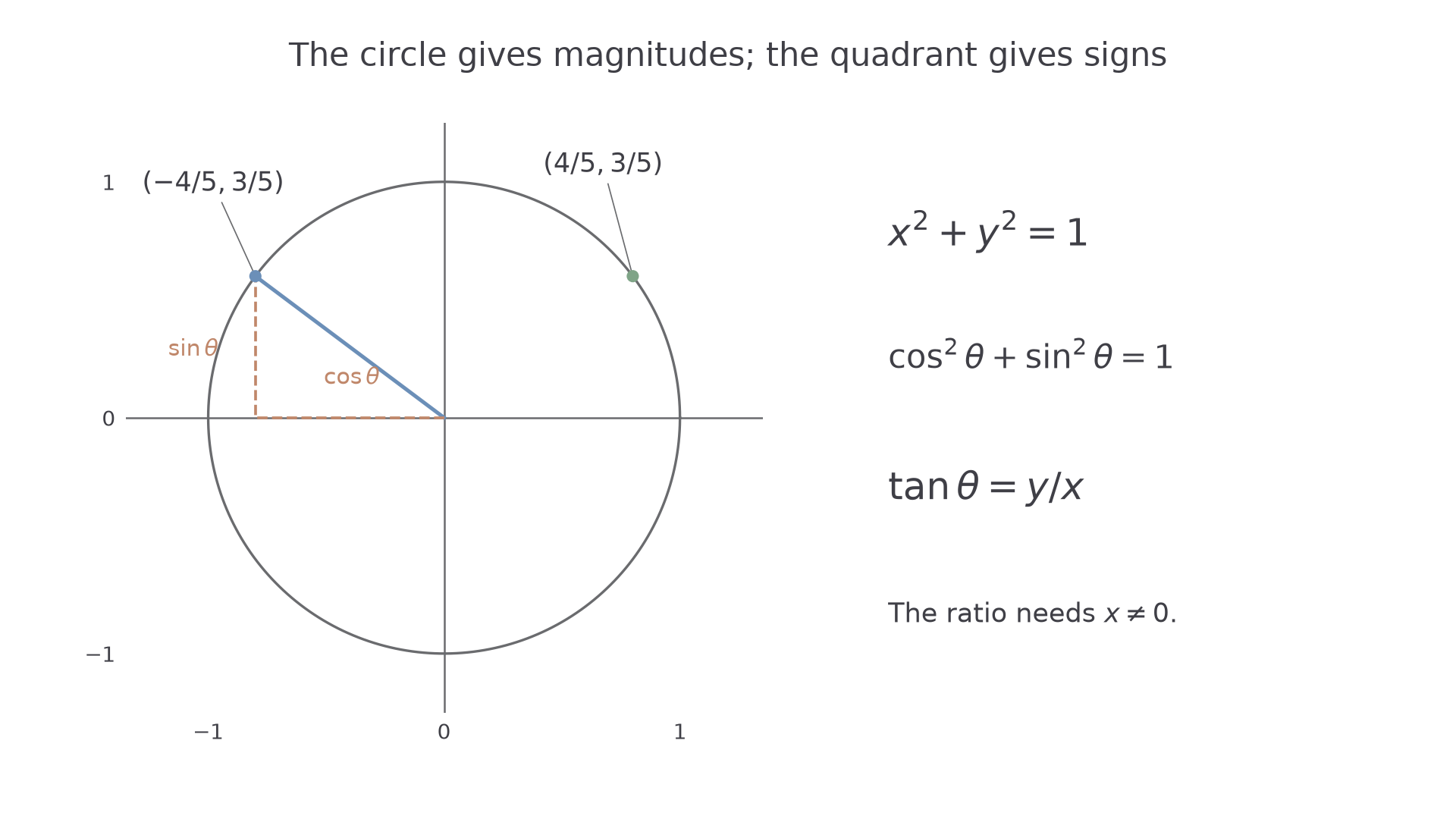
If , must be ? The unit circle gives the magnitude, but not the sign: and both lie on it. We need an identity and a quadrant to distinguish them.
You already know
The unit-circle point at angle is . Its distance from the origin is , and its coordinate signs identify the quadrant.
For example, . The same Pythagoras argument works at every angle, including those on the axes.
Trigonometric identity
An identity is an equality valid for every input in its stated domain. An equation usually holds only for particular inputs. For example, is an identity for all real angles; is an equation with selected solutions.
The tangent of the direction is the ratio of its signed vertical and horizontal coordinates. That ratio needs a nonzero horizontal coordinate.
The fundamental identities
Not in the formula sheet: learn it.
For integer , the tangent identity excludes . At , Pythagoras still gives , while tangent is undefined. Also means , not .
A useful surprise is that the sum without squares behaves differently: at , , rather than . Squaring the coordinates is essential, not a typographical detail.
Key idea
The unit circle gives a sum of squares for every angle; a ratio identity additionally needs its denominator to be nonzero.
One exact counterexample is enough to reject a claimed identity, but one successful substitution cannot prove it.
Recovering values without losing signs
An identity determines a squared magnitude; the given interval determines the sign of the function itself.
Rearranging gives or . These are algebraic forms of the unsupplied fundamental identity. Take both possible square-root signs seriously until the quadrant decides between them.
Worked example 1: positive sine, negative cosine
Question. Given and , find and exactly.
Plan. Find cosine squared, choose its quadrant-II sign, then use the tangent ratio.
Why this step? The equation alone permits both signs; the interval removes the positive option.
Answer. , .
Check. The squares sum to , and tangent is negative in quadrant II.
Change only the quadrant to quadrant I. The given sine stays , but the sign decision changes.
Worked example 2: the same sine in quadrant I
Question. Given and , find and exactly.
Plan. Reuse the squared magnitude with the positive quadrant-I sign.
Why this step? Equal sine values can belong to different quadrants, so they do not force equal cosine values.
Answer. , .
Check. Both coordinates and their ratio are positive, as the interval requires.
You can start from another function too. If in quadrant III, then , so and . If instead in quadrant III, write ; substitution gives , hence and .
Watch out
Wrong: conclude without checking signs. Right: the square root is a non-negative magnitude; cosine may be its negative.
Use a new sine value with the quadrant-II decision.
Simplifying and proving with domains
Start with one side of a proposed identity and transform it by valid steps, preserving every denominator restriction.
For example,
The simplified expression has more allowed inputs than the quotient. Cancellation does not define the starting quotient at its missing points. Likewise only on .
Continue this lesson.
You’re previewing NovaLearn without an account. Create a free account to read the rest.
Create free account