3.03r–3.03t - Contact forces, friction and limiting equilibrium
Rough contact has two components: a normal push and friction along the surface. You will separate them, calculate the overall contact force, and distinguish the friction actually needed at rest from its limiting or sliding value.
Normal force, friction and overall contact
Does a rough surface always exert its largest possible friction? Imagine a box resting on level ground while you pull gently with . If it stays at rest, friction must be , even if the surface could supply . The surface does not automatically use its full allowance.
You already know
Resolve a vector into perpendicular components and use Pythagoras for its magnitude. For a fixed mass, use the resultant in ; a component of one interaction is not an extra interaction.
First distinguish the two parts of rough contact and the combined interaction.
Normal and frictional contact forces
The normal contact force is perpendicular to the surface and pushes away from it. The frictional contact force is parallel to the surface, opposing sliding or its tendency. Their vector sum is the overall contact force. Smooth contact neglects friction; rough contact requires it to be considered, even when its actual value is zero.
On horizontal ground with right and up, write the overall contact force as , with . Its magnitude is . These contact-component and vector-magnitude results are not in the formula sheet.
[DIAGRAM: asset_name: Components of rough contact; asset_slug: rough_contact_components; description: Equal force-component scales show friction (-12,0), normal reaction (0,35) and their resultant (-12,35) newtons, clearly marked as alternative descriptions; caption: Friction and normal reaction combine to give the overall contact force]
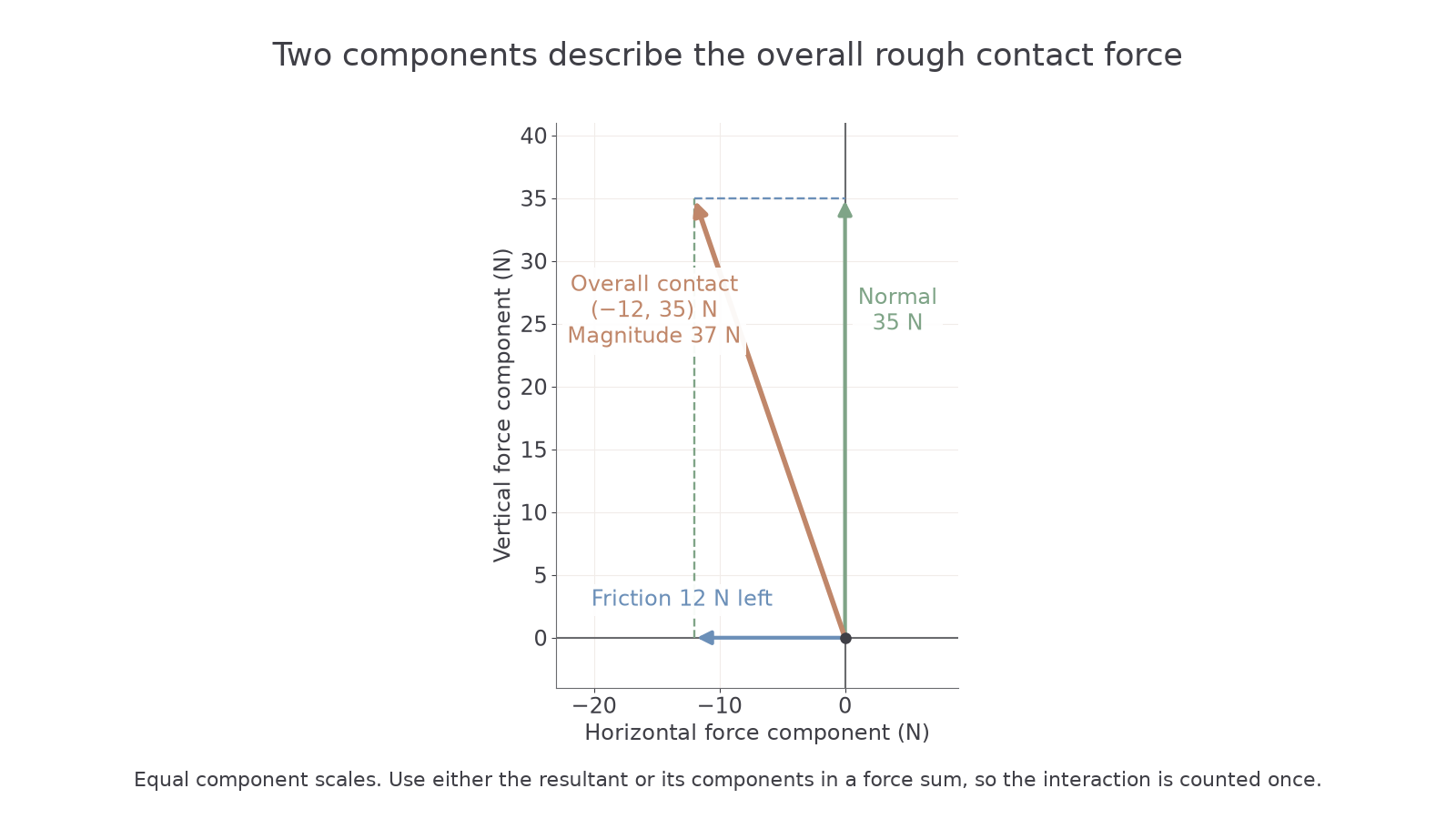
The picture's three arrows are alternative component and resultant descriptions, not three forces to add together.
Worked example 1: separating a contact vector
Question. On horizontal ground, take right and up. A particle's contact force is . Find the normal force, friction with direction, and the magnitude of the contact force.
Plan. Identify perpendicular and tangential components, then find their resultant magnitude.
Why use both squares? The overall contact is the vector sum of normal force and friction, not the normal force alone.
Answer. Normal force is upwards, friction left, and overall contact magnitude .
Check. The magnitude exceeds each individual component, as the right-angled component triangle requires.
Change only the sign of the tangential component. This reverses friction, not the normal push.
Worked example 2: friction in the other direction
Question. On the same ground and axes, the contact force is instead . Find the normal force, friction with direction, and the magnitude of the contact force.
Plan. Read the new parallel component and retain the same perpendicular component.
Why this step? Reversing one component reflects the vector but leaves its magnitude unchanged.
Answer. Normal force is upwards, friction right, and contact magnitude .
Check. Rightward friction is consistent with leftward sliding or a tendency to slide left.
A supplied friction force can also enter a dynamics equation directly. A particle moving right under a rightward pull and leftward friction has , so . Normal force and weight balance vertically if it remains on horizontal ground.
Watch out
Wrong: add the overall contact force and its normal and friction components to the same force sum. Correct: use the overall vector, or its two components, so the interaction is counted once.
Now separate a fresh contact vector.
Actual friction and its upper bound
At rest, find the friction required for balance before asking whether the surface can supply it.
The dimensionless coefficient of friction measures the model's friction capacity relative to normal reaction. A small force can require less than the capacity; no tangential driving force can mean zero friction.
Static and limiting friction
While contact is maintained, static friction magnitude satisfies
In limiting equilibrium, the particle is on the point of sliding and
The direction opposes the tendency to slide. The bound concerns normal reaction , which need not equal weight.
Not in the formula sheet: learn it.
An upward component of a pull reduces normal reaction; a downward push increases it. Solve the perpendicular balance as well as the tangential balance.
Worked example 3: a horizontal pull below the limit
Question. A box rests on horizontal ground with , under a horizontal pull right. Its only other forces are weight and contact. Use . Find normal reaction, friction required, friction capacity and whether equilibrium is possible and limiting. Give exact answers.
Plan. Balance vertically, balance horizontally, then compare required friction with .
Why compare last? The force needed for equilibrium and the greatest available friction are different quantities.
Answer. ; friction is left; capacity is . Equilibrium is possible and is not limiting.
Check. Both horizontal and vertical resultants vanish. The friction does not have to equal .
Continue this lesson.
You’re previewing NovaLearn without an account. Create a free account to read the rest.
Create free account