3.03k, 3.03o - Connected particles, strings and pulleys
A string links motions as well as forces. You will use separate particle equations to find acceleration and tension, then adapt the model when a particle reaches the floor or a string runs along an incline.
What a string and pulley model imposes
If both masses on a pulley are doubled, will they accelerate twice as quickly? Start with two equal hanging masses of . Each can remain at rest with an upward tension of balancing its weight. Unequal masses cannot both balance under that same common tension. The interesting question is how much the whole arrangement accelerates.
You already know
For a fixed mass, resultant force equals mass times acceleration. Weight is , and equilibrium means zero resultant. Draw the forces acting on each object separately.
A connection adds information that Newton's second law alone does not supply.
Ideal string and pulley
A light string has negligible mass; an inextensible string has fixed length. For a taut light string over a fixed smooth ideal pulley, use a common tension magnitude. In the simple arrangement with one straight segment to each particle, fixed length gives equal displacement, speed and acceleration magnitudes along the two segments. A slack string supplies no tension.
The adjectives do different jobs. Smooth contact removes friction at the pulley; light string and ideal pulley assumptions permit the same tension on its two sides. Inextensibility supplies the motion constraint. A string pulls towards its adjacent segment; it cannot push.
If one hanging particle accelerates downwards and the other upwards, their acceleration vectors differ. You can nevertheless use one signed scalar , taking down as positive for one equation and up as positive for the other. A negative answer reverses those assumed acceleration directions. It does not reverse the tension arrows.
For a train translating along one track, all its vehicles have the same acceleration vector. For a pulley system, adding compatible equations along different string segments is an algebraic elimination of tension. It is not a vector claim that two particles travelling in different directions form one translating particle. If you include the string in a vector system diagram, the support force from the fixed pulley is external too.
Key idea
The force model gives common tension; the taut fixed-length constraint gives common acceleration magnitude. These are separate assumptions, and neither says tension equals weight.
These connection rules are not in the formula sheet. Before using them, check the geometry rather than relying on the word “connected”.
A whole train and its individual vehicles
Use the whole train to find acceleration, then one vehicle to recover the force in the coupling.
A coupling force is internal to the engine-plus-trailer system but external to either vehicle separately. Resistances on both vehicles remain external. With forwards positive, an engine's drive , resistances , and masses give the following translating-system equation.
Whole train and trailer equations
For a taut light inextensible coupling on a horizontal track,
The first equation eliminates the internal tension; the second concerns the trailer alone. These are applications of Newton's second law, not additional laws.
Not in the formula sheet: learn it.
The separate equation is essential: the whole-system equation contains no tension to solve for.
Worked example 1: drive and two resistances
Question. A engine pulls a trailer through a taut light inextensible coupling on a horizontal track. Drive is ; resistances are on the engine and on the trailer. Find acceleration and tension.
Plan. Apply the second law to both vehicles together, then to the trailer.
Why this step? The coupling forces cancel for the whole train but must appear when the trailer is isolated.
Answer. Acceleration is forwards; tension is .
Check. The engine equation gives .
Change only the resistance on the trailer. It changes both the acceleration of the whole train and the force needed to pull that trailer.
Worked example 2: increased trailer resistance
Question. Keep the same engine, trailer, drive and engine resistance, but increase the trailer resistance to . Find acceleration and tension.
Plan. Recalculate the whole-system resultant, then use the new trailer equation.
Why this step? A larger resistance can require more tension even though the acceleration is smaller.
Answer. Acceleration is forwards; tension is .
Check. . Both vehicle equations agree.
A flexible coupling must remain in tension. A negative calculated tension would require a push and would invalidate that assumed connection. A rigid towbar can transmit compression, but then identify it as a push.
Watch out
Wrong: . This omits the trailer's resistance. Correct: include every external horizontal force on the chosen system, then use a separate vehicle equation for tension.
Try the same two-system choice for a different vehicle pair.
Two hanging particles and compatible signs
For two hanging particles, choose a positive direction for each particle that respects the string constraint.
Take the heavier mass downwards and lighter mass upwards. Each particle has two forces: upward tension and downward weight. Keep the same tension magnitude in both equations.
[DIAGRAM: asset_name: Separate equations for two hanging particles; asset_slug: hanging_particle_forces; description: Five-kg and three-kg particles on opposite sides of an ideal pulley, separate upward tension and downward weight arrows, acceleration 5 kg down and 3 kg up distinguished from force arrows; caption: The particles have opposite acceleration vectors and one common tension]
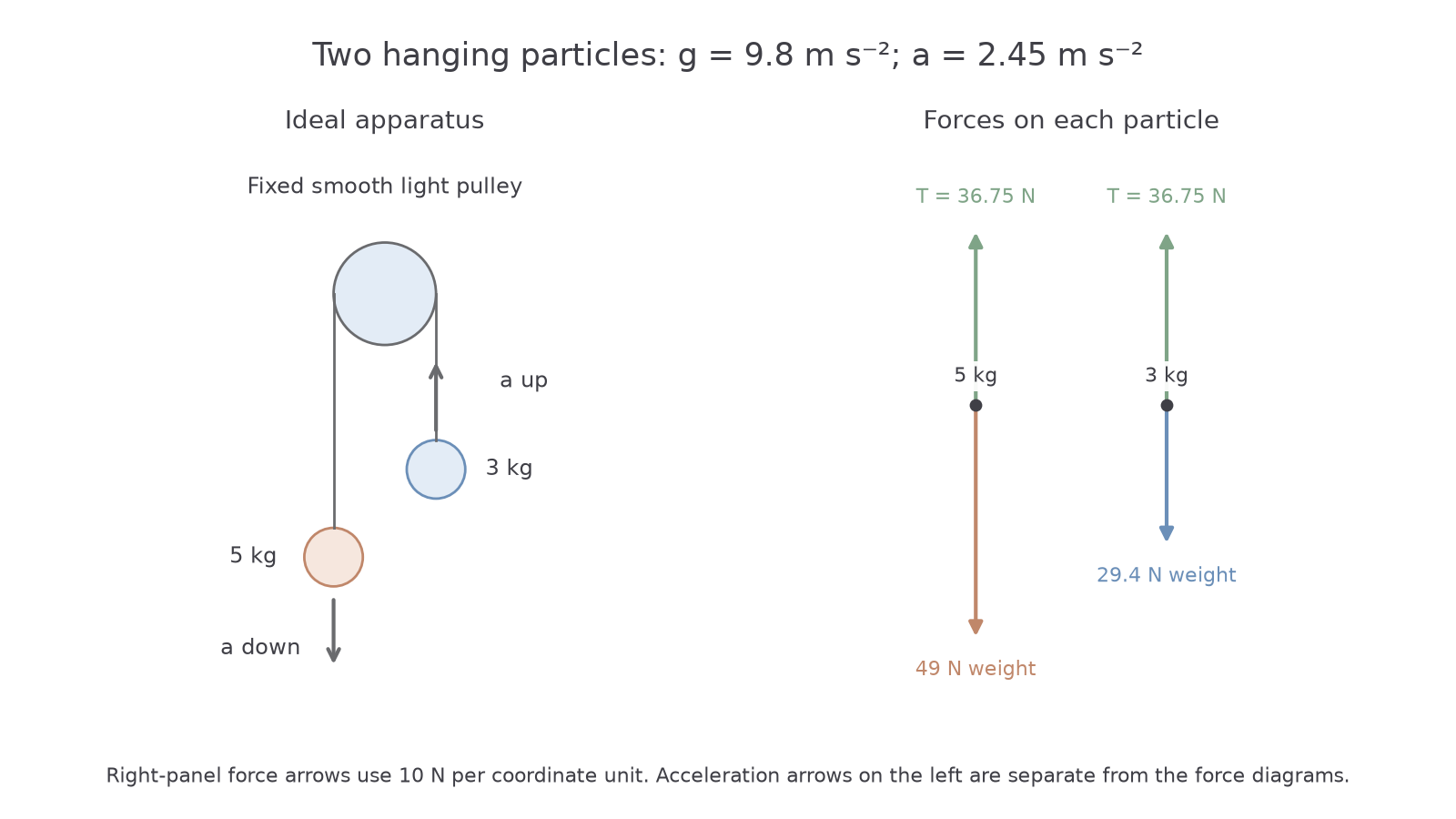
The equations also explain a useful surprise: doubling both masses doubles the driving weight difference and the total inertia. The acceleration stays the same.
Two hanging particles
For a taut light inextensible string over a fixed smooth ideal pulley, with ,
Recover tension from either separate equation. The acceleration formula is derived by adding the first two equations; it is not a substitute for setting up a new arrangement.
Not in the formula sheet: learn it.
Keep unrounded values while checking both equations.
Worked example 3: unequal hanging masses
Question. Masses and hang from a taut light inextensible string over a fixed smooth ideal pulley. Released from rest, find acceleration and tension, and identify the descending mass. Use ; give non-exact answers to significant figures.
Plan. Write equations in the directions down and up, then add.
Why these signs? The positive directions are opposite in space but compatible with one taut string.
Answer. Acceleration is ; tension is . The particle descends.
Check. ; tension lies between the two weights.
Now change only the common mass scale: double both masses and leave the geometry and gravity unchanged.
Worked example 4: doubling the masses
Question. Replace those masses by and . Under the same conditions, find acceleration and tension and identify the descending mass. Give non-exact answers to significant figures.
Plan. Form the two new second-law equations and compare their sum with the previous sum.
Why this step? Doubling both sides' masses does not double their acceleration: it doubles the net drive and the total mass together.
Answer. Acceleration is ; tension is . The particle descends.
Check. ; tension has doubled, as every force in the equations has doubled.
Continue this lesson.
You’re previewing NovaLearn without an account. Create a free account to read the rest.
Create free account