1.03a, 1.03b - Straight lines, distances and gradients
Turn a line's direction and position into an equation you can use. You will connect gradients, distances and midpoints, construct parallel and perpendicular lines, and find exactly where lines meet.
Gradient and direction
Can you find the line through that meets at a right angle, without relying on a drawing? Start with what a line does: from to , moving units right moves units up.
You already know
Coordinates give horizontal position first and vertical position second. Subtract coordinates in matching orders, and use Pythagoras for a right-angled triangle.
The rise–run triangle turns direction into a number.
[DIAGRAM: asset_name: Rise and run on a straight line; caption: A rise of 3 over a run of 6 gives gradient one half; asset_slug: h240-gradient-line; description: Equal-scale axes show y equals one half x plus 2 through A minus 2 comma 1 and B 4 comma 4. A dashed right triangle has horizontal run 6 and vertical rise 3. The y-intercept is 2.]
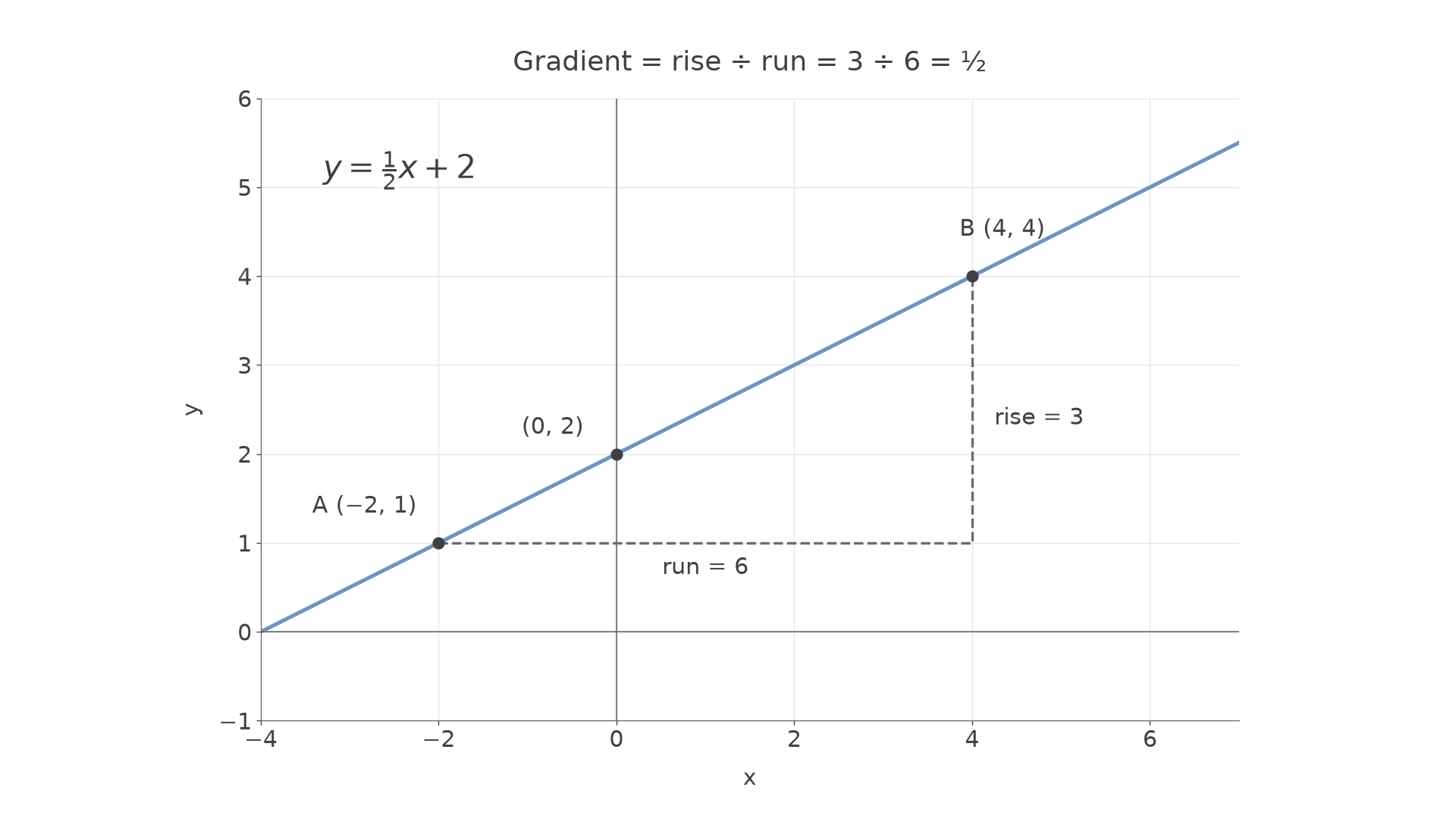
Gradient
The gradient of a non-vertical straight line is its change in per unit increase in . A positive gradient rises to the right; a negative gradient falls to the right.
Using two distinct points gives the same ratio wherever they lie on the line.
Gradient between two points
For , , with ,
Not in the formula sheet: learn it.
Keep both subtraction orders consistent: reversing both changes neither the ratio nor the direction.
Worked example 1: a rising line
Question. Find the gradient through and .
Plan. Divide the vertical change by the corresponding horizontal change.
Why this order? Both changes describe the same journey from to .
Answer. The gradient is : each unit right gives half a unit up.
Check. Reversing the journey gives .
Now change only the sign of the vertical change: keep the horizontal run but put below .
Worked example 2: a falling line
Question. Find the gradient through and .
Plan. Use the same ordered differences, retaining the negative rise.
Why keep the sign? It records that decreases as increases.
Answer. The gradient is .
Check. Moving units right changes by , reaching .
A horizontal line has gradient . A vertical line, such as , has undefined gradient: its horizontal change is zero, so division is impossible. On equal-scale axes, a line's anticlockwise inclination from the positive -axis satisfies ; this is the same right-triangle ratio, not a formula supplied in the sheet. Thus inclinations and give gradients and .
Watch out
Wrong: in Worked example 1. That is run divided by rise. Right: .
Your turn changes the size of the fall as well as the coordinates; keep its sign visible.
Equations and drawing a line
An equation describes every point on a line. In , setting gives , so is the vertical intercept. The diagram above therefore represents .
Equations of a straight line
Through with finite gradient ,
Equivalent forms are and , where are not both zero. If , the latter has gradient . If , it is a vertical line.
Not in the formula sheet: learn it.
Point–gradient form is the gradient quotient rearranged. It saves you guessing the intercept.
Worked example 3: from a point and gradient
Question. Find the line of gradient through , in general form.
Plan. Substitute into point–gradient form, then collect all terms on one side.
Why start with ? Subtracting the point's vertical coordinate means .
Answer. .
Check. At , ; rearranging gives gradient .
Change only the gradient's sign. The line still passes through the same point, but its intercept changes too.
Worked example 4: a negative gradient
Question. Find the line of gradient through , in general form.
Plan. Use the same point–gradient construction with the new gradient.
Why retain the brackets? The gradient multiplies the entire horizontal change.
Answer. .
Check. , and the coefficient of in is .
If given two points, calculate the gradient first: and give , then , so . Equal horizontal coordinates instead give a vertical line directly.
To draw , set to get and set to get . Mark these distinct points on labelled axes and extend the line through them. Alternatively rearrange to , start at and move one unit right, two down. For , mark two points with horizontal coordinate and join vertically. A graph supplies the reverse information: read a point and calculate rise over run, then construct the equation.
Watch out
Wrong: identify the gradient of as . Right: rearrange to ; the gradient is .
Find a new line and use its intercepts to check how you would draw it.
Parallel and perpendicular lines
Direction, rather than position, decides whether lines are parallel or perpendicular. Distinct parallel lines have the same gradient; equal gradients and equal intercepts describe the same line.
Gradient conditions
For non-vertical lines,
The perpendicular product requires both gradients to be finite. Horizontal and vertical lines are perpendicular to each other.
Not in the formula sheet: learn it.
Why the negative reciprocal? A direction rotates through a right angle to . Their gradients are and , whose product is when neither denominator is zero. A useful surprise follows: multiplying both changes by the same positive factor changes the distance travelled but leaves the gradient untouched.
Worked example 5: a parallel line
Question. Find the line through parallel to .
Plan. Read the given gradient, then use it through the new point.
Why use the same gradient? Parallel lines make the same vertical change for each horizontal step.
Answer. .
Check. , and both gradients are .
Now change only the requested relationship: perpendicular instead of parallel.
Worked example 6: a perpendicular line
Question. Find the line through perpendicular to .
Plan. Take the negative reciprocal of , then use point–gradient form.
Why change both sign and reciprocal? Their product must be , not .
Answer. , the line asked for at the start.
Check. , and .
For a line perpendicular to , write through the required point; no finite gradient is needed.
Watch out
Wrong: the perpendicular gradient to is . Right: it is , since .
Check the new point and the perpendicular relationship separately.
Midpoints and distances
A midpoint splits each coordinate change in half. A distance combines those changes by Pythagoras, so a negative vertical change does not give a negative length.
Midpoint and distance
For points and ,
These work for horizontal and vertical segments too.
Not in the formula sheet: learn it.
Average like coordinates; never average a horizontal coordinate with a vertical one.
Worked example 7: a segment falling to the right
Question. Find the midpoint and length of the segment from to .
Plan. Average corresponding coordinates and use the two changes as perpendicular sides.
Why square the signed changes? Pythagoras uses side lengths; squaring removes their directional signs.
Answer. Midpoint , length .
Check. Both steps to and to are , each of length .
Change only the vertical direction: the endpoint is now , so the vertical change is instead of .
Worked example 8: same length, different midpoint
Question. Find the midpoint and length from to .
Plan. Repeat the two coordinate calculations with the new endpoint.
Why is the length unchanged? Changing the sign of one coordinate change leaves its square unchanged.
Answer. Midpoint , length .
Check. From the midpoint to either endpoint, the squared distance is .
You can reverse an average too. If and , then and , giving .
Watch out
Wrong: for a falling segment. Right: add the squared changes, .
The next segment uses different changes; check that the midpoint is halfway in both coordinates.
Intersections and exceptional cases
An intersection is one coordinate pair satisfying both equations. Solving simultaneously finds it exactly; a drawing is a check, not a replacement for exact coordinates.
Worked example 9: two sloping lines
Question. Find the intersection of and .
Plan. Add to eliminate , then substitute for its value.
Why eliminate ? Its coefficients are opposites already, so no scaling is needed.
Answer. .
Check. and .
Replace only the second line by a vertical one. The intersection can still be found without a gradient for that line.
Worked example 10: one line is vertical
Question. Find the intersection of and .
Plan. Use the given horizontal coordinate directly in the other equation.
Why substitute rather than find two gradients? The vertical line already supplies one coordinate exactly.
Answer. .
Check. , and the horizontal coordinate is .
There are two exceptions to “one intersection”. Combining with gives : distinct parallel lines, no intersection. Combining with gives : the same line, infinitely many common points. Equal gradients alone do not distinguish these cases.
Exam tip
Give an intersection as a coordinate pair and check it in both equations. An identity means coincident lines; a contradiction means no common point. Neither calls for dividing by zero to produce a coordinate.
All these routes use the same principle: the required line or point must satisfy every stated condition.
Quick Recap
- Gradient is vertical change divided by matching horizontal change; vertical lines have undefined gradient.
- Use point–gradient form to construct a line and two distinct points to draw it.
- Parallel directions have equal gradients; finite perpendicular gradients multiply to .
- Average coordinates for a midpoint and use Pythagoras for distance.
- Solve line equations simultaneously, recognising contradictory and identical equations.
The opening perpendicular line is : it passes through and has gradient , the negative reciprocal of .