1.10b - Vectors in three dimensions
Extend vector operations, position calculations and geometric arguments to three perpendicular components. Calculate spatial lengths with two applications of Pythagoras, locate points and check every component when proving collinearity or balancing forces.
Components and magnitude in space
A cable runs across a room, along it and upwards between its endpoints. Is the straight cable long? Adding the three changes measures a route along three edges, rather than the direct route through space.
You already know
In a plane, add and scale corresponding components, find length by Pythagoras and normalise a non-zero vector by dividing by its magnitude. A position vector starts at the chosen origin.
A third perpendicular axis adds the unit vector . The fixed component order is horizontal , horizontal , then vertical . Our cable's displacement is . Only when this arrow begins at the origin do those entries also give its endpoint's coordinates.
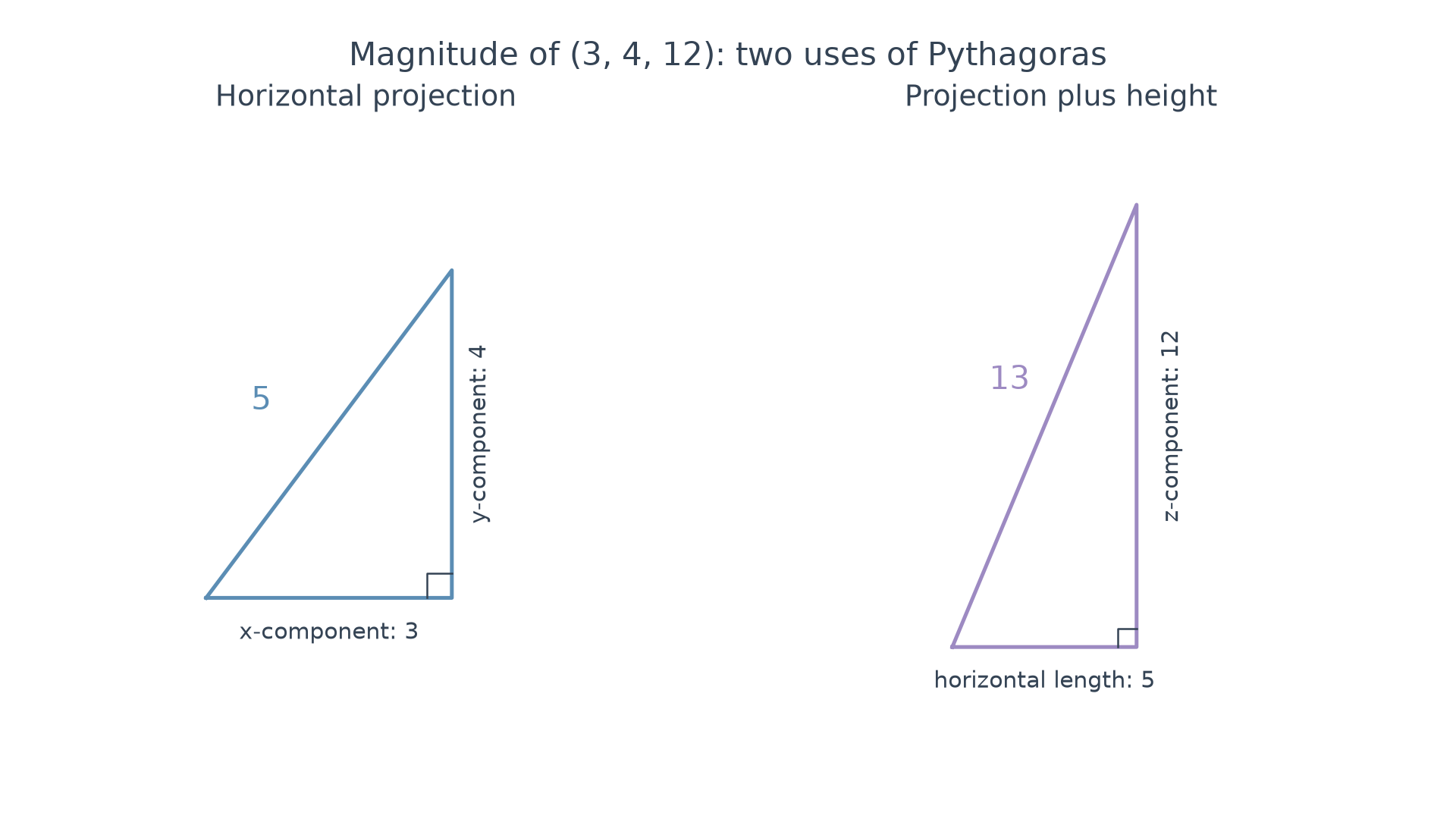
First combine perpendicular changes and to obtain horizontal projection length . Then combine and height to obtain the spatial length . The second panel's horizontal axis is projection length, not the original -axis.
Two right triangles give a rather pleasing result: all five lengths are integers. Combining the two Pythagorean calculations also removes the intermediate square root.
Three-dimensional magnitude and unit vector
For :
For , the unit vector in its direction is .
Not in the formula sheet: learn it.
A unit vector records all three signed component proportions. One planar angle cannot specify an arbitrary direction in space. Here we retain the spatial direction through its components.
Worked example 1: normalising a spatial vector
Question. Find the magnitude of and a unit vector in its direction.
Plan. Sum the three squared components, then divide by the positive magnitude.
Why this step? The full three-dimensional length sets the scale; dividing just by the horizontal length would not produce a unit vector.
Answer. Magnitude , unit vector .
Check. Its squared modulus is .
Change only the sign of the vertical component. This reflects the direction in the horizontal plane without changing its length.
Worked example 2: a downward component
Question. Find the magnitude and a unit vector for .
Plan. Square all three components for the length, but retain their signs in the unit vector.
Why this step? A negative component means downwards; it does not make the magnitude negative.
Answer. Magnitude , unit vector .
Check. , and .
Operations still work component by component. For , . Its zero -component means lies in the horizontal plane; it does not make the zero vector. The zero vector itself cannot be normalised.
Watch out
Wrong: . Right: . A length in space uses all three perpendicular changes.
Try a different downward vector.
Positions and distances in space
A displacement in space is still finish minus start. Distance is its magnitude, while locating a point along the segment uses one common fraction of all three component changes.
Positions, distances and division in space
For spatial position vectors :
A specified fraction from gives . Internal ratio uses .
Not in the formula sheet: learn it.
The formula locates a given point using a fraction of a displacement. Every coordinate uses the same fraction; changing the height fraction alone generally leaves the segment.
Worked example 3: an internal point in space
Question. , . Find and the position of when internally.
Plan. Find the three-component displacement, calculate its length and add one-quarter of it to .
Why this step? The ratio compares the two pieces of the segment, so the total has four equal shares.
Answer. , .
Check. , and .
Change only the ratio from to . The endpoint coordinates and distance stay fixed.
Worked example 4: moving nearer the other endpoint
Question. For the same , find when .
Plan. Add three-quarters of the same displacement to .
Why this step? Measuring from would use one-quarter instead; the chosen start determines the fraction.
Answer. .
Check. , since the two vectors are and .
Continue this lesson.
You’re previewing NovaLearn without an account. Create a free account to read the rest.
Create free account