1.04a, 1.04b - Integer binomial expansion and combinations
Find a chosen coefficient without multiplying out every bracket. You will connect factorials and Pascal's triangle to integer binomial expansions, then see why the same numbers count success patterns in probability.
Factorials and binomial coefficients
Can you find the coefficient of in without expanding the whole expression? In five copies of , an term comes from choosing from three brackets and from the other two. First we need to count those choices.
You already know
Expanding a product means choosing one term from each bracket, multiplying the chosen terms and adding the results. For example, : there are two ways to obtain .
Choosing the first and second bracket gives the same selection as choosing the second and first. The order in which you name the positions must not create an extra choice.
Factorial and binomial coefficient
For a positive integer , , and . The binomial coefficient , also written or , counts selections of distinct positions from , without regard to order. For example, , not .
There are ordered selections of positions. Each unordered selection appears times, once for each ordering, so divide by .
Binomial coefficients
For integers and ,
Choosing the positions left out gives . The factorial formula and coefficient notation are printed; symmetry follows by interchanging the denominator factors.
In the formula sheet.
Cancelling common factors is usually quicker than evaluating three large factorials.
Worked example 1: choosing two bracket positions
Question. How many selections of two positions are possible in five copies of ?
Plan. Count unordered pairs using .
Why divide by ? Each pair was counted in its two possible orders.
Answer. There are selections.
Check. Listing pairs by their smaller position gives .
Change only the number selected from two to three. Choosing three positions is equivalent to leaving two out.
Worked example 2: counting the complementary choice
Question. Find and explain its connection with .
Plan. Evaluate the factorial ratio, then pair each selection with its complement.
Why the same answer? Every selection of three positions leaves exactly one selection of two positions.
Answer. .
Check. The denominators and are equal.
A calculator's combinations key evaluates this same count. Its permutations key counts ordered choices instead.
Watch out
Wrong: . This counts every pair twice. Right: . At the endpoints there is one empty selection and one selection of everything, consistent with .
Try complementary selections in a larger product.
Pascal's triangle and a finite expansion
Pascal's triangle stores these position counts: row contains . Its edges are , and each interior entry adds the two above it.
To choose positions from , either leave the last position out and choose from , or include it and choose from . These disjoint possibilities explain the addition rule. Thus .
[DIAGRAM: asset_name: Pascal coefficients count bracket choices; caption: Pascal coefficients count bracket choices; asset_slug: h240-pascal-triangle; description: Pascal triangle from row 0 through row 6, with the two 3 entries in row 3 feeding the highlighted 6 in row 4 and the fourth-power row identified]
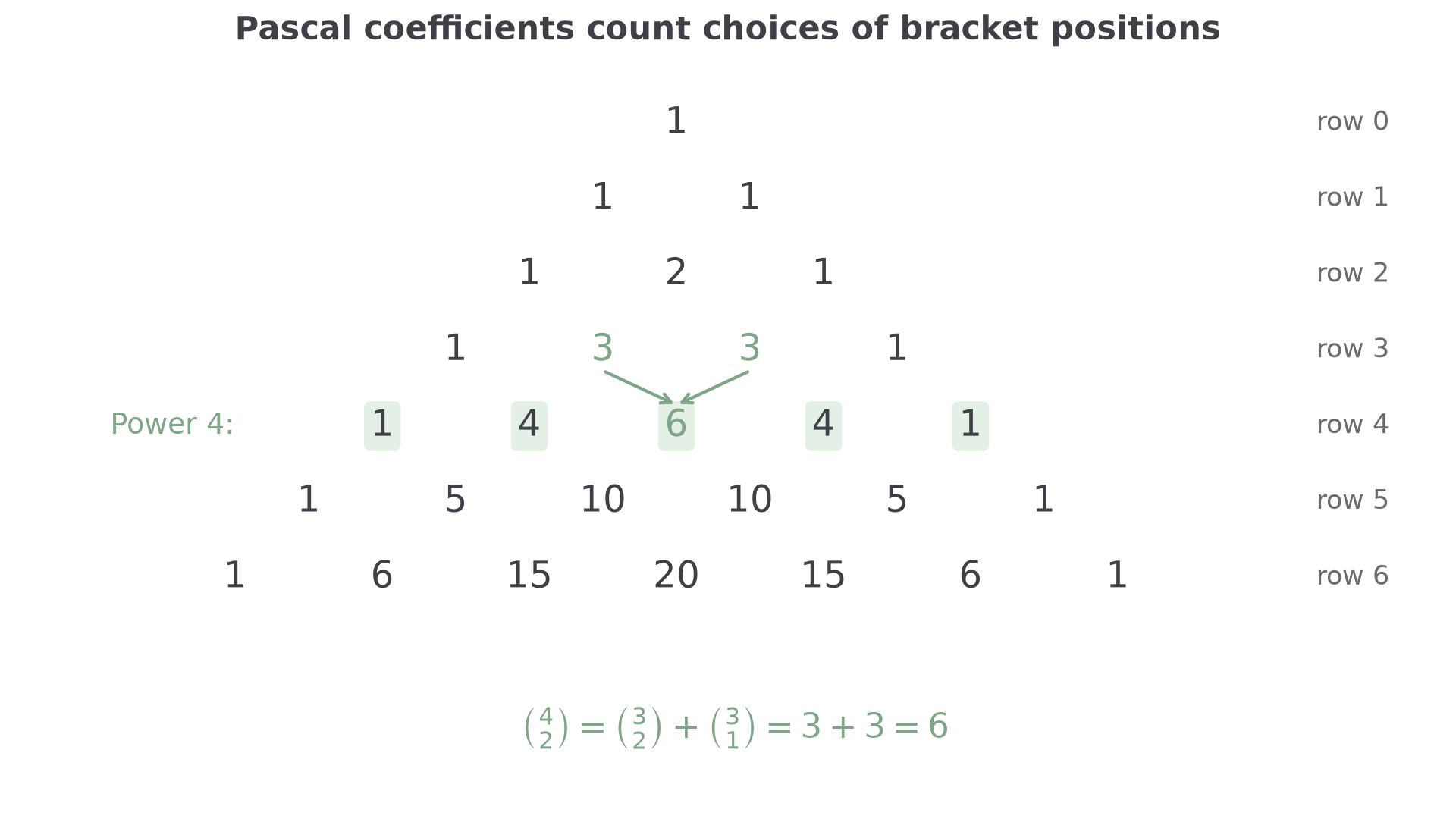
Each selection with copies of contributes . The coefficient counts how many times that contribution appears.
Finite binomial expansion
For a positive integer ,
It is an exact polynomial identity for every real , with terms before any zero coefficients are removed. This is the sheet's formula with replaced by .
In the formula sheet.
A neat fact is hidden in the rows: their totals double each time. Setting in the expansion gives row total , so row totals .
Worked example 3: a positive inner term
Question. Expand in ascending powers of .
Plan. Use row , applying each power to the whole term .
Why keep the brackets? The power applies to as well as .
Answer. .
Check. At , the polynomial totals .
Now change only the sign of the inner term. The even powers stay positive; the odd powers change sign.
Worked example 4: a negative inner term
Question. Expand in ascending powers of .
Plan. Use the same row with in place of .
Why not make every coefficient negative? A negative number squared or raised to the fourth power is positive.
Answer. .
Check. At , .
These are finite expansions. No “small ” condition belongs on them.
Watch out
Wrong: . Right: . Write the signed input in brackets before raising it to a power.
Keep the fourth power and change the magnitude of the inner coefficient.
Finding a particular term or coefficient
The opening question needs just one selection count. There is no reason to calculate the other powers first.
The contribution containing in is . This follows directly from the supplied finite expansion. Its coefficient is ; the term includes . The constant is the first term, so the term is in position when terms are in ascending powers.
Worked example 5: the opening coefficient
Question. Find the coefficient of in .
Plan. Choose from three brackets and from the remaining two.
Why the power ? Two of the five brackets still supply their constant term.
Answer. The coefficient is , and the term is .
Check. There are choices, each contributing .
Change only the sign of the variable term. The requested power is odd, so its coefficient changes sign.
Worked example 6: an odd power with a minus sign
Question. Find the coefficient of in .
Plan. Keep the same selection count and include the signed factor .
Why is the sign negative? Three selected variable terms give three negative factors.
Answer. The coefficient is ; is the fourth term.
Check. Replacing by in the previous expansion reverses precisely its odd-power coefficients.
If the exponent were instead, the same requested coefficient would be : both the selection count and the number of constant factors change. The coefficient is never just the Pascal number.
Exam tip
If OCR asks for a coefficient, identify the number multiplying the requested power. A term such as is not itself a coefficient. Write the selection expression before evaluating it so your method is visible.
Now change the requested power while keeping the bracket and exponent from example 6.
Why the same coefficients appear in probabilities
A success pattern also selects positions. For three trials, two successes can occur as SSF, SFS or FSS. These are three different outcomes even though their success counts match.
You already know
For independent events, multiply probabilities along a specified pattern. Add probabilities of mutually exclusive patterns. If success has probability , failure has probability .
With independent two-outcome trials and the same on each, a specified pattern of successes has probability . There are possible success-position selections.
Exactly a given number of successes
For a fixed positive integer , independent two-outcome trials and constant ,
Here is an integer. This counts disjoint patterns of equal probability. At , all trials fail with probability ; at , all succeed with probability . Handle these cases directly, without substituting an expression .
In the formula sheet.
This is the binomial probability formula you will meet again in statistics. Here the key idea is why the coefficient is needed.
Worked example 7: two successes in three trials
Question. Three independent trials each have success probability . Find the probability of exactly two successes.
Plan. Multiply the probability of one pattern by its number of possible positions.
Why multiply by ? The successes need not occupy only the first two positions.
Answer. .
Check. SSF, SFS and FSS each contribute .
Change only the required success count from two to one. Keep the trials and probability unchanged.
Worked example 8: one success instead
Question. For the same three trials, find the probability of exactly one success.
Plan. Count the three possible positions of the single success.
Why is this not again? The counts agree, but each pattern now contains two failure factors instead of two success factors.
Answer. .
Check. The probabilities for successes total , just as .
The opening coefficient and these probabilities use the same position-counting idea, with different factors attached to each choice.
Watch out
Wrong: probability . A count can exceed . Right: multiply that count by the probability of each pattern, after checking independence and constant success probability.
Use the same one-success method with one more trial and a different success probability.
Quick Recap
- Factorials count ordered arrangements; dividing by gives unordered position selections.
- Pascal's triangle and supply the coefficients of a finite binomial expansion.
- Apply each power to the whole signed term, including its numerical factor.
- Binomial probabilities count equally likely success-position patterns before adding their probabilities.
The opening coefficient is : just one calculation, without expanding the other five terms.