1.10a, 1.10c, 1.10d - Vectors, components, magnitude and direction
Read vectors as directed movements, combine their components and convert between component form and magnitude with direction. You will distinguish a signed component from a length and use a sketch to keep an inverse-tangent answer in the right quadrant.
Vectors and their components
A robot travels east and south. It has travelled , but is it from where it started? And which way should it point to travel straight back? We will answer both questions using one arrow.
You already know
Coordinates record horizontal and vertical changes. Pythagoras finds the hypotenuse of a right-angled triangle, and sine, cosine and tangent connect its lengths and angles.
Take right as positive horizontal and up as positive vertical. The robot's net movement is right and down, so the signs are part of the information.
Scalar and vector
A scalar has magnitude only; a vector has magnitude and direction. Distance and speed are scalars. Displacement and velocity are vectors. A displacement of east includes a direction; a distance of does not.
The standard unit vectors and point along the positive horizontal and vertical axes. Each has magnitude . The robot's displacement can be written in either form:
The entries are Cartesian components, in a fixed order. The component vectors are and . Their signed coefficients are scalars; the whole displacement is a vector. In print use bold letters or an arrow such as ; when handwriting, underline a vector letter so it cannot be mistaken for a scalar.
Equal vectors and the zero vector
Vectors are equal when corresponding components agree: their magnitudes and directions are the same, wherever the arrows are drawn. The zero vector has all components zero, magnitude zero and no defined direction. It is not a unit vector.
Moving an arrow without rotating or stretching it does not change its vector. Reversing the arrow does: . The same length with the opposite direction is a different vector.
Here is the first surprise: the robot's route leaves it only from its start, because . Reversing the order of its two moves changes the route but not that final displacement.
Key idea
A negative component records a direction along an axis. Magnitude is a non-negative length, not a signed component.
Use that distinction to diagnose the following claim.
Adding, subtracting and scaling vectors
To combine movements, place the second arrow's tail at the first arrow's head. The arrow from the first start to the final finish is the resultant.
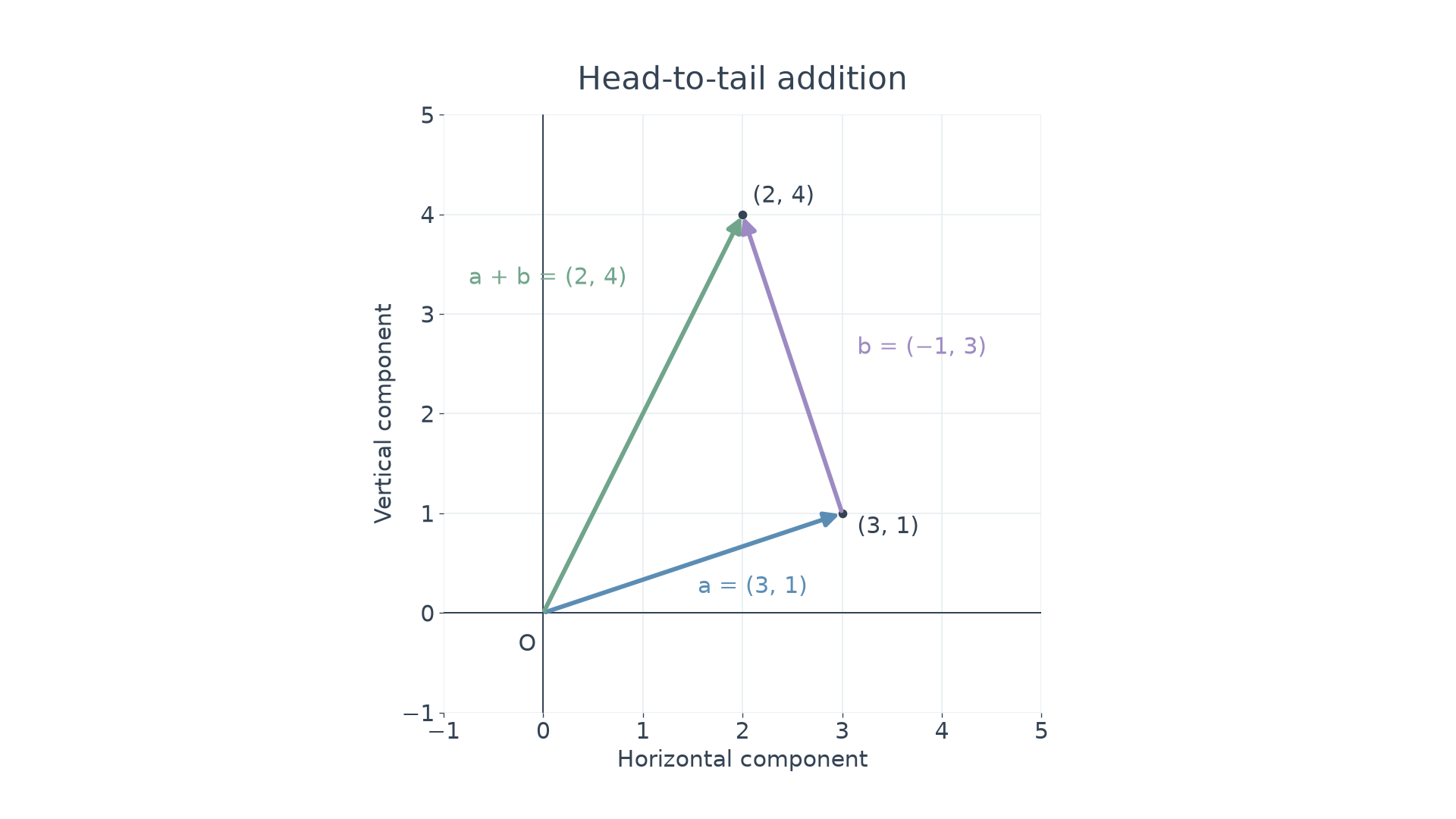
The blue vector is , the translated purple vector is , and the green resultant is . The axes use the same scale.
Horizontal changes add to horizontal changes, and vertical changes to vertical changes. Subtraction means adding the opposite arrow. With both arrows starting at the origin, points from the head of to the head of .
Vector operations
For , and real :
The magnitude of is . For a non-zero vector, positive preserves direction, negative reverses it, and gives .
Not in the formula sheet: learn it.
Apply the operation to the whole vector before combining components. This is particularly useful when a subtraction follows a scalar multiplication.
Worked example 1: adding scaled vectors
Question. For and , find .
Plan. Scale each vector, then add corresponding components.
Why this step? Each coefficient scales an entire movement, so it acts on both components.
Answer. .
Check. Moving right then left leaves right; moving up then up leaves up.
Change only the sign before the second scaled vector. The subtraction now reverses that movement.
Worked example 2: subtracting a scaled vector
Question. With the same and , find .
Plan. Add to .
Why this step? Subtracting changes both signs, not just the first.
Answer. .
Check. Adding back to gives .
The same reasoning works with general arrows. If and , the route gives . Components are useful, but not compulsory.
Watch out
Wrong: . Right: . A negative multiplier reverses every component.
Try a new pair of vectors, keeping the subtraction structure.
Magnitude and unit vectors
The arrow and its two perpendicular components form a right-angled triangle. Pythagoras finds its length, also called its modulus.
Continue this lesson.
You’re previewing NovaLearn without an account. Create a free account to read the rest.
Create free account