1.07m - Tangents and normals to curves
Use a derivative and a curve point to construct tangent and normal equations in 1.07m. You will handle horizontal and vertical exceptions, then work backwards from a specified direction to all possible points of contact.
A tangent needs a point and a gradient
How do you write the straight line which follows a curve's direction at one chosen point? For at , the curve point is and the gradient is . Those two facts determine the tangent completely.
You already know
A line through with finite gradient has equation . Differentiate a curve first, then substitute the input to obtain its numerical tangent gradient.
The input of the contact point is fixed. The coordinate in the line equation is free to move along the resulting straight line.
Tangent equation
For , at where a finite derivative exists,
Not in the formula sheet: learn it.
Find the point and slope separately before combining them. This also gives you two quick ways to check the result.
Worked example 1: a tangent to a cubic
Question. Find the tangent to at .
Plan. Evaluate the curve, evaluate its derivative, then use the point-gradient equation.
Why this step? The derivative gives the direction; the curve gives the point. Both are needed to select this particular line.
Answer. .
Check. At , the line gives , and its gradient is .
Change only the contact input, keeping the same cubic. Its local direction need not be the same elsewhere.
Worked example 2: a different contact point
Question. Find the tangent to the same curve at .
Plan. Reuse the derivative, but recalculate both the point and slope.
Why this step? A different point requires a new gradient evaluation, even though the derivative formula is unchanged.
Answer. .
Check. Substituting gives , and the line's gradient is .
If coordinates are supplied, check they actually lie on the curve. A correct slope through an incorrect point produces a parallel line.
Watch out
Wrong: for the tangent at . Right: evaluate the derivative first, giving the constant gradient . A changing gradient does not describe a straight line.
Use a fresh point on the same cubic.
The normal is perpendicular to the tangent
A curve has another useful line at a point: its normal. The normal uses the same contact point but turns the direction through a right angle.
Normal
A normal to a curve at a point is the line through that point perpendicular to the tangent. It is not a line through the origin unless the geometry happens to require that.
The graph uses equal scales, so the perpendicular directions look perpendicular as well as satisfying the algebraic test.
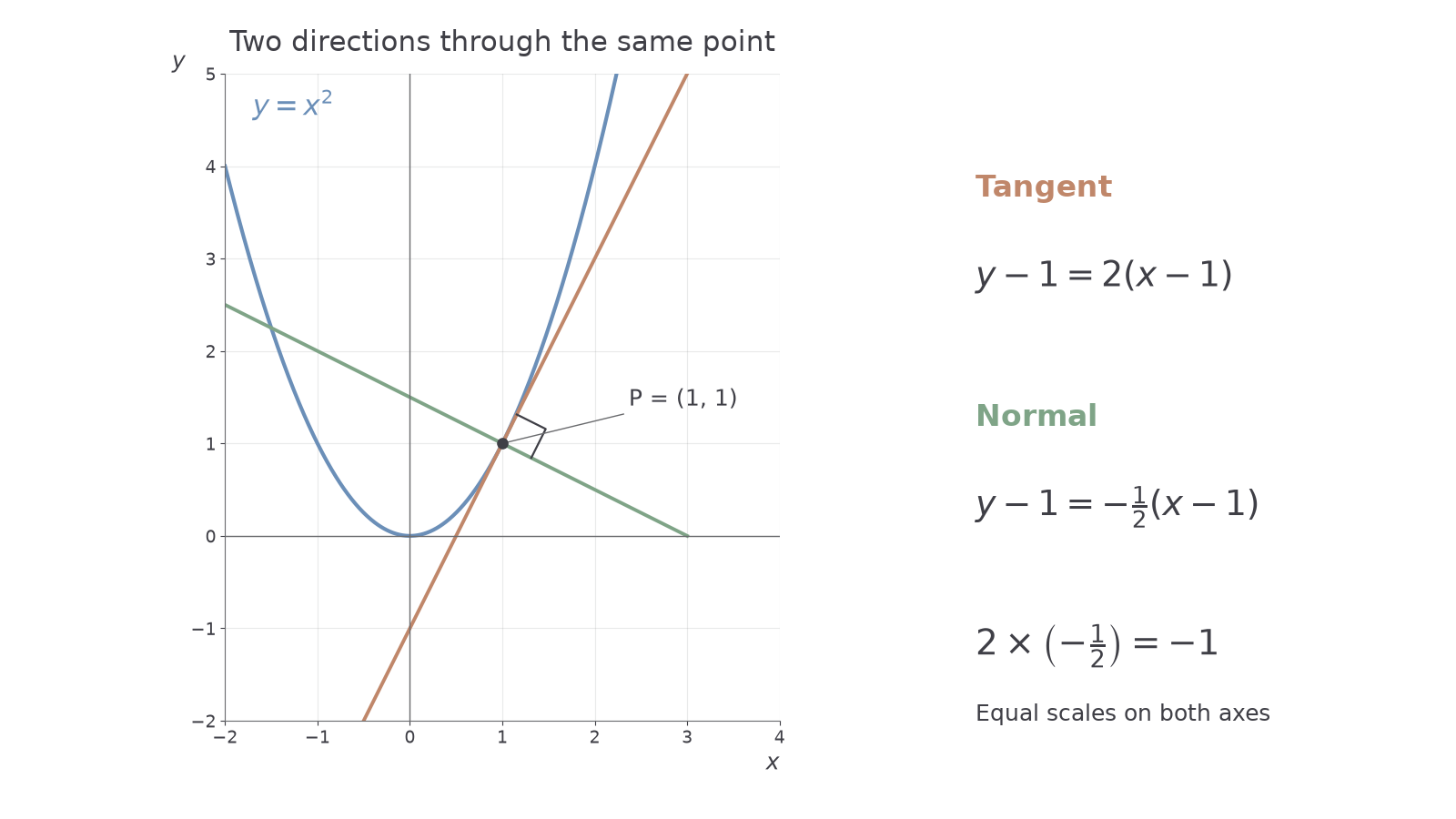
Normal with a finite gradient
If the tangent gradient is finite and nonzero, the normal has gradient
The condition is essential.
Not in the formula sheet: learn it.
Use the negative reciprocal, not just a sign change. For example, tangent gradient gives normal gradient ; their product is .
Worked example 3: a normal to a parabola
Question. Find the normal to at .
Plan. Find the tangent gradient, turn it into a normal gradient, then use the contact point.
Why this step? The derivative belongs to the tangent; the question asks for its perpendicular line.
Answer. .
Check. It contains and .
Change only the sign of the contact input. The normal gradient changes sign too.
Worked example 4: a normal on the other side
Question. Find the normal to at .
Plan. Recalculate the tangent gradient and use the unchanged height .
Why this step? The normal's slope must reverse sign when the parabola is reflected in the vertical axis.
Answer. .
Check. At , the line gives , and .
A normal can meet the curve again. The first example's normal crosses at as well as , since . Perpendicular at one point does not mean “never intersects elsewhere”.
Exam tip
Label tangent and normal gradients separately before writing the line. Check their product is , then check the line contains the curve point, not a point copied from a different line.
Move the contact input once more.
Continue this lesson.
You’re previewing NovaLearn without an account. Create a free account to read the rest.
Create free account