1.07f, 1.07p - Concavity and points of inflection
A curve can flatten without turning, and it can change its bending without flattening. You will use second-derivative signs to describe convex and concave sections (1.07f), then locate and classify stationary and non-stationary points of inflection (1.07p).
The sign of the second derivative describes bending
How can a curve rise, become horizontal for a moment, then keep rising? The curve does exactly that at . Its changing bending will explain the flat point.
Start with a simpler distinction. On , the gradients at are . The curve initially falls, but its gradients increase.
You already know
measures the curve's gradient; measures change in that gradient. A stationary point has , but need not be a turning point.
The second derivative describes bending, independently of the direction in which the height changes.
Convex and concave sections
In OCR Mathematics A, a smooth section with is convex: gradients increase and it bends upwards. A section with is concave: gradients decrease and it bends downwards. For example, is convex; is concave. Neither word means increasing height.
To find the intervals, factor the second derivative and establish its sign throughout each interval. These sign rules are not in the formula sheet: learn them.
Worked example 1: bending while the curve falls
Question. Describe the bending of , and compare it with the direction of the curve for .
Plan. Use the second derivative for bending and the first for direction.
Why this step? A falling curve can have increasing gradient, so the two derivative signs answer separate questions.
Answer. Convex everywhere, although decreasing for .
Check. Its slopes increase through the falling part to its minimum.
Change only the sign of the whole function. This reverses both its direction and its bending.
Worked example 2: the reflected bending
Question. Describe the bending of , and its direction for .
Plan. Differentiate twice and interpret each sign separately.
Why this step? Reflection reverses gradient change as well as gradient itself.
Answer. Concave everywhere, while increasing for .
Check. At , the slopes decrease despite the rising height.
The reflected examples separate direction from bending.
Watch out
Wrong: , therefore the curve is convex. Increasing height uses ; convexity uses . A rising curve can be concave, as the second example shows before its maximum.
For a cubic, bending can differ on the two sides of one point. For instance, has , so it is concave for and convex for .
A zero second derivative is only a candidate
A zero second derivative tells you where to investigate; a change of bending tells you what you have found.
Point of inflection
A point of inflection is a point on a curve where its bending changes from concave to convex, or vice versa. For the smooth curves here, find candidates from and establish a sign change across the point. The origin on is an example; the origin on is not.
The sign-change criterion is not in the formula sheet: learn it.
The two cubics below have identical second derivatives, but different tangent gradients at zero. Adding a straight-line term can change the slope without changing the bending at all.
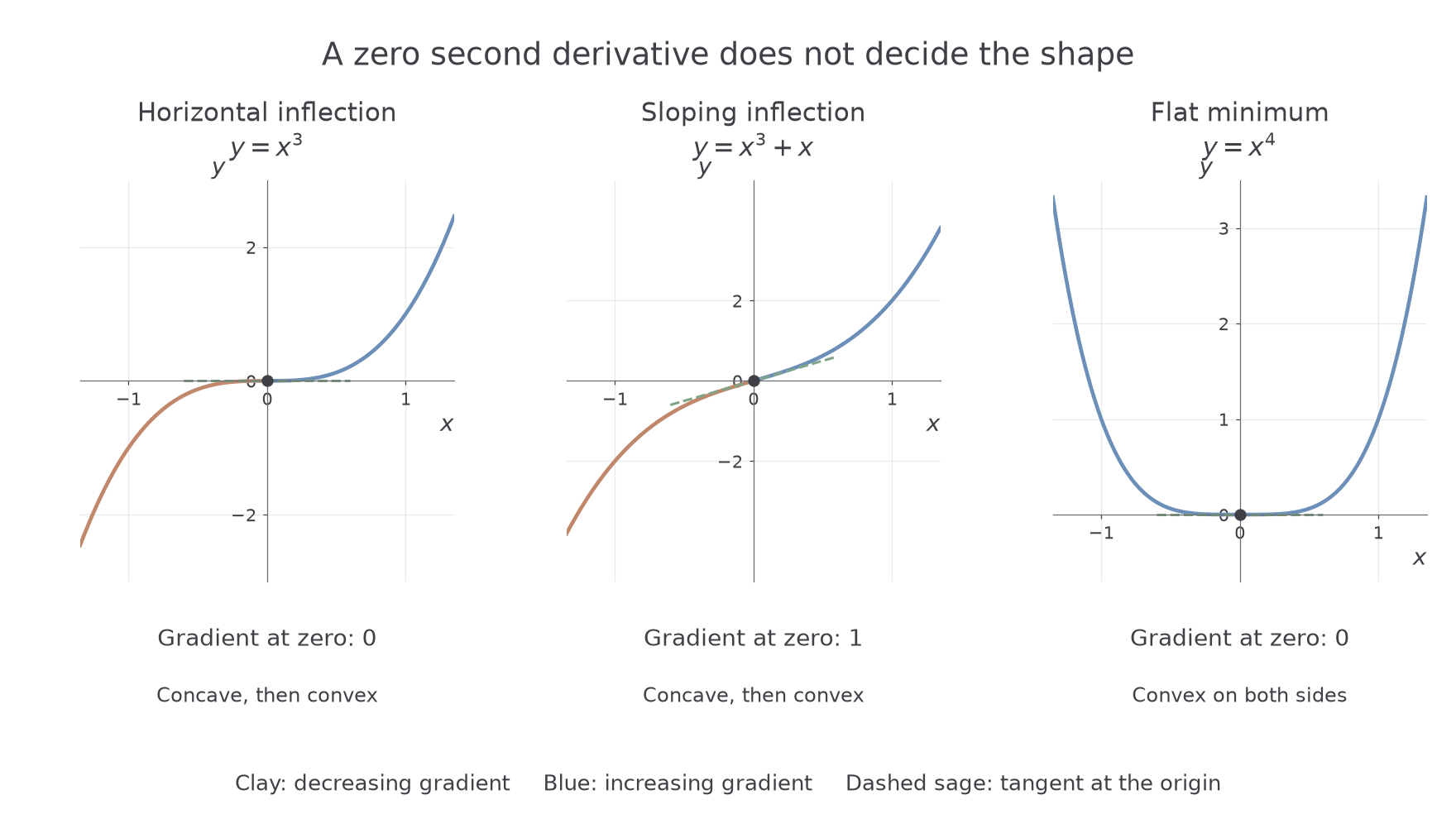
This is a useful surprise: the same bending need not mean the same direction or the same stationary points.
Worked example 3: proving a change of bending
Question. Find the point of inflection of , giving a reason.
Plan. Find a second-derivative zero, prove its sign change and calculate the height.
Why this step? The sign change proves an inflection; solving alone only locates a candidate.
Answer. Point of inflection .
Check. The second derivatives at and 1 are and 6, consistent with the interval signs.
Change only the leading power from 3 to 4. A repeated zero of the second derivative behaves differently.
Worked example 4: rejecting a candidate
Question. Decide whether is a point of inflection of .
Plan. Compare second-derivative signs on both sides of zero.
Why this step? An even power stays positive across its zero, so the curve does not change its bending.
Answer. No inflection at the origin: the curve is convex on both sides.
Check. At and , the second derivative is 12 in both cases.
A repeated second-derivative zero is a particularly useful warning against stopping too soon.
Watch out
Wrong: , therefore the origin is an inflection. The quartic example has no change in sign. Establish a change of bending before calling a candidate an inflection.
Domain gaps also matter. For , changes sign between the two branches, but there is no point at zero. The gap is not an inflection. Use the zero-second-derivative method on the smooth curves for which it is stated; do not assume it describes every possible non-smooth curve.
Stationary and non-stationary inflections
Once an inflection is proved, one first-derivative value tells you whether its tangent is horizontal.
Continue this lesson.
You’re previewing NovaLearn without an account. Create a free account to read the rest.
Create free account