1.03g - Parametric curves and cartesian equations
Describe a curve by giving both coordinates in terms of one shared variable. You will convert between parametric and Cartesian equations, retain the correct restrictions, and sketch the path with its direction of traversal.
One parameter, two coordinates
Can two different pairs of equations describe the same curve but send you along it in opposite directions? Try , , then , . Both give , yet increasing makes the first point move right and the second move left. A curve equation can forget information that the parameter remembers.
You already know
Substitution evaluates an expression at a stated value. Eliminating a variable links two equations; any restrictions on that variable must survive the elimination.
Think of the parameter as a label that selects an entire coordinate pair, not just one coordinate.
Parameter and parametric equations
A parameter is a variable used to specify points through equations such as , , together with its domain. The same value of must be used in both equations. It may represent time, angle or a convenient mathematical label.
A table records the generated points; it does not permit mixing an -value from one row with a -value from another.
Worked example 1: a shared parameter
Question. For , , , find the endpoints and describe the traversal.
Plan. Substitute both parameter endpoints into both equations.
Why this step? Both endpoints must use one shared value in the two coordinates.
Answer. A straight segment is traced from to , right and down as increases.
Check. At , the points are , , in that order on the segment.
Change only the parameter interval. The equations remain unchanged, but less of the line is drawn.
Worked example 2: an open endpoint
Question. Describe the path for the same equations with .
Plan. Evaluate the boundary values and retain which boundary is included.
Why this step? An open parameter boundary produces an open endpoint even though you can calculate its coordinates.
Answer. The segment runs right and down from, but excluding, , up to and including .
Check. gives the interior point .
With , these equations would describe the whole line, not a segment.
Watch out
Wrong: combine with to get a generated point . Right: forces , whose matching coordinate is .
Keep the equations and move the interval once more.
Elimination with the original restrictions
A Cartesian equation relates and directly. Solve the simpler parametric equation for the parameter, substitute into the other, then translate its domain.
For the preceding segment, gives . With , its complete description includes . The unrestricted equation would add points you never generated.
Worked example 3: a restricted branch
Question. Eliminate from , , , retaining exactly the same curve.
Plan. Use the linear equation to recover , then translate its sign restriction.
Why this step? The squared equation alone would also admit , requiring forbidden negative parameters.
Answer. , ; equivalently , .
Check. Every stated point gives , so the conversion works in reverse too.
Change only the parameter domain to . The path now crosses the vertex.
Worked example 4: both sides of a vertex
Question. Give the Cartesian description for the same equations with .
Plan. Keep the eliminated equation and translate the new interval using .
Why this step? An -interval alone cannot distinguish all the required upper and lower pieces of this sideways parabola.
Answer. , .
Check. The parameter endpoints give , ; gives the vertex .
Squaring may add a branch; division may remove a point. If a proposed elimination divides by , first check in the given equations. For example, , includes : cancelling without checking it would risk losing that point. Neither the elimination procedure nor these curve equations is in the formula sheet: learn the method.
Watch out
Wrong: replace , , by the whole parabola with . This adds points with the wrong -values. Right: retain the translated -interval.
The next interval is reflected towards the lower branch.
Converting from Cartesian form
To go in the other direction, choose a parameter that expresses both coordinates and preserves the required domain. Several choices can describe the same set of points.
Worked example 5: use the suggested shift
Question. Parametrise , , using .
Plan. Rearrange the suggested relation for and substitute it into .
Why this step? A choice of parameter must come with its own domain; copying the -domain would move the endpoints.
Answer. , , .
Check. The endpoints are , , matching the Cartesian curve.
Change only the suggested parameter to . The points will be the same, but their increasing-parameter order changes.
Worked example 6: reverse the parameter
Question. Parametrise the same Cartesian curve using .
Plan. Solve for , substitute, and reorder the interval endpoints correctly.
Why this step? Subtracting reverses the inequality order: corresponds to .
Answer. , , .
Check. Increasing takes the point from to , reversing the preceding traversal.
Using itself is often simplest, but not compulsory. For , choosing gives . A vertical line is naturally , . Parametrisation is not a single memorised formula and is not in the formula sheet.
Watch out
Wrong: with for the same segment. Right: translate the domain from the given relation, obtaining .
Use a scaled reversed parameter next.
A circle described by an angle
An angle around the centre supplies a natural parameter for a circle. On a unit circle centred at the origin, is the horizontal coordinate and the vertical coordinate of the radius endpoint. They are signed projections: left of the centre makes cosine negative; below it makes sine negative. Pythagoras gives . Scaling by a radius and shifting the centre gives the general form.
Parametric circle
For centre , radius and angle measured anticlockwise from the positive horizontal direction,
A full circle is traced once with . These equations use to give . Not in the formula sheet: learn it.
One turn is radians, or . Including both and repeats the starting point.
Worked example 7: identify a full circle
Question. Describe , , .
Plan. Read the centre and radius, then use quarter-turn points to establish direction.
Why this step? The equation identifies the set of points; the ordered quarter-turns identify traversal.
Answer. Centre , radius , traced once anticlockwise from .
Check. gives , , the leftmost and bottom points.
Change only the sign of the sine term. The circle stays put, but the direction reverses.
Worked example 8: the same circle clockwise
Question. Describe , , .
Plan. Eliminate the angle and compare the first two quarter-turn points.
Why this step? Reflection in the horizontal line through the centre leaves the circle unchanged but reverses its traversal.
Answer. The same circle is traced once clockwise.
Check. still gives ; the negative sign changes the vertical projection only.
A restricted angle interval describes an arc rather than the whole circle.
Watch out
Wrong: every parametrisation of a given circle has the same direction. Right: examine points in increasing parameter order; elimination can hide direction.
Keep the clockwise direction but change only the radius from to .
Sketching the path and its traversal
A useful sketch combines the Cartesian shape, the permitted section and arrows for increasing parameter. A sparse table alone can hide a turn or a repeated point.
[DIAGRAM: asset_name: Parametric path and traversal; caption: Parametric path and traversal; asset_slug: h240-parametric-paths; description: Equal-scale axes show x equals t squared minus 1 and y equals 2t for minus 2 to 2, with endpoint and vertex labels and traversal arrows, beside a centre 1 comma minus 2 radius 3 circle traced anticlockwise by an angle]
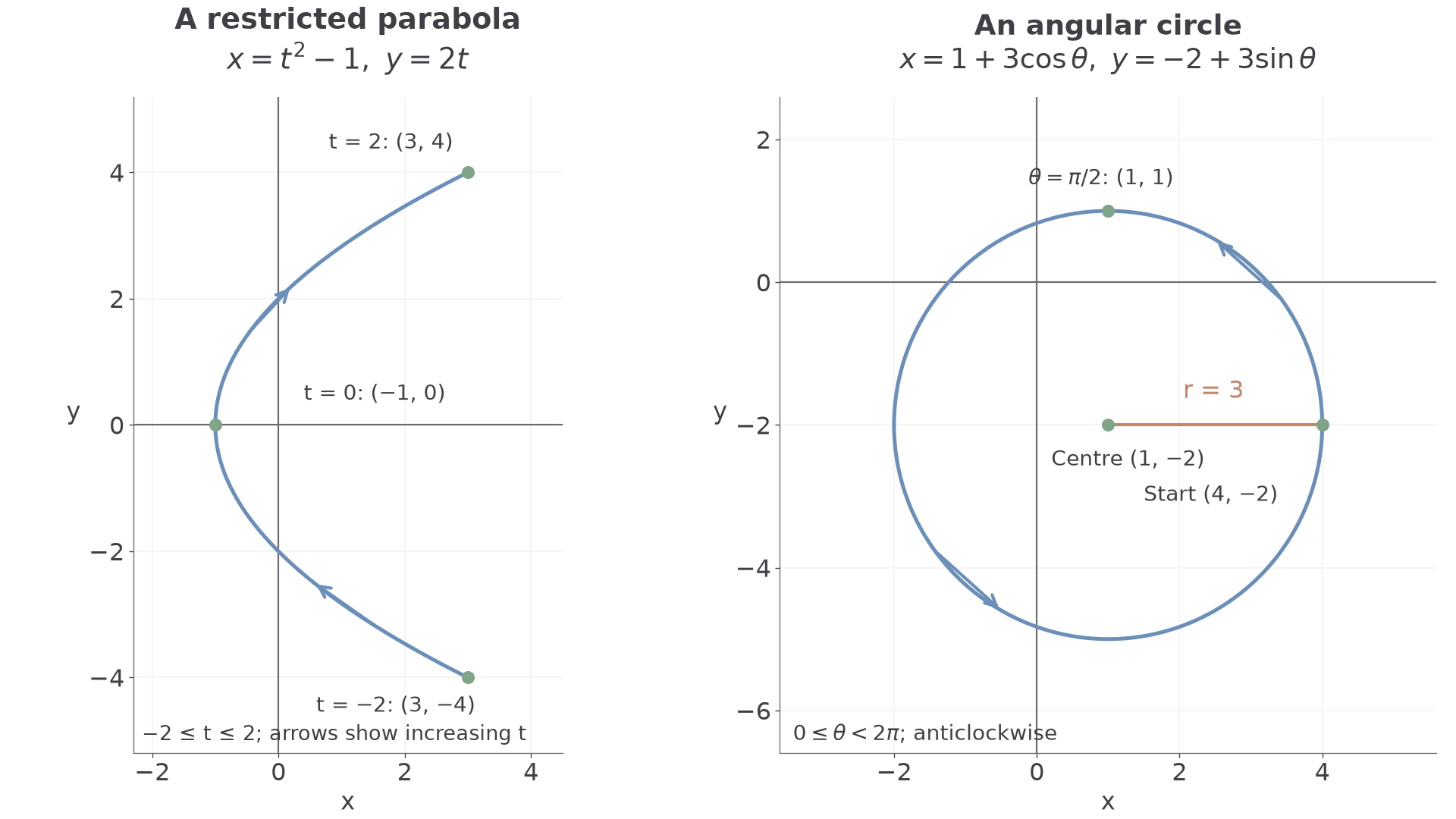
The left curve turns in at its vertex while keeps increasing. Join the calculated points smoothly along the parabola, not as a zigzag.
Worked example 9: sketch a sideways parabola
Question. Describe the sketch and traversal of , , .
Plan. Eliminate , find endpoints and vertex, then order them by .
Why this step? The vertex occurs inside the interval, so it belongs on the sketch even though it is not an endpoint.
Answer. A right-opening parabola segment goes from up and left to , then up and right to .
Check. gives , , consistent with the two branches.
Change only the lower parameter limit to . One branch disappears.
Worked example 10: retain only the upper branch
Question. Describe the same equations for .
Plan. Keep the shape and translate the narrower domain.
Why this step? The old lower endpoint requires , which is no longer allowed.
Answer. Only the upper branch segment remains, traversed up and right from the vertex.
Check. ; no point below the horizontal axis can occur.
A plotting calculator can help when you enter both equations in parametric mode with the correct shared range. Check its step size too: widely spaced samples may hide the curve. Arrows indicate parameter order, not necessarily equal speed. Sketching and traversal rules are not in the formula sheet: learn the method.
Exam tip
Give coordinates for endpoints and important turning points, then state which portion is included. An unrestricted Cartesian equation is not a complete answer to a restricted parametric problem.
Move the interval to the lower branch for your sketch description.
Quick Recap
- Use one shared parameter value in both coordinate equations.
- Eliminate the parameter and translate its domain; check for added branches or lost points.
- A parameter choice is not unique, and its interval changes with that choice.
- Sine and cosine describe circle projections; signs and intervals control direction and arcs.
- A sketch needs endpoints, important intermediate points, restrictions and traversal arrows.
Yes: the opening pairs and describe the same parabola, but increasing sends the points in opposite directions.