1.09f - Trapezium rule and area bounds
Can straight-edged shapes give a trustworthy answer for a curved area? Under 1.09f, you will build and refine a trapezium estimate, use curvature to decide its error direction, and construct rectangle bounds that state what the integral must lie between.
Build the composite trapezium rule
How much area lies under between and ? Four straight chords give . That is useful, but whether it is an estimate or a guarantee matters.
You already know
A trapezium with parallel sides and width has area . A definite integral is signed: below-axis contributions are negative.
Split into equal strips, each of width . The vertical heights are called ordinates. There are ordinates, including both endpoints.
Composite trapezium rule
For equally spaced ordinates,
In the formula sheet.
Each interior ordinate belongs to two neighbouring trapezia, so it is counted twice. Each endpoint belongs to only one.
Worked example 1: four strips, five heights
Question. Estimate with four equal strips.
Plan. Find the width, evaluate all five ordinates, then apply the weights.
Why double only the interior values? Adding adjacent trapezia counts their shared vertical sides twice.
Answer. The estimated integral is .
Check. The individual contributions also sum to .
Change only the vertical constant from to , keeping the interval and strip count.
Worked example 2: a vertical translation
Question. Estimate with four equal strips.
Plan. Add to each ordinate and retain the same weights.
Why keep the width? Translating the graph changes its heights, not the partition.
Answer. The estimate is .
Check. Raising a graph by over width adds exactly , agreeing with .
The same method gives for ordinates at . Negative ordinates still work for a signed integral; for geometric area, split at zeros and add magnitudes, or integrate the absolute value.
Watch out
Wrong: four strips means four heights. Right: four strips need five heights. Put brackets around the whole weighted sum before multiplying by .
Translate the first graph once more.
Use technology and refine the estimate
A spreadsheet can record each input, ordinate, weight and weighted value. Use endpoint weights , interior weights , and multiply their sum by . Retain precision until the final answer.
Worked example 3: a coarse calculation
Question. Estimate with two equal strips and compare with its exact value.
Plan. Use the three required ordinates and evaluate the elementary integral as a check.
Why use an exactly integrable example? It lets us see the actual approximation error before applying the rule to harder functions.
Answer. The estimate is , exceeding the integral by .
Check. The spreadsheet weights sum to .
Change only the strip count from two to four.
Worked example 4: halving the strip width
Question. Repeat the comparison with four equal strips.
Plan. Insert the missing half-step ordinates into the table.
Why is the estimate better here? Each shorter chord follows this smooth curve more closely.
Answer. The error has fallen from to .
Check. Halving the width has quartered the error in this quadratic example; that is not a universal exact rule for every function or data set.
For unequal data spacing, add individual trapezia instead. Readings give , using widths and . One common width would be invalid. For a function such as , numerical integration is useful because ordinary elementary antiderivatives do not provide a formula.
Exam tip
When the question specifies the trapezium rule, show enough substituted values to demonstrate that rule. More strips can improve a smooth-function estimate; agreement alone is not a rigorous bound, and a narrow unmeasured peak can remain hidden.
Halve the width once more, keeping the same function and interval.
Decide the direction of trapezium error
Increasing is not the same as curving upwards. The direction of trapezium error depends on where the chords lie relative to the curve.
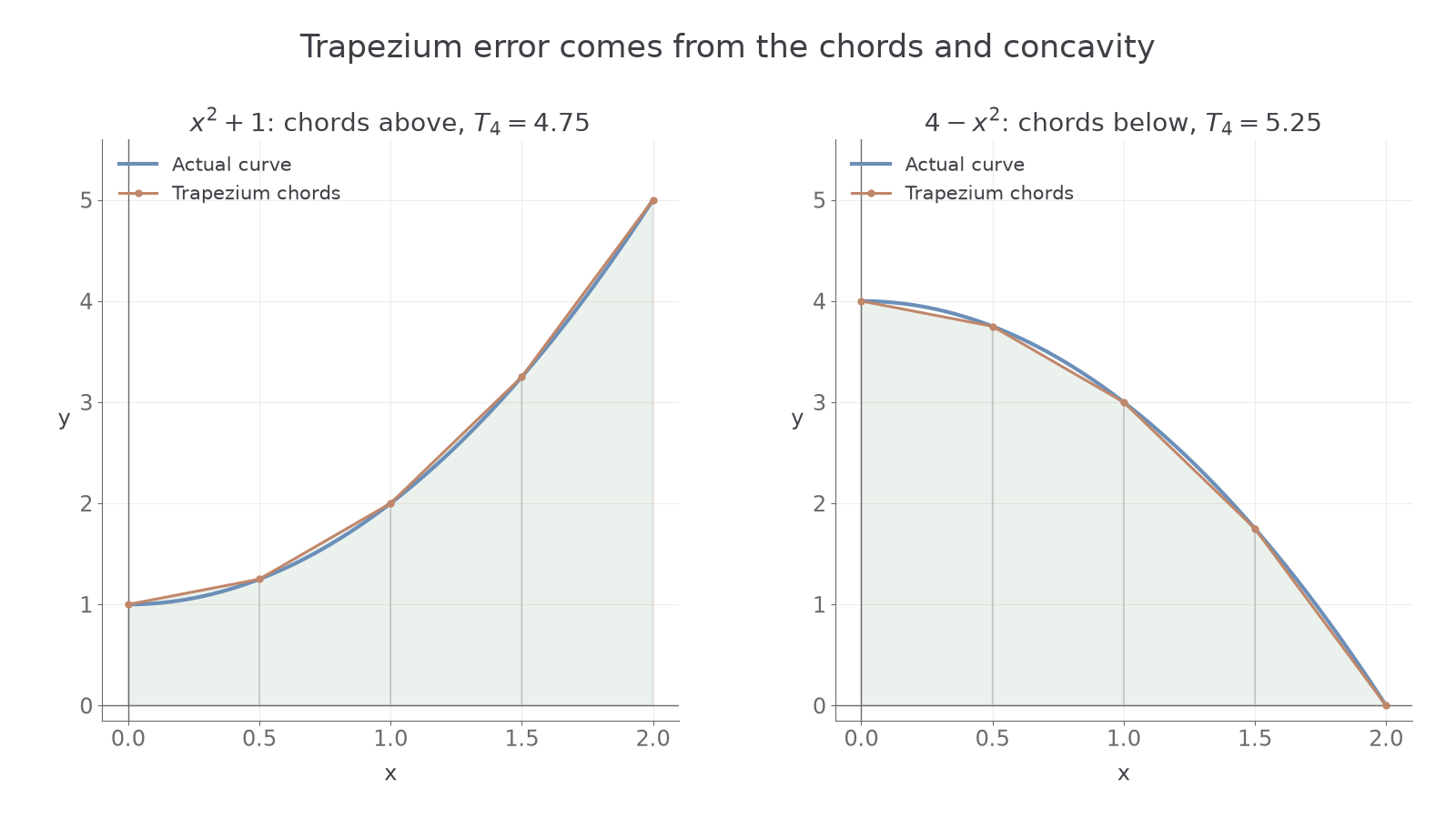
The left graph has chords above it; the right graph has chords below it.
Continue this lesson.
You’re previewing NovaLearn without an account. Create a free account to read the rest.
Create free account