1.05d - Radians, arc length and sector area
Define angles through arc length, convert between radians and degrees, and derive circle formulae that distinguish curved boundaries, sectors and segments.
An angle defined by arc length
A circular fan has radius . Its radii enclose a small angle of , but the fabric covers the reflex sector. How much curved edging and fabric does it need? First we need an angle unit that talks directly to length and area.
On a circle of radius , an arc of length subtends one radian. Doubling the circle doubles both lengths, leaving the angle unchanged. Unlike degrees, radians are built from the circle itself.
You already know
A full circle has circumference , area and angle . An angle and a length are different quantities; always match length units before forming a ratio.
The ratio of arc to radius defines the angle; it does not depend on the size of the circle.
Radian
One radian is the angle subtended at the centre of a circle by an arc equal in length to its radius. An arc of length on radius subtends angle radians, using matching length units.
A full circumference contains radii, so a full turn is radians. A surprisingly close near-fit: six arcs each one radius long almost go round a circle, but leave . Six radians is not a full turn.
Convert angle units
The conversion factors preserve the sign of a directed rotation.
Not in the formula sheet: learn it.
Keep exact multiples of when possible. For the reverse conversion, for example, radians becomes .
Worked example 1: convert an anticlockwise turn
Question. Convert to an exact radian measure.
Plan. Multiply the degree measure by and simplify.
Why this conversion factor? must become , so each degree is radians.
Answer. radians.
Check. Multiplying by returns .
Change only the direction of rotation. A clockwise angle is negative in either unit.
Worked example 2: convert a clockwise turn
Question. Convert to radians exactly.
Plan. Apply the same conversion and keep the negative sign.
Why keep the sign? Conversion changes the unit, not the direction or number of turns.
Answer. radians.
Check. It is between and , matching a clockwise angle between and .
Rotations can be negative or exceed . A physical sector instead needs the positive angle bounding the specified region; the reflex fan will need the larger angle.
Watch out
Wrong: radians means radians. Right: a decimal angle already is its radian measure; multiply by only when the question actually contains it.
Make one more clockwise conversion without reducing away a full turn.
Arc length and sector area
The same fraction of a full turn selects the arc's fraction of circumference and the sector's fraction of circle area.
Sector
A region bounded by two radii and their joining arc. Its perimeter includes both radii; the arc is only the curved part of its boundary. A reflex sector uses an angle greater than and less than .
For an angle radians, the fraction is . Multiplying by the full circumference and area gives
These simple forms work because the full turn is , not .
Arc, sector and boundary
Use and the positive radian angle of the chosen sector, normally . Arc length and perimeter have length units; area has squared units.
Not in the formula sheet: learn it.
The diagram separates the arc, full sector, triangle and segment. Those are different regions and boundaries.
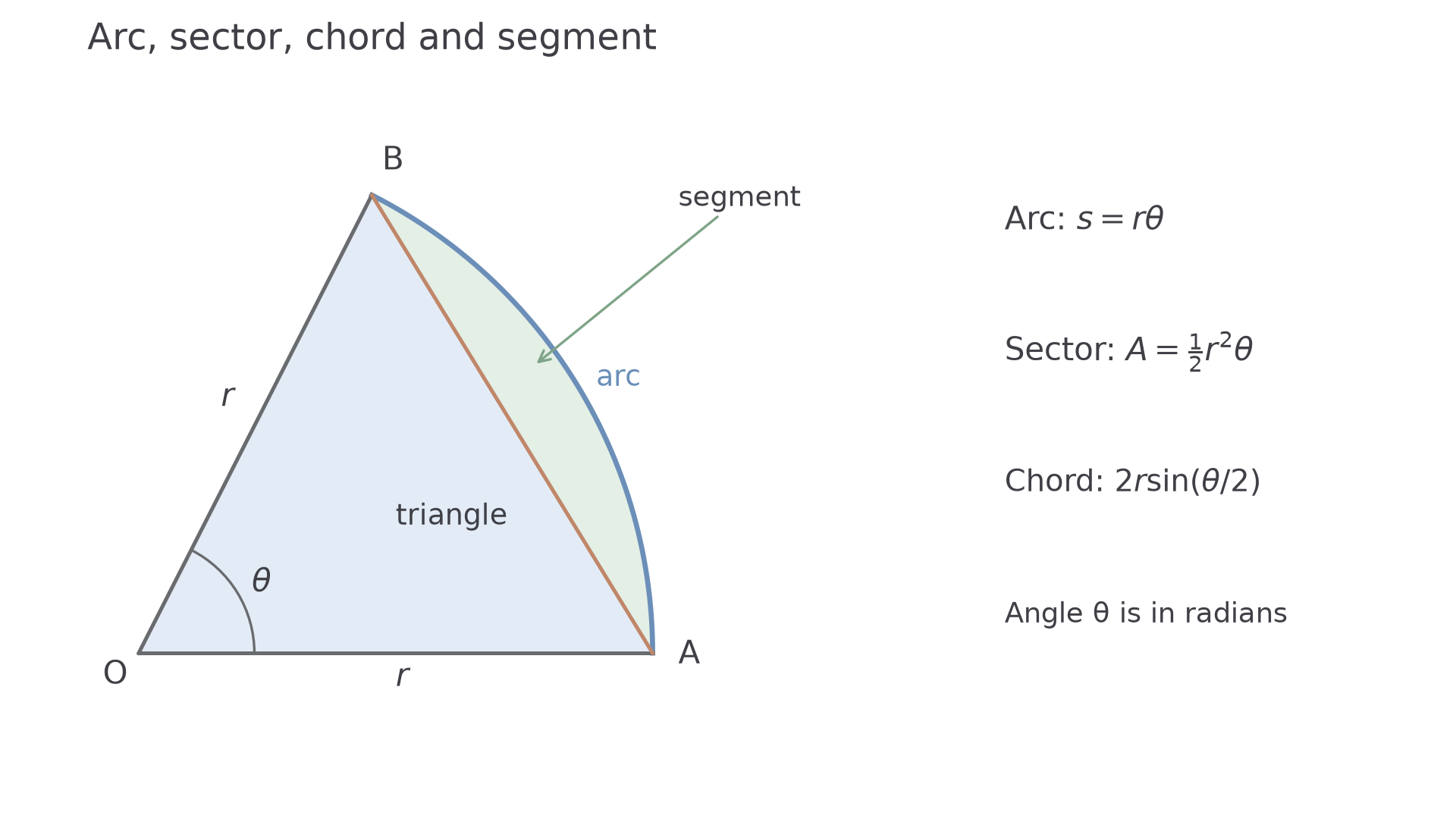
Begin with the small sector between the fan's radii before finding the fabric's reflex region.
Worked example 3: the minor sector
Question. A circle has radius . Find the arc length, area and perimeter of the sector with angle .
Plan. Use the positive angle directly in each formula.
Why add for the perimeter? The sector has two straight sides, each a radius.
Answer. Arc , area , perimeter .
Check. The angle is one sixth of a turn, so the arc and area are one sixth of their full-circle values.
Change only the chosen region: take the reflex sector between the same two radii. Its angle is the rest of a full turn.
Continue this lesson.
You’re previewing NovaLearn without an account. Create a free account to read the rest.
Create free account