2.03c, 2.03d - Conditional probability and two-way data
Use a given event to choose the right denominator, then connect two-way tables, trees and Venn regions. You will calculate conditional probabilities from first principles in 2.03d and use the diagram and probability rules of 2.03c to distinguish a branch, a complete path and independence.
Given an event changes the denominator
Why can the same eight people produce probabilities and ? In a group of 50, eight speak both French and Spanish. Eighteen speak Spanish and twenty speak French. Those eight people make up different fractions of the two language groups. The numerator can stay still while the question changes its denominator.
You already know
An intersection means both events. To calculate a probability from equally likely outcomes, divide by the number in the relevant sample space. A complement means “not”, relative to that sample space.
“Given Spanish” tells you to look only at Spanish speakers. Everyone outside that group is irrelevant to this particular fraction.
Conditional probability
is the probability of given : the probability within the group satisfying . The event after the vertical bar supplies the condition. In a finite equally likely model, count outcomes in both , then divide by the number in .
The following complete table makes the two possible conditioned groups visible. A person is selected uniformly; means French and means Spanish.
| Total | |||
|---|---|---|---|
| 8 | 12 | 20 | |
| 10 | 20 | 30 | |
| Total | 18 | 32 | 50 |
The table gives before any condition is imposed. The general conditional formula expresses the same restriction in probabilities.
Conditional probability
For ,
A zero-probability condition makes this ratio undefined. For this finite model, an empty conditioned group supplies no usable denominator.
In the formula sheet.
Use the counts directly or use their probabilities: the total 50 cancels in the ratio.
Worked example 1: within Spanish speakers
Question. Using the complete language table, find and .
Plan. Restrict the table to its Spanish column.
Why this step? The selected person is already known to be one of the 18 Spanish speakers, not just one of all 50 people.
Answer. The conditional probabilities are and .
Check. They sum to 1 because split the same conditioned group. The formula also gives .
Change only the condition to not speaking Spanish. Keep the person-selection rule and the events being measured unchanged.
Worked example 2: within non-Spanish speakers
Question. Using the same table, find and .
Plan. Restrict to the non-Spanish column instead.
Why this step? Changing the condition changes both the available group and which members satisfy the event.
Answer. The probabilities are and .
Check. They sum to 1. Dividing by 50 would instead calculate a joint probability, which answers a different question.
The full table also lets you count Spanish speakers within the French group directly: . This explains the opening puzzle. A conditional with the events exchanged generally has a different denominator; it is not obtained by simply swapping the letters in an answer.
Watch out
Wrong: . Right: . The whole-space denominator belongs to the joint probability, not the conditional probability. Do not cancel a condition merely because all the data came from one survey.
Try the same distinction with a fresh complete-count description.
Tree paths use the branch condition
A branch after the first outcome gives a conditional probability; a complete path gives a joint probability.
Let mean first red and mean first blue. Let refer to the second draw. After reaching , the next red branch is , not .
Conditional multiplication
For ,
Multiply the first event's probability by the probability of the second within that first event. If are independent, the second factor equals .
In the formula sheet.
Every pair of exhaustive outgoing branches sums to 1. Different completed paths are disjoint, so their probabilities may be added.
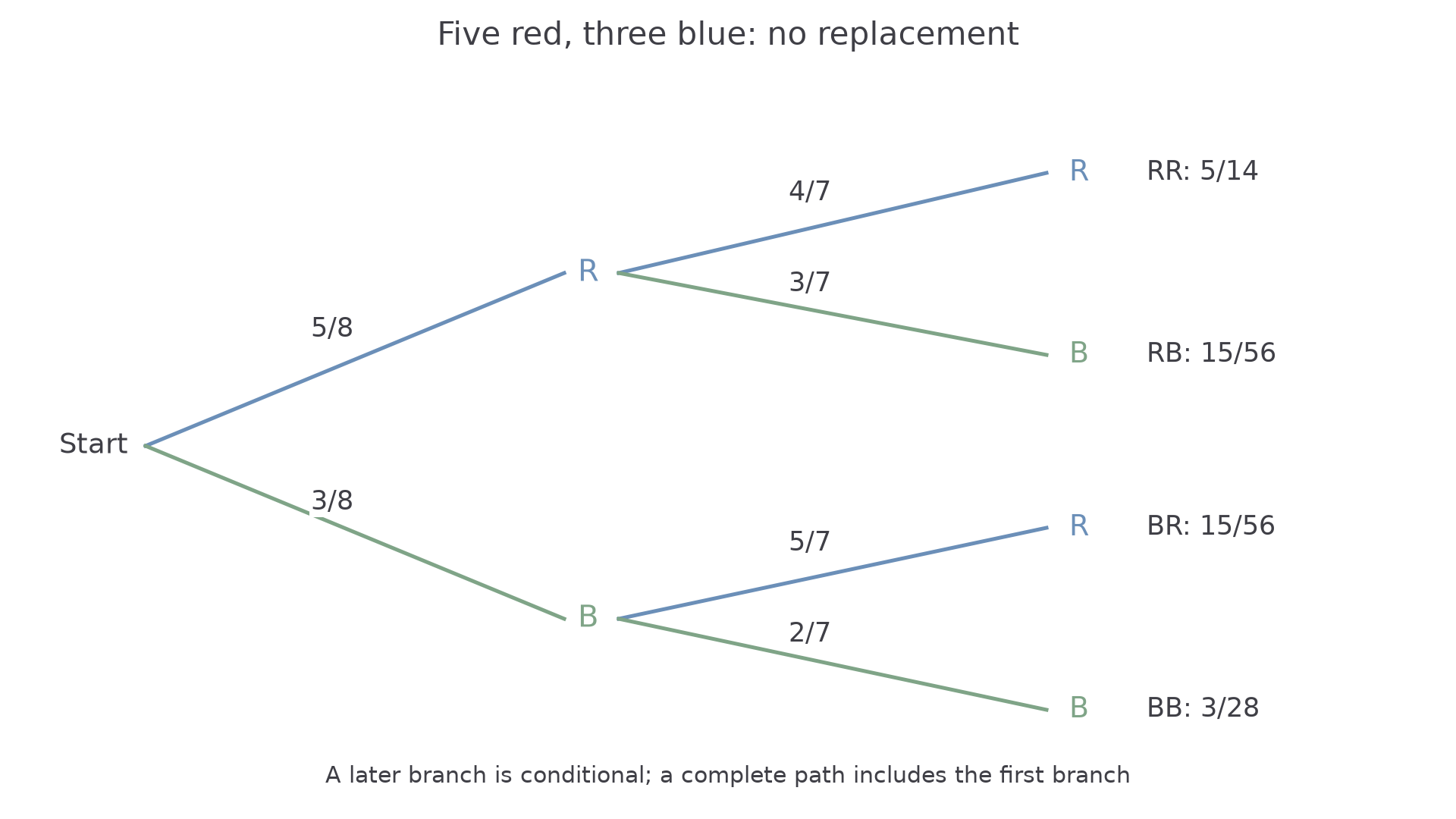
Worked example 3: a conditional branch without replacement
Question. Five red and three blue counters are in a bag. Draw two without replacement. Find , , and the probability of different colours.
Plan. Read the remaining bag after blue, then calculate both different-colour paths.
Why this step? The condition first blue has already occurred in the branch probability, but it must still be included in the whole-path probability.
Answer. The three probabilities are , and .
Check. RR has probability and BB has probability . Together with the two mixed paths, they sum to 1.
Continue this lesson.
You’re previewing NovaLearn without an account. Create a free account to read the rest.
Create free account