3.03v - Motion on rough surfaces
Use friction in directed equations of motion, with its direction set by sliding. Find accelerations on level ground and inclines, reconsider the forces when motion stops, and solve connected-particle problems with rough contact.
Sliding on a horizontal surface
A crate slides right, slows down and stops. Does its leftward friction then make it accelerate backwards? It does not. The equation for rightward sliding ends when the crate stops; static friction must then be reconsidered.
For a crate with and , friction during sliding is . Without a drive, an initial speed of falls to zero after . After that, zero horizontal applied force needs zero static friction, so the crate can stay still.
You already know
Choose a positive direction and use resultant force . Constant acceleration allows and ; these kinematic equations are in the formula sheet. They apply only while the stated acceleration persists.
Throughout this lesson, sliding friction is modelled as , with the same stated coefficient used in the static bound. Real surfaces can need a more detailed model.
Sliding on rough horizontal ground
For rightward sliding under a horizontal rightward drive , with no other vertical force,
The friction direction follows sliding velocity, even when the acceleration is negative. Reassess the model at first rest.
Not in the formula sheet: learn it.
Begin with a drive stronger than friction.
Worked example 1: speeding up while sliding
Question. A particle slides right at on rough horizontal ground. A horizontal drive is right, , and . Find its acceleration and its speed after , assuming the conditions persist.
Plan. Calculate friction, apply Newton's second law rightwards, then use the velocity equation.
Why subtract friction? It opposes the rightward velocity, not the direction in which you hope the particle accelerates.
Answer. Acceleration is right; the speed after is .
Check. The speed remains positive and increases, consistent with the positive resultant.
Change only the drive, from to zero. Find the same quantities after the same time.
Worked example 2: slowing down while still sliding right
Question. The same particle starts at right, with and , but no drive acts. Find its acceleration and speed after .
Plan. Use the unchanged friction as the whole horizontal resultant and check that the particle has not stopped.
Why check the sign of velocity? A negative result would mean the assumed sliding stage ended before the requested time.
Answer. Acceleration is left; the speed after is , still rightwards.
Check. First rest occurs at . The distance to first rest is .
Beyond , the second example stays at rest. Substituting a later time into its sliding equation would create a false reversal.
Watch out
Wrong: “Acceleration is leftwards, so friction must be rightwards.” Right: friction opposes sliding. A leftward resultant can slow a rightward-moving particle.
Try a smaller drive that still leaves a positive rightward speed.
Motion down a rough incline
A particle sliding downhill has uphill friction. It can speed up or slow down, depending on whether the downhill weight component exceeds friction.
We consider motion along the line of greatest slope. Resolve perpendicular to the plane to find the reaction, then parallel to it for the equation of motion.
Downhill sliding under weight and contact
For a plane at acute angle , with downhill positive,
This holds while the particle slides downhill and remains in contact. Positive means speeding up downhill; negative means slowing down downhill.
Not in the formula sheet: learn it.
The acceleration formula comes from force balance; there is no need to memorise it instead of the diagram and equations.
Worked example 3: downhill motion speeding up
Question. A particle is projected down a rough incline at . Here , , , and . Find its downhill acceleration and the distance travelled in the first second.
Plan. Subtract uphill friction from downhill weight, then use constant-acceleration displacement.
Why resolve perpendicular first? Friction depends on , which is , not the whole weight.
Answer. The downhill acceleration is , and the distance is .
Check. Final velocity is downhill. Average speed gives the same distance.
Change only , from to . Keep downhill as positive and find the same outputs over one second.
Worked example 4: downhill motion slowing down
Question. The same particle is projected downhill at on the same plane, but . Take . Find its downhill acceleration and the distance travelled in the first second.
Plan. Recompute friction, retain its uphill direction, and check that downhill sliding lasts for the full second.
Why keep friction uphill? The particle still slides downhill, even though it is slowing.
Answer. The downhill acceleration is , meaning uphill. The distance is .
Check. Final velocity is downhill. First rest is at , beyond the interval used.
For this course, incline-motion problems follow the line of greatest slope; resolving motion across the plane is unnecessary. The force diagram still needs both parallel and normal directions.
Watch out
Wrong: switch friction downhill when the calculated downhill acceleration is negative. Right: keep uphill friction until downhill sliding stops. Then reassess the static bound.
Try a different slope, using the same force-and-kinematics chain.
Stopping, holding or reversing on an incline
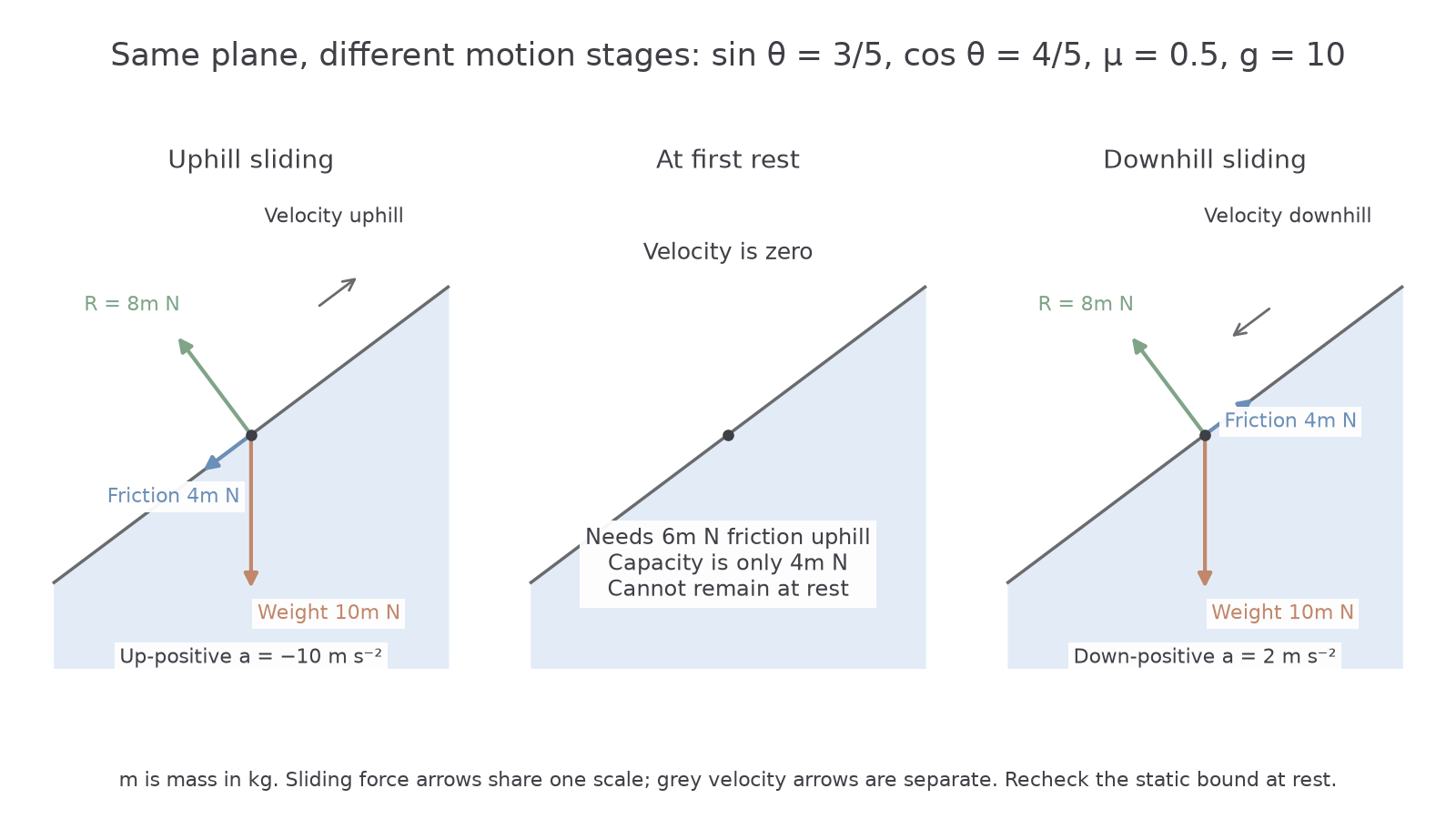
During uphill sliding, both friction and the downhill weight component oppose the motion. At the first stop, ask a new question: can static friction now balance the downhill pull?
If it can, the particle stays at rest. If it cannot, the particle begins sliding downhill and friction reverses. This can make the return journey slower than the climb, although gravity has not changed.
[DIAGRAM: asset_name: Friction changes at reversal; asset_slug: incline_friction_stages; description: Same rough incline shown in uphill sliding, first rest and downhill sliding stages, with separate force arrows, weight components and friction directions; caption: Reassess static friction at rest before choosing the next sliding equation]
Continue this lesson.
You’re previewing NovaLearn without an account. Create a free account to read the rest.
Create free account