1.08f - Areas between curves and parametric areas
Find the area of a region by choosing its boundaries and the direction of its strips. Locate intersections, split crossing curves and use horizontal or parametric descriptions without losing the geometry.
Find the region before integrating
Can two curves enclose a positive area while their net integral is zero? First picture the small region between and : its height is , so its area is square unit. The strip height matters, rather than either curve's distance from the axis.
You already know
A definite integral adds signed strip contributions. Solve simultaneous equations to find intersections, then subtract the lower boundary from the upper boundary.
The same reasoning works when both graphs are below the axis. Moving both down leaves every gap unchanged.
Area using vertical strips
If throughout , then
Use intersection abscissae or the supplied vertical boundaries as limits. Not in the formula sheet: learn it.
The sketch identifies the enclosed region; exact equations establish its ends.
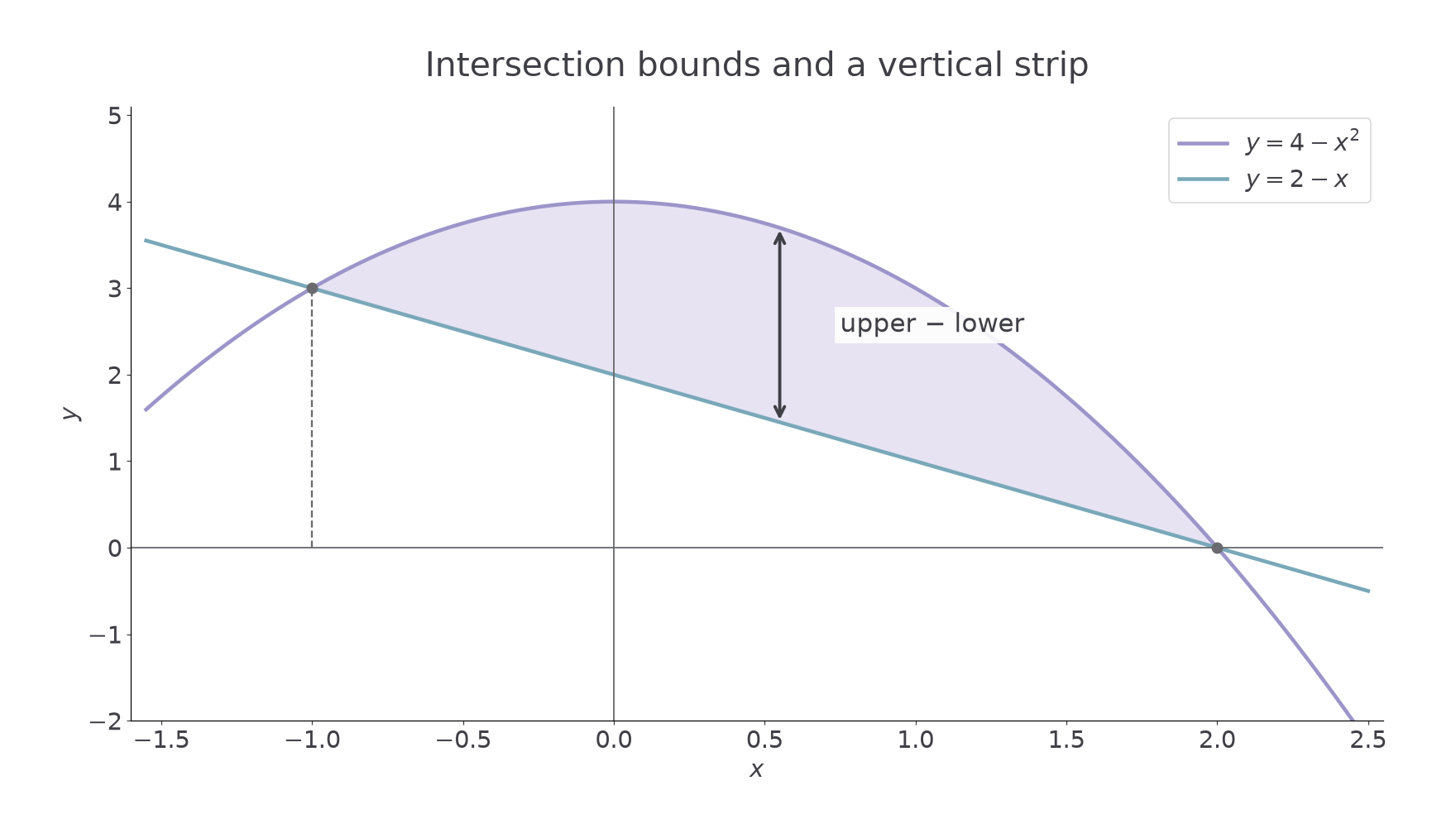
Worked example 1: an enclosed region
Question. Find the area enclosed by and .
Plan. Find the intersections, test the order between them, then integrate the gap.
Why this order? At , the parabola has height , above the line's ; no other intersection changes that order.
Answer. square units.
Check. The region has width and greatest gap , so its area is below , as required.
Now change only the line's constant, from to . The intersections move, so the old limits cannot survive.
Worked example 2: moving one boundary
Question. Find the area enclosed by and .
Plan. Recalculate the intersections before integrating the new gap.
Why this step? The common vertical offset cancels, leaving exactly the opening strip height.
Answer. square unit.
Check. At , the gap is positive, .
The bounds and subtraction order are separate decisions; get both onto the page.
Watch out
Wrong: integrate the sum of the two heights. Right: integrate their difference. A geometric area is non-negative, even when both boundary heights are negative.
Change the line's constant once more and find the new region.
Split where the upper graph changes
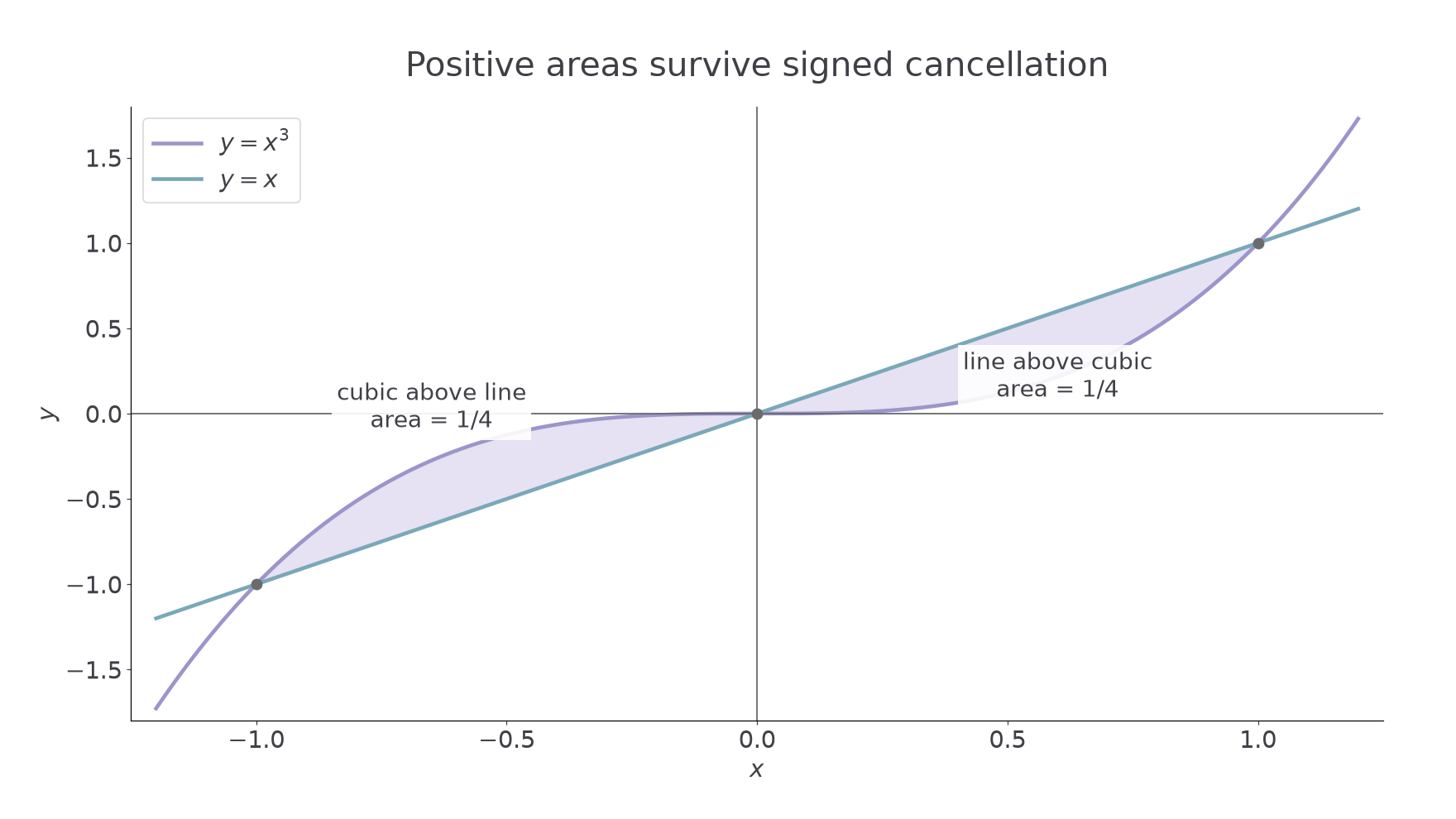
Crossing graphs can cancel in a signed integral even though each lobe has positive area. Here is the answer to the opening puzzle: an odd difference can integrate to zero across a symmetric interval while enclosing two visible regions.
Change of order
A change of order occurs when the upper and lower graphs exchange positions at an intersection. A touching intersection need not exchange them; test the sign on each side.
Locate every intersection within the supplied interval. Use one subtraction order on each interval where its sign is fixed.
Worked example 3: two equal lobes
Question. Find the total area between and on .
Plan. Split at the interior intersection .
Why split? The cubic is above the line on the negative interval, but below it on the positive interval.
Answer. square unit, although .
Check. The lobes are related by a half-turn, so their areas agree.
Change only the line's coefficient to . Its outer intersections now have irrational abscissae, but their powers simplify exactly.
Worked example 4: wider lobes
Question. Find the total area enclosed by and .
Plan. Find all intersections and double the positive-side area by symmetry.
Why is symmetry useful? The difference is odd, so opposite strip gaps have equal magnitudes.
Answer. square units.
Check. A separate calculation on the negative interval gives , matching the positive lobe.
Supplied end lines can also matter. Between and on , split at ; the pieces have areas and , giving .
Watch out
Wrong: take the absolute value of one net integral after cancellation. Right: split where the gap changes sign, then add the non-negative pieces.
Try the same lobe structure with a new coefficient.
Continue this lesson.
You’re previewing NovaLearn without an account. Create a free account to read the rest.
Create free account