1.02l, 1.02s, 1.02t - Modulus graphs, equations and inequalities
Turn modulus notation into distances, straight-line branches and clear solution sets. You will sketch a folded line, solve equations at its intersections and decide which intervals satisfy an inequality.
Modulus as distance and bounds
How can the same two boundary points describe either a middle interval or two outside intervals? Imagine a number-line alarm that accepts positions at most 2 units from 3. It accepts 1 and 5, but also everything between them; an alarm accepting positions more than 2 units away chooses the outside instead.
Modulus
The modulus of a real number is its distance from zero, written . Thus and . It is non-negative, rather than always positive. The distance between and is .
For a negative input, changing its sign makes the distance positive. In particular, , not .
Modulus and distance bounds
For real ,
For real and ,
Replace both strict signs by inclusive signs for . An outside condition uses “or”: means or .
Not in the formula sheet: learn it.
Try the distance picture before the algebra. Both tell you which side of each boundary to keep.
Worked example 1: an inclusive distance
Question. Solve .
Plan. Find the positions 2 units either side of 3, then keep the interval between them.
Why this step? A distance at most 2 allows movement in either direction from 3, including both endpoints.
Answer. .
Check. At and the distance is 2; at it is 0. All three are accepted.
Change just the comparison to “more than”. The boundary positions stay put, but the accepted region changes.
Worked example 2: an outside distance
Question. Solve .
Plan. Use the same boundaries and keep the two outside intervals, excluding equality.
Why this step? Positions outside the interval are further than 2 from 3; a position cannot lie in both outside intervals at once.
Answer. or .
Check. gives distance 3 and works; gives 0 and fails. Neither endpoint works because its distance is exactly 2.
A distance cannot have a negative upper bound: has no solutions. The boundary case gives only ; gives none.
Watch out
Wrong: gives .
Right: gives or . First decide whether the distance is inside or outside the bound.
The next check changes the centre and the distance, keeping the outside reasoning.
Folding a linear graph
A modulus graph keeps the part of a line above the horizontal axis and folds the part below it upwards.
You already know
A straight line has gradient and vertical intercept . Its horizontal intercept is found by setting .
For , the line underneath changes sign at . To the left, its output is negative, so that branch changes sign; to the right it stays as it is.
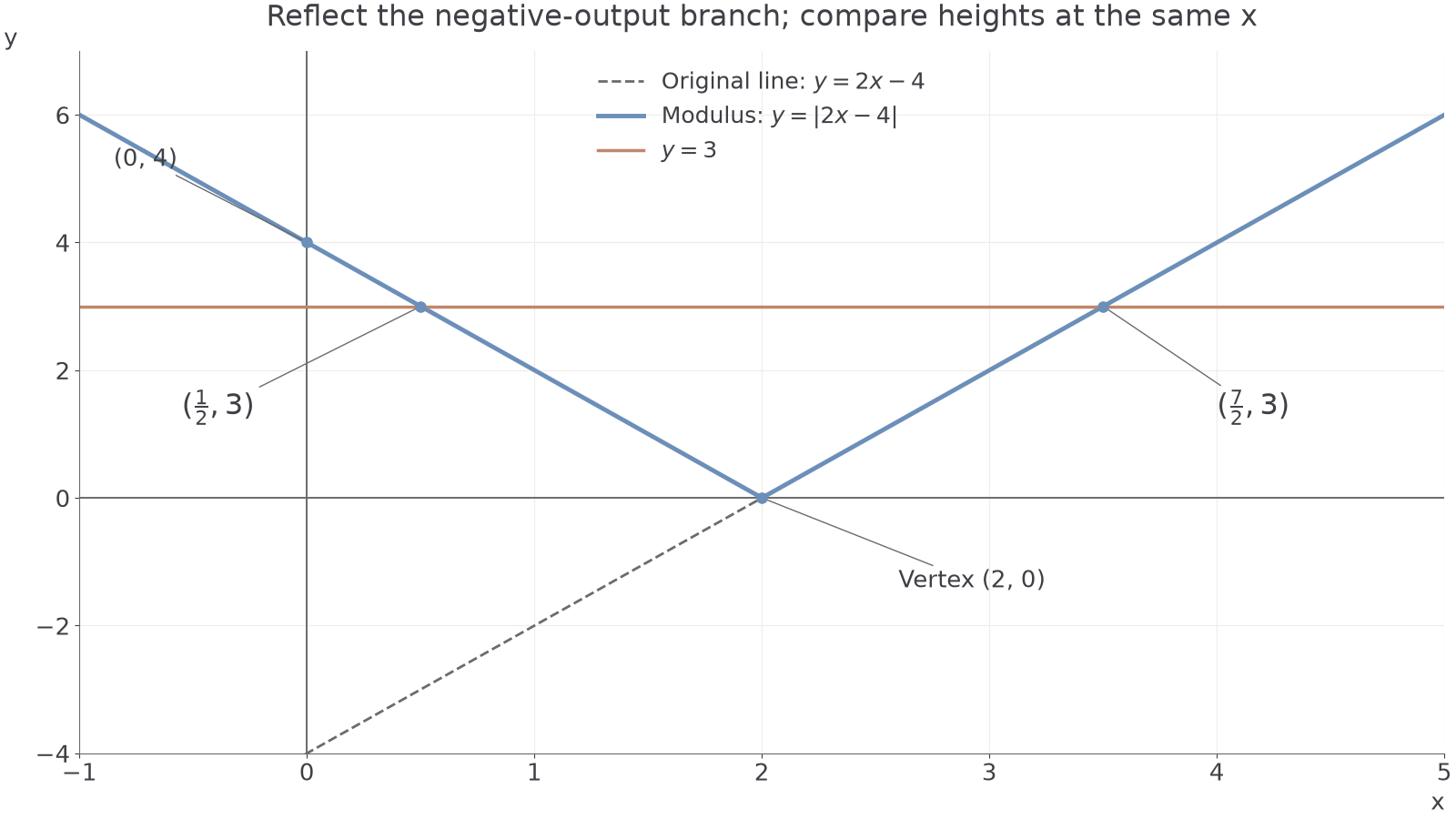
The V has straight arms, not the rounded bottom of a parabola.
A single linear modulus graph
For real ,
Its vertex is , its axis of symmetry is , and the two branch gradients have magnitude . If , the graph is the horizontal line .
Not in the formula sheet: learn it.
Locate the zero before writing the branches: the sign of the expression inside the modulus decides which branch to use.
Worked example 3: folding a positive-gradient line
Question. Describe a sketch of , giving its vertex, vertical intercept and branches.
Plan. Find the zero of the inside expression, then change its sign exactly where it is negative.
Why this step? Only negative outputs are reflected; positive outputs already equal their modulus.
Answer. Draw straight branches meeting at , through , with left gradient and right gradient 2.
Check. At and , the output is 2 on both sides of the vertex.
Now reverse the sign of the entire expression inside the modulus. This is a useful surprise: the folded graph does not change at all.
Worked example 4: a negative-gradient line
Question. Describe the graph and branches of .
Plan. Find where changes sign and compare the resulting branches with the previous graph.
Why this step? Modulus loses the sign of the whole input. A descending line and its negative produce the same V.
Answer. The vertex is , the vertical intercept is , and the graph is unchanged.
Check. At , , the same output as .
This folding rule is for one modulus sign applied to a linear expression. Do not use a smooth curve as a substitute for its straight branches.
Watch out
Wrong: reflecting the entire line to obtain .
Right: keep where , and reflect only the branch where .
Apply the same branch method with a new zero.
Equations and admissible intersections
A solution of a modulus equation is an input where the modulus graph meets the graph on the other side.
On the diagram above, meets twice. Graphs show how many intersections to expect; the branch equations give exact values.
Removing a modulus in an equation
For real and ,
Equivalently, require and . Without the sign condition, squaring can introduce false solutions.
Not in the formula sheet: learn it.
A horizontal line above the vertex cuts both arms; one below the horizontal axis cannot meet this V at all.
Worked example 5: two horizontal intersections
Question. Solve .
Plan. Set the inside expression equal to 3 and to .
Why this step? The modulus is 3 for the two signed inputs 3 and .
Answer. or , the horizontal coordinates of the two intersections with .
Check. The inside outputs are and 3, whose moduli are both 3.
Change one feature: the other graph is now a sloping line. A candidate from extending an arm backwards may fail its branch condition.
Worked example 6: rejecting a false intersection
Question. Solve .
Plan. Split at , solve each linear equation and check its branch.
Why this step? Each straight-line equation represents only one arm of the V, so its solution must lie on that arm.
Answer. The only solution is .
Check. At , both sides are . At the rejected , they are 14 and , so the unsquared equation is false.
Squaring would preserve the equality of the two squares at . It would not repair the negative right-hand side of the actual equation.
Watch out
Wrong: has both roots of .
Right: check the branch or substitute into the unsquared equation; is not a solution.
Your next sloping line meets both arms. Establish that both candidates are admissible.
Choosing intervals from modulus inequalities
Intersections locate the boundaries of a graphical inequality; vertical order decides which intervals to keep.
For , look for the V below the horizontal line. Between its two intersections the V is lower; outside, it is higher. With a sloping line, the acceptable set need not be a middle interval.
Graphical comparison
For graphs and ,
selects the inputs where the first graph is below the second. Include their intersections for , and exclude them for . Use only inputs where both functions are defined.
Not in the formula sheet: learn it.
Use the picture to choose the intervals, then algebra to locate their exact endpoints.
Worked example 7: below a horizontal line
Question. Solve graphically, giving exact boundaries.
Plan. Find the intersections with , then select where the V lies below it.
Why this step? The inequality asks for vertical order, so the crossings alone are not the complete answer.
Answer. .
Check. At , ; at , is false. Both equality endpoints are excluded.
Change only the other graph to a sloping line, keeping the same modulus and strict comparison. Compare each arm with the line and restrict the answer to that arm.
Worked example 8: below a sloping line
Question. Solve .
Plan. Compare the two straight arms with , then join the permitted inputs.
Why this step? The first inequality is solved inside , not on the whole number line. Its answer contributes , not .
Answer. Joining both branches gives .
Check. At , both sides are , so that endpoint is excluded. At , the inequality becomes , so that input fails.
You can also obtain the answer by sketching the V and line: they meet once, after which the line stays strictly above both arms.
Watch out
Wrong: square an inequality with a potentially negative right-hand side and keep every resulting interval.
Right: use branches or vertical order. A negative number cannot be an upper bound for a non-negative modulus.
Keep the graph interpretation as you solve the next two-branch comparison.
Comparing two distances
When both sides are moduli, both are non-negative, so squaring preserves their order.
This is a useful distinction from the previous part: there is no hidden negative right-hand side to reject. Algebra can compare the distances without drawing two V-shaped graphs.
Comparing moduli by squares
For real and ,
The same equivalence holds with , , or . It works because squaring preserves order for non-negative numbers.
Not in the formula sheet: learn it.
The difference of the two squares gives a familiar quadratic sign problem.
Worked example 9: two inclusive distances
Question. Solve .
Plan. Square both non-negative sides, factor their difference and select its sign intervals.
Why this step? It is the two moduli that are squared, not two arbitrary signed expressions whose order might reverse.
Answer. or .
Check. At , the distances are 2 and 1, so the middle interval fails. At , both are 3 and equality is accepted.
Change only the sign to a strict comparison. The quadratic boundaries stay the same and equality is now removed.
Worked example 10: the same comparison made strict
Question. Solve .
Plan. Repeat the squared comparison, retaining only positive values of the difference.
Why this step? Strictness changes endpoint membership, not the sign of the product between its roots.
Answer. or .
Check. At , works. At , fails.
The opening alarm problem and this comparison have the same final decision: locate the boundaries, then decide which intervals satisfy the actual sign.
Watch out
Wrong: gives .
Right: compare and , or compare all valid straight-line branches. For example, is false although is true.
Finish by changing the two distances rather than the comparison sign.
Quick Recap
- Modulus is a non-negative distance; zero is allowed.
- Fold only the negative-output part of a line to sketch its modulus.
- Equations locate intersections; inequalities also require a choice of intervals and endpoints.
- Check branch conditions when the other side can be negative. Squaring two moduli preserves their comparison.
The alarm's boundaries are 1 and 5: distance at most 2 selects , while distance more than 2 selects or .