3.03a, 3.03f, 3.03g, 3.03i, 3.03j - Particles, forces and mechanical assumptions
Build a useful force model: identify and represent forces in 3.03a, connect mass, weight and local gravity in 3.03f and 3.03g, and understand normal reaction and smooth contact in 3.03i and 3.03j. You will see how a small change in an assumption changes the forces you should include.
What a mechanical model retains
A parcel rests on a table. You lift gently with an upward force of , but the parcel stays on the table. Does the table still support its whole weight? We will build the model that answers this, and find when contact ends.
For a small parcel on a large table, its position matters more than its shape. For a parcel tipping over the table's edge, shape matters very much. The useful model depends on the question.
You already know
Mass is measured in kilograms; force and weight are measured in newtons. A vector has magnitude and direction, so force arrows need both a label and a direction.
A model keeps selected features of reality and deliberately omits others. State what an assumption removes, then ask whether that omission could affect the prediction.
Particle and smooth contact
A particle has mass but negligible size for the purpose of the model: its orientation and rotation are not tracked. A smooth contact is one at which friction is neglected; a normal contact force can still act.
Treat a train as a particle to track its position on a long straight route. Retain its length to decide when its rear clears a platform. Likewise, smooth contact may suit a well-lubricated slider, but can fail when friction noticeably slows a moving block.
Other common assumptions make different simplifications:
| Assumption | What it lets you neglect or retain |
|---|---|
| Light string or rod | Neglect its mass and weight; it can still transmit force. |
| Inextensible string | Retain a fixed length; a string can nevertheless become slack. |
| Uniform body | Use evenly distributed mass; this does not make the body rigid. |
| Rigid body or rod | Neglect changes in shape and dimensions; its mass need not be uniform. |
Refining a model means restoring a relevant omitted feature. Add air resistance if a falling object's observed motion differs substantially from a gravity-only prediction. For a tipping question, replace the particle by a body with size. Compare the revised prediction with observations; adding every possible detail is not automatically useful.
Key idea
“Smooth” removes friction at the named contact. It does not remove weight, normal reaction or every other resistance in the problem.
A useful explanation connects the assumption to its physical consequence.
Forces belong to a chosen body
Name the body before drawing any arrows. A force diagram includes forces acting on that body, not every force it exerts on something else.
Force diagram
A force is a vector interaction that can change a body's velocity. A force diagram represents each force acting on the selected body by a directed line segment or arrow, labelled with its magnitude or symbol. Here the forces act in at most two dimensions.
An arrow's direction is essential: two opposite forces of do not act like one force of in a single direction. A schematic diagram need not use arrow lengths to scale, but should make every force's line and direction clear.
| Force on a body | Direction |
|---|---|
| Weight | Locally vertically downwards, towards the attracting body |
| Tension in a taut string | Along the string, pulling away from the body |
| Thrust or compression from a rod | Along the rod, pushing on the body |
| Normal reaction | Perpendicular to the contact surface, away from it |
| Friction | Along the contact, opposing relative sliding or its tendency |
| Resistance | Opposes motion relative to the resisting medium |
| Driving force | In the direction in which the drive acts |
On a slope, “normal” does not mean “vertical”. For a falling ball moving down through still air, resistance acts upwards; if air resistance is neglected, weight is the only force after release. A ball can even have zero velocity at the highest point of an upward throw while its weight is still non-zero. An instant of rest does not switch gravity off.
[DIAGRAM: asset_name: Contact and falling-body force diagrams; asset_slug: mechanics_forces; description: Forces on a crate on a rough horizontal floor, a bead on a smooth incline and a falling ball with resistance; caption: Contact and falling-body force diagrams]
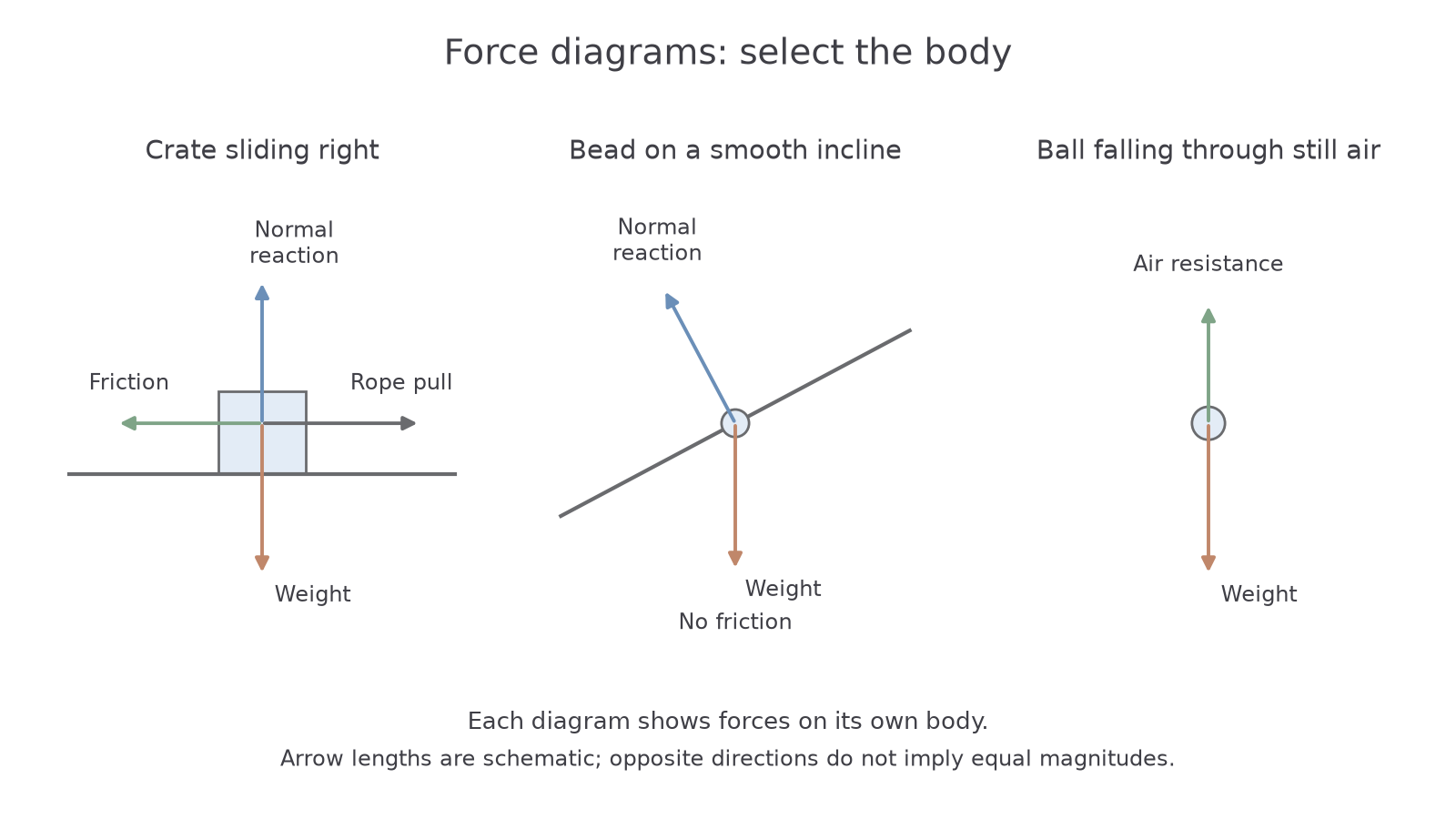
The diagram shows forces on three separate bodies. The arrow lengths are schematic: opposite directions do not by themselves imply equal magnitudes.
Worked example 1: a smooth-floor diagram
Question. A crate is pulled to the right by a horizontal taut rope on a smooth horizontal floor. Air resistance is neglected. State the forces on the crate and their directions.
Plan. Identify the objects interacting with the crate, then apply the smooth assumption.
- Earth attracts the crate: weight acts downwards.
- The floor supports it: normal reaction acts upwards, perpendicular to the floor.
- The rope pulls it: tension acts horizontally rightwards.
- The floor is smooth: omit friction.
Why this step? The assumption removes the tangential contact force, not the perpendicular support force.
Answer. Draw down, up and right on the crate.
Check. Every arrow has a physical source. There is no separate “force of motion”.
Change only the floor from smooth to rough, with the crate sliding rightwards. One additional interaction must now appear.
Worked example 2: a rough-floor diagram
Question. The same crate and horizontal rope are used on a rough horizontal floor. The crate slides rightwards. Air resistance is neglected. State the forces and directions.
Plan. Keep the existing interactions and restore friction at the floor.
- Retain weight downwards and normal reaction upwards.
- Retain tension horizontally rightwards.
- Add friction leftwards, opposing the crate's sliding relative to the floor.
Why this step? Rough contact allows a tangential resistance; its direction follows the relative sliding, not the rope's label.
Answer. The four arrows are down, up, right and left.
Check. All forces act on the crate. The force the crate exerts on the rope belongs on a different body's diagram.
A body can keep moving after a push ends. Continued motion does not justify retaining a force from a person who is no longer touching it.
Watch out
The line “smooth surface, so ” removes the wrong force. Smooth means friction is neglected; the normal reaction remains while the surface pushes on the body.
Apply the rough-contact model to a sledge, with the towing rope detached.
Mass, weight and local gravity
Carry a package to a different gravitational environment and its mass stays the same, but its weight changes.
Weight and gravitational acceleration
Weight is the gravitational force on a body. Near Earth's surface, gravitational acceleration is often modelled as constant, with magnitude . The value of depends on location; it is not a universal constant.
Use the value stated in the question. Otherwise use ; choosing a different approximation changes the model's numerical predictions. We do not need an inverse-square gravitation law for this course's calculations.
Weight
Here is weight magnitude in newtons, is mass in kilograms and is local gravitational acceleration magnitude in . Weight acts downwards in the local Earth model.
Not in the formula sheet: learn it.
Start with a package and the usual Earth approximation.
Worked example 3: weight near Earth
Question. Calculate the weight of a package using , and state its mass.
Plan. Multiply mass by the stated gravitational acceleration.
The units multiply to .
Why this step? Weight is a force, found by multiplying mass by the local .
Answer. Its weight is , downwards, and its mass is .
Check. is close to , so an answer close to is sensible.
Change only the local gravitational acceleration. Keep the same package and mass.
Worked example 4: the same mass elsewhere
Question. The package is moved to a location where . Calculate its weight and state its mass there.
Plan. Retain the mass and replace only in the weight formula.
The smaller gravitational acceleration gives a smaller weight.
Why this step? Mass is a property of the package; the gravitational force changes with its environment.
Answer. Its weight is , and its mass remains .
Check. The weight ratio is , exactly the ratio of the two gravitational accelerations.
Continue this lesson.
You’re previewing NovaLearn without an account. Create a free account to read the rest.
Create free account