1.02w, 1.02x - Transforming and combining graphs
Move a graph by changing its inputs and outputs, even when you have no formula for the curve. You will describe single transformations in 1.02w, then combine them, form equations and recover important sketch features in 1.02x.
Changing heights by translation and stretch
How can you turn a graph upside down, move it right and find its new roots without knowing its formula? Start with one point: if the graph contains , multiplying its outputs by sends that point to . Its horizontal position stays put. We will move a whole unfamiliar graph this way in the last part.
You already know
A point on means . The domain contains the permitted inputs; the range contains the outputs actually reached.
An operation outside the function changes the output. Adding changes a height of to ; multiplying by changes it to . Addition and multiplication therefore move a graph differently.
Translation and stretch
A translation moves every point by the same vector. A stretch parallel to an axis multiplies the corresponding coordinates by a positive scale factor, leaving the other coordinates unchanged. For example, a vertical stretch of scale factor maps onto ; moving every point up is a translation, not that stretch.
Follow a general point to describe the whole graph. Negative multipliers need a reflection as well as a positive stretch factor.
Changes to outputs
For on , with real and ,
The domain stays the same. If , reflect in the -axis and stretch parallel to the -axis by . If , the reflection alone suffices.
Not in the formula sheet: learn it.
For a translation up , every range value increases by . For a stretch, transform the two range endpoints and put them back in increasing order.
Worked example 1: bringing heights closer to the axis
Question. Let , for . Describe , form its equation and state its vertex, roots and range.
Plan. Halve the outputs, then read the features from the resulting quadratic.
Why this step? The multiplier acts on every term of the output, so the vertex height changes as well as the quadratic coefficient.
Answer. A stretch parallel to the -axis with scale factor . The equation is , vertex , roots , domain and range .
Check. At , , agreeing with the unchanged root.
Change just the sign of the multiplier. The graph now crosses the axis in the same places but opens downwards.
Worked example 2: reflecting the same stretched graph
Question. For the same , describe and give the same features.
Plan. Reflect the heights from the preceding example in the -axis.
Why this step? Multiplying an inequality by a negative number reverses its direction; the lowest old height becomes the highest new height.
Answer. Reflect in the -axis and stretch parallel to the -axis by , in either order. The equation is , vertex , roots , domain and range .
Check. At , the new output is , and every other output is at most .
There is one exceptional multiplier. If , the graph collapses onto height over its existing domain; this is not an invertible stretch. If , writing still does not permit .
Watch out
Wrong: the range becomes under multiplication by . Right: it becomes ; intervals are written from the smaller endpoint to the larger one.
Now change the multiplier again and apply the same coordinate reasoning to a curve whose formula is unknown.
Changing inputs and horizontal scale
To find a horizontal movement, solve for the new input that produces an old output.
For , the old input is reached when , so . The graph moves left , even though the equation contains a plus sign. For example, maps onto . This is a translation by .
Changes to inputs
For real , and real ,
The horizontal stretch factor is . If , also reflect in the -axis. The range is unchanged because every old input is still reached.
Not in the formula sheet: learn it.
The new domain is found by requiring the inside expression to belong to the old domain. This is more reliable than trying to remember a direction.
Worked example 3: a horizontal stretch with scale factor below one
Question. A function has domain , and its graph contains . Describe , give the image of the point and find the new domain.
Plan. Solve for coordinates and impose the old input restriction.
Why this step? The same output is now reached at half the old horizontal coordinate, so the horizontal scale factor is the reciprocal of .
Answer. A stretch parallel to the -axis by scale factor ; the point is , and the domain is .
Check. The new endpoints feed and into , exactly the old endpoints.
Change only the sign inside the function. The reflection reverses left and right, including the order of the domain endpoints.
Worked example 4: reflecting the input scale
Question. With the same function and point, describe , give the image and find the domain.
Plan. Match the old input again, remembering that division by a negative number reverses inequalities.
Why this step? A negative inside multiplier changes the sign of horizontal coordinates; the height is untouched.
Answer. Reflect in the -axis and stretch parallel to the -axis by , in either order. The point maps onto , and the domain is .
Check. At the new left endpoint, ; at the new right endpoint, .
The same rule moves a vertical asymptote to . If , the reciprocal rule breaks: is constant for every real input if is in the old domain, and is nowhere defined otherwise.
Here is a useful surprise: for , . A horizontal stretch of factor and a vertical stretch of factor produce the same parabola. A final graph need not reveal a unique history of moves.
Watch out
Wrong: has horizontal scale factor . Right: solve , giving , so the scale factor is .
A new negative multiplier checks that you can separate the reflection from the positive scale factor.
Combining moves and forming equations
A combined transformation is safest when you track a general point before describing separate moves.
A translation by maps onto , so its equation is . For instance, translating by gives , with vertex .
A combined point mapping
For real , with and ,
Horizontally, scale by , reflect if , then translate by . Vertically, scale by , reflect if , then translate by .
Not in the formula sheet: learn it.
This is not an extra rule to memorise blindly: solve for the horizontal coordinate and evaluate for the height.
Worked example 5: scales followed by translations
Question. A point lies on . Describe a sequence producing , and find the point's image.
Plan. Read the factored input, then transform the two coordinates separately.
Why this step? Matching the old input protects the order of the horizontal operations: , rather than .
Answer. Stretch horizontally by , translate right , stretch vertically by , then translate down . The point maps onto . Horizontal and vertical operations may be interleaved because they affect different coordinates.
Check. Substituting into the new input gives , as required.
Change just the direction of the horizontal translation. Keep both stretches and the vertical translation fixed.
Worked example 6: reversing one translation
Question. For the same point, describe and find its image.
Plan. Solve the new inside equation and retain the unchanged output calculation.
Why this step? Factoring identifies the translation after scaling: means left , not left .
Answer. Stretch horizontally by , translate left , stretch vertically by , then translate down . The image is .
Check. The inside expression at is .
Order matters for operations on the same coordinate. Scaling by then adding gives ; adding first then scaling gives . Similarly, differs from .
To form an equation from a sequence, reverse the horizontal point mapping. A horizontal stretch by followed by right gives , hence . If , a horizontal stretch by followed by down instead gives : substitute into the whole formula.
Watch out
Wrong: means scale horizontally by , then left . Right: factor , giving scale , then left .
The next sequence gives the movements first, so construct its input expression rather than reading one.
Sketching from a supplied graph
A supplied graph gives you points and shape, even when it gives you no algebraic formula.
For a sketch, transform the endpoints, turning points, intercepts and asymptotes that are supplied. Preserve smoothness or straight segments and included or excluded endpoints. The image of an old intercept need not be a new intercept: an upward translation takes a zero height off the axis.
Worked example 7: moving an unfamiliar segmented graph
Question. A graph consists of straight segments through , with included endpoints and no points outside those segments. Describe the sketch of , including its domain, range and intercepts.
Plan. Map each vertex, join the images with straight segments, then locate the new zero heights.
Thus the vertices map as follows:
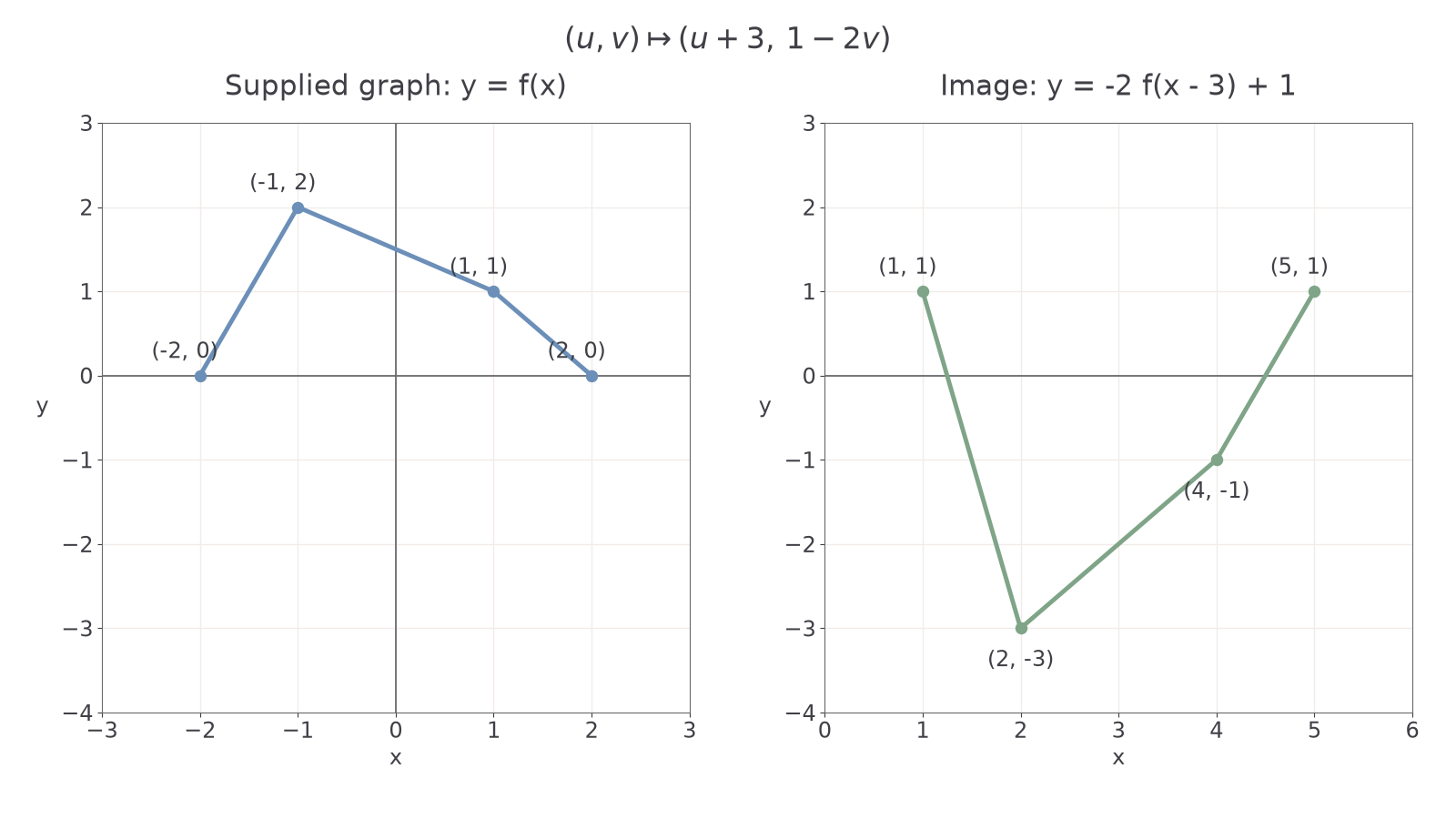
Why this step? The graph is completely specified by the vertices and straight connections, so mapping those vertices determines every intervening segment too.
The first image segment has equation ; the last has . Hence
Answer. Join the four image vertices in order, keeping the endpoints included. Domain , range , roots . There is no -intercept because is outside the domain. This answers the opening puzzle without finding a formula for .
Check. Both roots lie on their claimed segments, and the two middle vertices have negative heights, so no further segment crosses the axis.
Change only the vertical multiplier, from to . The horizontal positions stay fixed, but the new zero heights must be found again.
Worked example 8: changing the vertical scale
Question. For the same supplied graph, describe the sketch and features of .
Plan. Keep the input mapping and replace the output rule by .
The first image segment has equation , so
Why this step? Old points with height , rather than , become new roots after the reflection and upward translation.
Answer. Join in order. Domain , range , roots , and no -intercept.
Check. The vertex is a root; the last segment rises from it and introduces no additional root.
Technology can suggest patterns but a screen has boundaries. For the family , a plot restricted to , shows no part of . It has not disproved the roots: gives , both outside that window. Widening it reveals them. Changing shifts every height by the same amount; the vertex explains the whole family, including values beyond a plotted grid.
Exam tip
A sketch should show the relevant features and their coordinates, not just a recognisable shape. Recalculate intercepts after a vertical translation; mapped old intercepts may no longer lie on an axis.
Use the same method on a new set of supplied straight segments. All the information needed is in the question.
Quick Recap
- Outside changes alter heights; inside changes require you to solve for the new input.
- A negative scale includes a reflection, and a horizontal stretch uses the reciprocal inside multiplier.
- Track a general point to respect the order of combined transformations and form the equation.
- Sketch from mapped features, preserving the supplied shape and domain boundaries; find new intercepts afterwards.
To turn an unfamiliar graph upside down and move it right, map its points first: for , use , then locate the new roots on its transformed segments.