1.07a–1.07c - Derivatives as gradients and rates of change
Find a curve's gradient at one point by bringing two points together. You will connect the tangent and derivative in 1.07a–1.07b to instantaneous rates and their units, then sketch gradient functions in 1.07c without confusing height with slope.
From a chord to a tangent
How can a curve have a gradient at just one point, when calculating a gradient needs two points? On , the chord joining to has gradient . Move the second point to , and the gradient becomes . The two points are getting closer, and the slopes are settling towards .
You already know
A straight line through and , with , has gradient . A positive gradient rises as you move right; a negative gradient falls.
Keep one point fixed and let the other move along the curve. The straight lines joining them show how an average direction can approach a local direction.
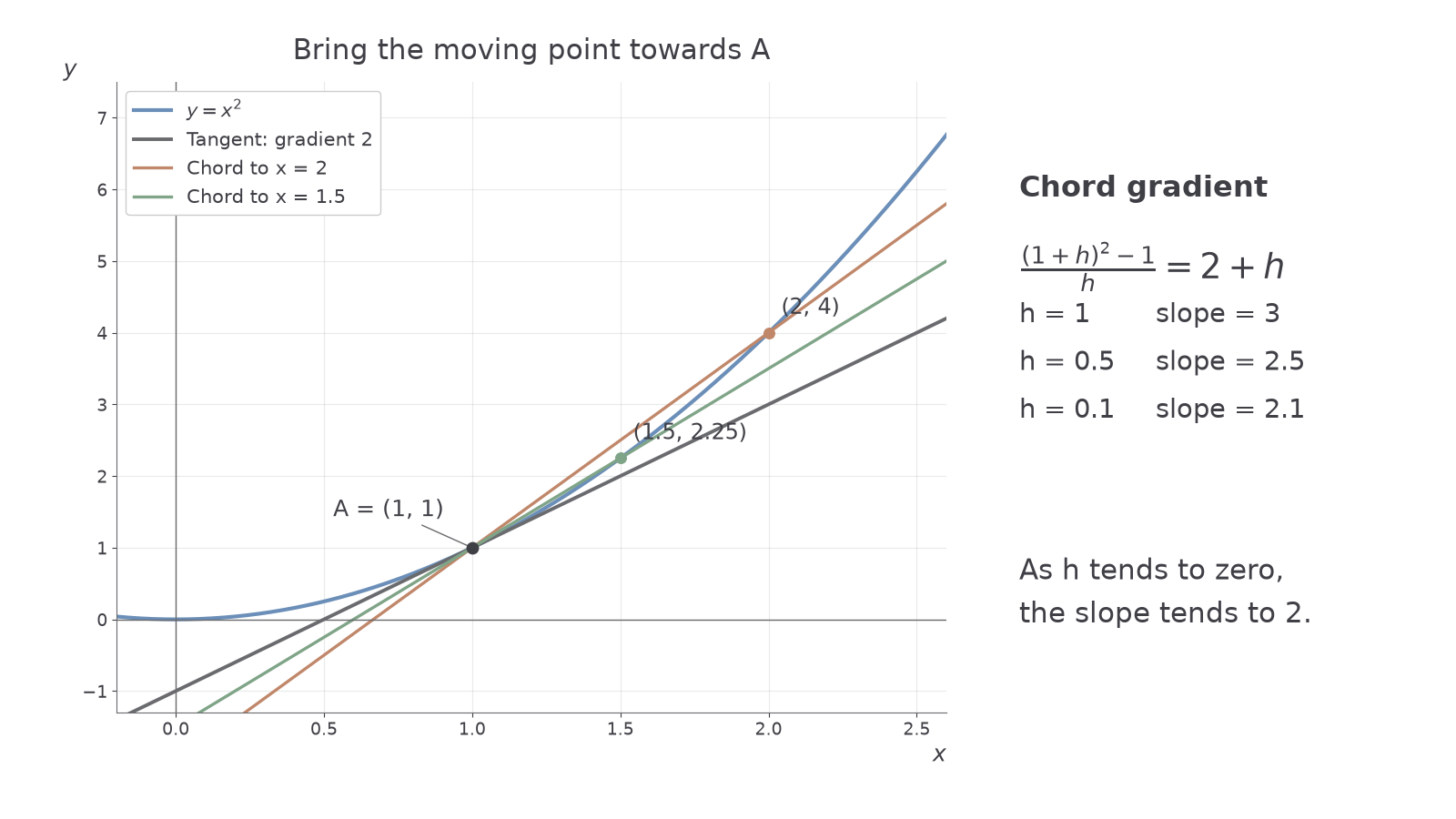
Chord and tangent
A chord joins two distinct points of a curve. At a smooth point with a finite limiting chord gradient, the tangent is the straight line through that point with that gradient. A tangent need not meet the curve only once: the tangent to at also meets the curve at .
That last fact is a useful surprise. Tangency describes what happens nearby, not how many intersections occur elsewhere. For the parabola, the limit can be established exactly rather than guessed from rounded values.
Limiting chord gradient
At , provided the same finite limit exists from both sides,
Keep while simplifying. The first-principles limit definition is in the formula sheet.
In the formula sheet.
The limit asks what values approach; it never asks you to divide zero by zero.
Worked example 1: the tangent at one
Question. For , find the chord gradient between and . Hence find the tangent gradient at .
Plan. Form the coordinate differences, cancel , then take the limit.
Why this step? Cancelling while replaces the fraction by an expression whose limit is easy to see.
Answer. The chord gradient is ; the tangent gradient is .
Check. For , the slopes are ; for , they are . Both sides agree with the algebraic limit.
Change only the fixed point in the second example. The curve and the limiting argument stay the same.
Worked example 2: moving the fixed point
Question. Find the tangent gradient to at from a chord calculation.
Plan. Use the nearby point with horizontal coordinate .
Why this step? Both coordinates of the moving point must come from the same input .
Answer. The tangent gradient is .
Check. The chord slopes for and are and , straddling .
This distinction between a nonzero increment and its limit prevents the most common first-principles error.
Watch out
Wrong: put into the unsimplified quotient. That gives , which is undefined. Right: simplify for , then find the value approached as .
Try the same curve at a point on its falling side.
The derivative at a point and as a function
Instead of finding one tangent gradient, collect all of them into a function. For , the same chord algebra at a general input gives ; taking its limit gives .
Derivative
The derivative is the function giving the tangent gradient wherever the finite derivative exists. If , write it equivalently as . The value is the gradient at the particular input , whereas is the curve's height there.
Here follows from the limit, not from a rule you must assume. A derivative formula applies only where the function is defined and differentiable. At an endpoint, a one-sided rate may exist without a two-sided derivative.
Worked example 3: height and gradient
Question. Given and , state the point and tangent gradient when .
Plan. Substitute into the function for height and into its derivative for slope.
Why this step? The two formulas answer different questions even though their input is the same.
Answer. The point is ; its tangent gradient is .
Check. The nearby chord has slope , tending to .
Change only the input to a negative number. Positive height does not force a positive slope.
Worked example 4: above the axis but falling
Question. For the same function, state the point and tangent gradient when , and interpret the sign.
Plan. Evaluate both formulas before describing the curve's direction.
Why this step? Falling or rising is decided by the derivative, not by whether the point is above the axis.
Answer. At , the tangent gradient is , so the curve is locally falling as increases.
Check. Moving from to lowers the height from to .
The symbols for differentiation are a compact name for this limiting process.
Watch out
Wrong: . The derivative is a limit of ratios of changes, not the ratio of the current coordinates. For at , but the derivative is .
You can interpret derivative information even when no complete function is given.
Rates of change and their units
A derivative acquires practical meaning when the axes measure something. Suppose a tank contains litres after minutes, for . Its volume at is litres, but its filling rate is a different quantity.
Continue this lesson.
You’re previewing NovaLearn without an account. Create a free account to read the rest.
Create free account