1.02f - Solving quadratic equations and disguised quadratics
A complicated-looking equation may hide a familiar quadratic. Learn to choose a solving method, explain why it works and separate genuine solutions from candidates introduced by your algebra.
Reversible rearrangement
How can have four real solutions, while squaring produces a candidate that is not a solution? The difference is what happens when you return to the equation you started with. Try : it satisfies both equations. By the end, you will know how to find every solution and keep only the valid ones.
You already know
Expand brackets before collecting like terms. An equation stays true if you add the same expression to both sides or multiply both sides by the same non-zero number.
A solving step should work backwards as well as forwards, or its answers need checking. For instance, implies , but also allows .
Equivalent equations
Two equations are equivalent on a stated domain if they have exactly the same solutions there. For example, and are equivalent. The equations and are not equivalent over the real numbers.
Constant denominators are straightforward: multiply every term by a common denominator. For example, gives , hence ; both given sides then equal . A variable denominator needs its excluded values recorded first.
Worked example 1: clearing a constant denominator
Question. Make the subject of .
Plan. Clear the constant denominator and isolate .
Why this step? Multiplying by a non-zero constant can be undone, so it neither loses nor adds solutions.
Answer. , with no restriction on real .
Check. At , the formula gives , and .
Now change the denominator from a constant to an expression containing the unknown. This introduces a domain restriction, even though clearing the fraction still helps.
Worked example 2: retaining a denominator restriction
Question. Make the subject of .
Plan. Record the excluded denominator, clear it, then collect and factor the terms containing .
Why this step? Factoring collects both appearances of the subject. At , the preceding line would be , so there is no missing solution to recover.
Answer. , with .
Check. Taking gives , and . Also .
Squares and reciprocals require the same care. If , with and , then and . Without , both signs are possible. If , then , and both variables must be non-zero. These rearrangement rules are not in the formula sheet: learn them.
Watch out
Wrong: divide by and keep only . Division has discarded the possible value . Keep it by writing .
Carry the restriction alongside the algebra in your turn too.
Solving by factorisation
Factorisation turns one quadratic equation into two simpler possibilities. First put every term on one side: the other side must be zero.
Zero-product rule
For real and ,
If neither factor were zero, dividing by either would show the product could not be zero.
Not in the formula sheet: learn it.
Expand your proposed brackets to check the middle term before reading off the roots.
Worked example 3: two non-zero roots
Question. Solve .
Plan. Factorise and set each factor equal to zero.
Why this step? One zero factor is enough; both factors need not be zero together.
Answer. or .
Check. Substitution gives and .
The next quadratic has a zero constant term. That changes one root to zero, so dividing by the unknown would be especially dangerous.
Worked example 4: keeping the zero root
Question. Solve .
Plan. Take out the common factor , keeping both zero-factor cases.
Why this step? Factoring is valid even at ; division by is not.
Answer. or .
Check. The second value gives ; zero also satisfies the equation.
An equation such as does not yet have zero on one side. Expand and rearrange to ; setting either factor equal to would not solve the product equation.
Watch out
Wrong: , therefore and . The word is or: either value can make the product zero.
Try another common-factor equation, with a different non-zero root.
Completing the square and the formula
When factors are awkward, make a square or use the quadratic formula. Both methods come from the same rearrangement.
For , divide by and complete the square:
A non-negative right side allows real square roots. Taking both signs produces the formula below. Since , replacing by simply exchanges the two signs when .
Quadratic formula
For , where , the real roots, when , are
A zero discriminant gives one repeated root; a negative discriminant gives no real roots.
Not in the formula sheet: learn it.
A useful surprise: and multiply to , although neither looks like a simple reciprocal. The completed square in the first example explains their pairing.
Worked example 5: completing a monic square
Question. Solve exactly.
Plan. Make , then take both square roots.
Why this step? Both and square to ; itself means the non-negative root.
Answer. or .
Check. Each gives . Their product is .
Change only the leading coefficient, from to . Completing the square still works, but the formula now keeps the fractions under control.
Worked example 6: a non-unit leading coefficient
Question. Solve exactly.
Plan. Substitute the signed coefficients into the quadratic formula and simplify the surd.
Why this step? The denominator divides the entire numerator, including the surd.
Answer. or .
Check. Completing the square gives ; each answer makes the square .
Choose factors when you can see them, a completed square when its form is helpful, and the formula for a reliable general route. A calculator can check roots. Exact answers stay as fractions or surds.
Watch out
Wrong: . A negative coefficient must be bracketed when squared: .
Apply the formula with another leading coefficient.
Graphical solutions
A graph solves an equation by showing where the required output occurs. For , the horizontal-axis crossings solve ; another output requires a horizontal line at another height.
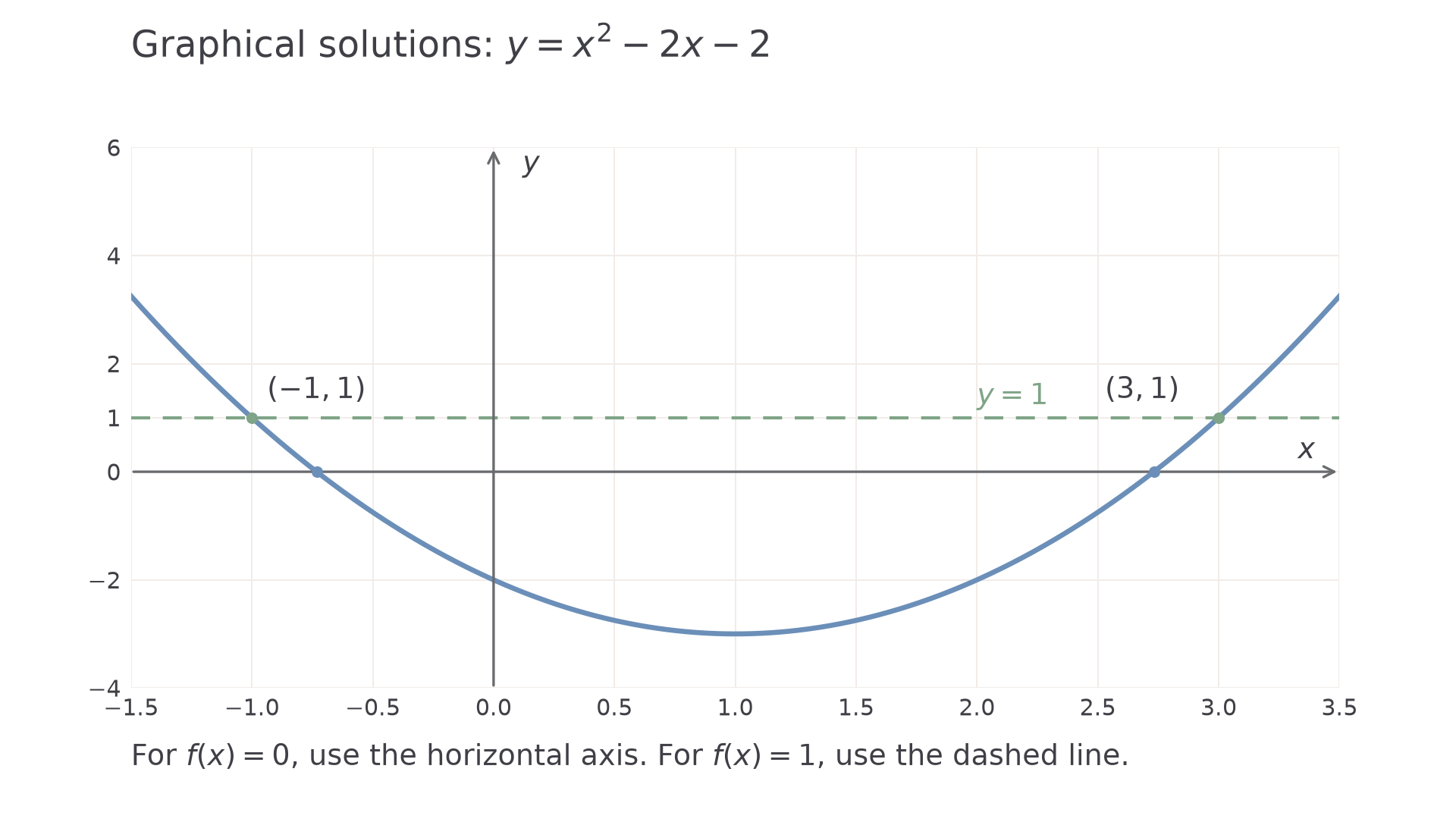
Read the horizontal coordinate of an intersection, not its height. The axes show the scale needed for an estimate.
Worked example 7: an output of zero
Question. Use the graph of to estimate the roots of .
Plan. Read the two crossings of , then check their sizes algebraically.
Why this step? An axis crossing has height zero, so it satisfies precisely the required equation.
Answer. Approximately and , to one decimal place.
Check. and , agreeing with the graph.
Change just the required output to . The curve stays put; the horizontal line moves.
Worked example 8: an output of one
Question. Use the same graph to solve .
Plan. Find where the curve meets , then check by substitution.
Why this step? The equation asks for height , so the axis crossings would answer a different question.
Answer. The graph suggests or ; algebra confirms both exactly.
Check. Each gives output in .
A graph has finite resolution. It suggests roots and their sizes, but cannot establish an exact surd. An unsuitable window may hide a crossing; use completed-square form or the discriminant when you need a complete count. Graphical solving is not a formula supplied on the formula sheet.
Exam tip
“In this question you must show detailed reasoning” requires an analytical route. A calculator's root list is useful as a check, but it does not replace the working that instruction requests.
Change the output once more and connect the picture to exact algebra.
Quadratic substitutions
Look for one repeated expression and its square. Naming that expression can turn a fourth power or fractional power into a quadratic.
Quadratic in an expression
An equation of the form , with , is quadratic in . Setting gives , subject to the possible values of .
Write the substitution's range before solving. For , . Thus becomes ; reject and obtain . This restriction is part of the method, not an optional extra.
Worked example 9: the opening fourth-power equation
Question. Solve over the real numbers.
Plan. Put , solve for , then solve each square equation for .
Why this step? The two values of each correspond to two values of , so the equation can have four real roots.
Answer. .
Check. For , ; for , .
Keep the same quadratic coefficients but change the repeated expression to the real cube root. Its inverse is cubing, not taking two square roots.
Worked example 10: a fractional-power substitution
Question. Solve , interpreting as the real cube root.
Plan. Set , solve the same quadratic, then cube each value.
Why this step? Every real has exactly one cube ; inserting a plus-or-minus sign here would invent extra candidates.
Answer. or .
Check. The cube roots are , giving and .
Substitution and its restrictions are not in the formula sheet: learn the reasoning. The final answer must use the variable asked for.
Watch out
Wrong: “ or , so or .” Those are values of the temporary variable. Reverse its definition before finishing.
Try the cube-root structure with new roots of the temporary quadratic.
Restrictions and extraneous candidates
A candidate becomes a solution only when it satisfies the given equation, including every denominator and sign condition.
For example, needs . Set to obtain . Then gives . Both work: their left sides are and . If a reciprocal substitution ever produces , reject it: no finite real gives that reciprocal.
Extraneous candidate
An extraneous candidate satisfies a transformed equation but fails the given equation. Squaring can create one because opposite numbers have the same square.
Square roots supply a second restriction: their values are non-negative, including zero. Compare the right side's sign before squaring.
Worked example 11: a non-negative right side
Question. Solve over the real numbers.
Plan. Record the necessary sign condition, square, then check every candidate.
Why this step? Squaring forgets the sign, so these are candidates until checked.
Answer. Only .
Check. , but ; reject .
Change only the sign of the right side. The squared equation will be identical, but the admissible root changes.
Worked example 12: the same square, a different solution
Question. Solve over the real numbers.
Plan. Restrict using both the radicand and right side, then square and check.
Why this step? Only lies in the required domain; the same quadratic can come from different equations.
Answer. Only .
Check. At , both sides are . At , the two sides are and , so fails.
The opening puzzle is now resolved. The fourth-power equation legitimately gives four roots when its substitution is reversed; the square-root equation keeps only a root with the right sign. These domain and candidate checks are not supplied on the formula sheet.
Watch out
Checking a candidate in the squared equation is insufficient: it was found from that equation. Check in the equation containing the root or denominator you started with.
Keep the negative right side and change the radicand for your turn.
Quick Recap
- Preserve solutions when rearranging; retain every non-zero-denominator restriction.
- Factorise an equation with zero on one side, or complete the square/use the quadratic formula.
- Graph intersections estimate roots; exact algebra establishes exact values.
- For a disguised quadratic, state the substitution's range and return to the requested variable.
- Squaring can add candidates: check them in the given equation.
The opening equations have four real roots and just one real root , respectively, because reversing their algebra imposes different conditions.