3.03m, 3.03n - Particle equilibrium and polygons of forces
Use zero resultant to solve particle-equilibrium problems with vectors, strings, inclines and simple ideal connections. You will select effective axes, interpret closed force polygons, and check whether the calculated forces can exist in the stated model.
Zero resultant and equilibrium equations
Can supporting a weight need more than of tension in each string? Yes: two almost horizontal strings supply only small upward components, even when their tensions are large. First establish what it means for all the force vectors to balance.
You already know
The resultant is a vector sum. For a particle, zero resultant gives zero acceleration, allowing either rest or constant velocity in a straight line.
The word particle matters: its size and turning effects are ignored. Concurrent forces on a body act through one point, so their balance can also be treated there. General rigid-body turning effects need further conditions studied later.
Particle equilibrium
For coplanar forces on a particle,
for two perpendicular axes. Equivalently, the resolved sum is zero in every direction. Not in the formula sheet: learn it.
“One direction” must not mean “only one direction checked”. A horizontal balance can coexist with an unbalanced vertical force.
Worked example 1: an unknown balancing force
Question. A particle is in equilibrium under only , and . Find and its magnitude exactly.
Plan. Cancel the sum of the two known vectors.
Why reverse both signs? Each perpendicular sum must be zero.
Answer. , magnitude .
Check. , .
Change only the second known force's vertical component. The unknown vector must adapt to that change alone.
Worked example 2: changing one component
Question. A particle is in equilibrium under only , and . Find and its magnitude exactly.
Plan. Recalculate the known sum before reversing it.
Why is no vertical balancing force needed? The given vertical components already sum to zero.
Answer. , magnitude .
Check. The final horizontal sum is , while the vertical sum remains zero.
An unconstrained unknown force can have either component sign. A string tension instead has a known direction and non-negative magnitude; a string cannot push.
Watch out
“Equilibrium, therefore velocity zero” adds an unsupported conclusion. Equilibrium determines acceleration zero; initial conditions determine whether the constant velocity is zero.
Use a new pair of known forces and interpret what equilibrium tells you.
A particle suspended by two strings
String tensions point away from the particle along the strings. Their vertical components support the weight; their horizontal components cancel each other.
Two-string suspension
For weight , a left string at above horizontal and a right string at above horizontal,
These are equilibrium equations for taut strings with no other forces. Not in the formula sheet: learn it.
Separate strings need not have equal tensions. Symmetry can justify equality; the word “equilibrium” alone cannot.
Worked example 3: unequal string angles
Question. A particle of weight hangs at rest from two separate light strings, left at and right at above horizontal. Find both tensions exactly.
Plan. Express one tension using horizontal balance, then substitute vertically.
Why eliminate horizontally first? There is no weight term there, giving a direct ratio of tensions.
Answer. Left tension , right tension .
Check. Upward components are and , totalling ; both tensions are positive.
Change only the weight to . The angles, equations and requested outputs remain the same.
Worked example 4: scaling the weight
Question. A particle of weight hangs at rest from two separate light strings, left at and right at above horizontal. Find both tensions exactly.
Plan. Reuse the horizontal ratio and solve the new vertical balance.
Why do both tensions scale equally? Their directions stayed fixed, so only the force scale changed.
Answer. Left tension , right tension .
Check. upwards; each tension is of its previous value.
For equal angles , horizontal balance gives equal tensions and vertical balance gives . With , needs in each string. That answers the opening puzzle. Exactly horizontal strings have zero upward component, so no finite tension can support a positive weight in this model.
Watch out
Writing adds magnitudes in different directions. It is the upward components that sum to weight.
Now change the string geometry to a symmetric arrangement.
Closed triangles and polygons of forces
Equilibrium can also be seen geometrically: force arrows placed head to tail return to the starting point.
Closed force polygon
A force polygon is a head-to-tail addition diagram for force vectors. Closure means the vector sum is zero. Its arrows keep the directions and lengths of the forces, although they are translated away from the particle.
For example, arrows from to , then to , need a closing vector , magnitude . Reading it the other way would give the opposite force and fail to close the polygon.
[DIAGRAM: asset_name: One equilibrium represented in two ways; asset_slug: suspension_force_triangle; description: Separate equal-scale panels show the three forces at the particle and their closed head-to-tail triangle for weight 60 N and string angles 30 and 60 degrees; caption: The same three equilibrium forces at a particle and in a closed triangle]
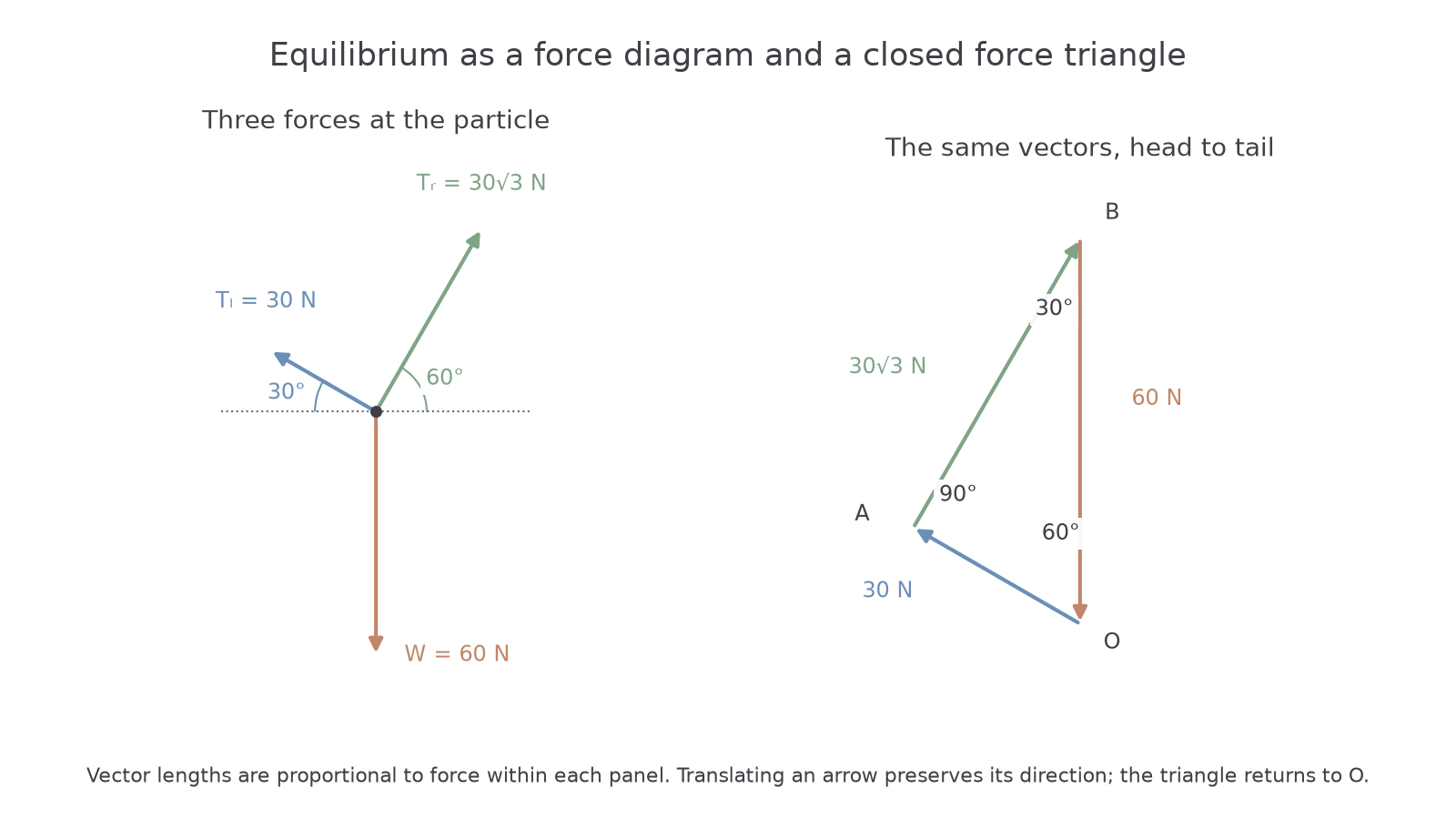
In the diagram, vectors , and newtons close. A triangle of forces lets you use the sine rule, which is not in the formula sheet and must be learnt.
Continue this lesson.
You’re previewing NovaLearn without an account. Create a free account to read the rest.
Create free account