3.02a–3.02c - Motion language and kinematics graphs
Describe motion along a straight line using position, displacement, distance, velocity, speed and acceleration. Use graph gradients and signed areas to reconstruct a journey, including stops and reversals.
Position, displacement and distance
Can you travel all afternoon and still have zero average velocity? Walk from your front door to a shop and back: your legs record a journey, but your overall change of position is zero. A surprisingly busy journey can have the same average velocity as staying at home.
You already know
A scalar has magnitude; a vector also has direction. On a line, choose an origin and a positive direction, then use signs to record direction. A negative coordinate is a place on the line, not a negative length.
Take right as positive. Starting at coordinate , moving metres right and metres left ends at coordinate . The change is metres, although the route is metres long.
Position and travel
Position locates a particle relative to an origin. Displacement is final position minus initial position; it is a vector. Distance from the origin is the magnitude of position. Distance travelled is the total route length, a non-negative scalar. Returning to the start gives zero displacement, not necessarily zero distance travelled.
Divide the appropriate journey total by the whole elapsed time, including rests.
Average velocity and average speed
For elapsed time ,
These averages need not equal the value at any particular instant.
Not in the formula sheet: learn it.
Keep the route and the coordinate change on separate lines.
Worked example 1: a return leg
Question. A walker starts at , goes right and left in . Find the final position, displacement, distance travelled, average velocity and average speed.
Plan. Add signed movements for position and unsigned leg lengths for travel.
Why separate these totals? Returning cancels displacement but does not undo travel.
Answer. Final position , displacement , distance , average velocity , average speed .
Check. Distance exceeds displacement magnitude ; the final distance from the origin is .
Change only the return-leg length to . The requested quantities and elapsed time stay the same.
Worked example 2: back to the start
Question. The walker starts at , goes right and left in . Find the same five quantities.
Plan. Recalculate the signed change and route length separately.
Why is average velocity zero? Its numerator measures the endpoint change alone.
Answer. , , , and , respectively.
Check. The final position equals the initial position, yet the distance is positive.
An equation of motion relates motion quantities, such as position and time. Its origin, direction and time interval are part of its meaning.
Watch out
Wrong: “Average velocity is final position divided by time.” Correct: use final minus initial position divided by elapsed time. The origin can be moved without changing the journey's displacement.
Now extend the return leg once more.
Velocity, speed and acceleration signs
A negative acceleration can make a particle speed up: it depends on which way the particle is already moving.
Velocity, speed and acceleration
Velocity is the rate of change of position or displacement. Speed is the magnitude , a scalar. Acceleration is the rate of change of velocity, a vector; its magnitude is . At rest means , whereas constant velocity means throughout an interval.
Changing steadily from to in gives average acceleration . The particle moves left but slows. Reversing those endpoint velocities gives acceleration : now the leftward motion speeds up. Both accelerations have magnitude .
More generally, average acceleration is velocity change divided by elapsed time; this rate definition is not in the formula sheet. When , equal signs of velocity and acceleration mean increasing speed; opposite signs mean decreasing speed. Analyse either side of a reversal separately. At its highest point, a freely moving ball can have zero velocity and non-zero downward acceleration.
Key idea
The sign of acceleration tells you how velocity changes. Combine it with the velocity sign before deciding how speed changes.
Try the sign decision without relying on the everyday word “deceleration”.
Velocity from a displacement graph
Read a motion graph as a record of quantities against time, not as a picture of a road.
[DIAGRAM: asset_name: Piecewise displacement against time; asset_slug: displacement_segments; description: Displacement-time graph through (0,0), (2,6), (4,6) and (7,0), with time in seconds and displacement in metres; caption: Piecewise displacement against time]
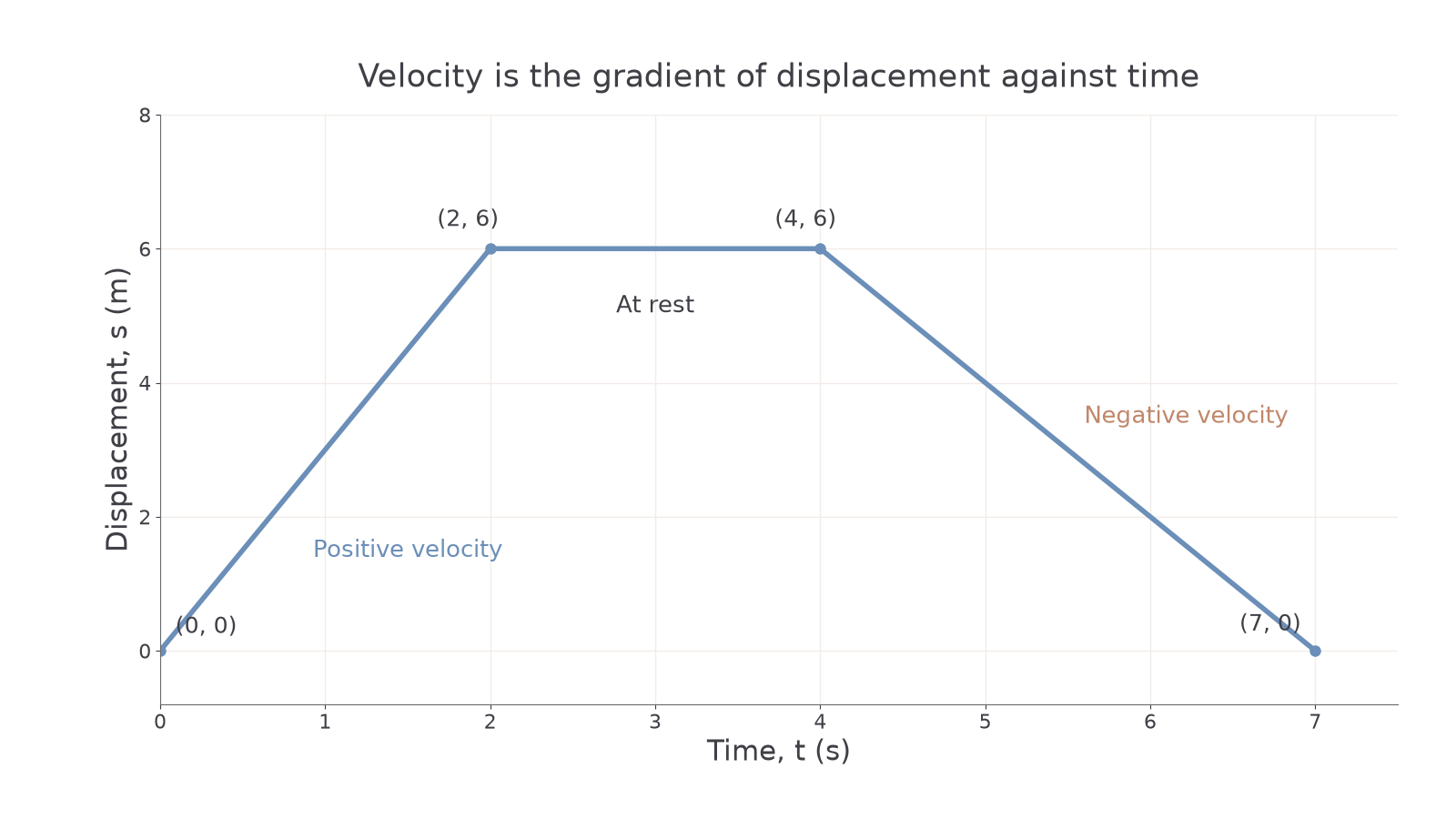
The first segment gains in , so its velocity is . The plateau means rest; the final descent means negative velocity, not travelling downhill.
Continue this lesson.
You’re previewing NovaLearn without an account. Create a free account to read the rest.
Create free account