1.06a, 1.06b - Exponential functions and the number e
Read exponential graphs as repeated multiplication, distinguish growth from decay, and explain the special role of the number . Use its gradient property to connect a graph's height with its rate of change.
Positive bases and repeated multiplication
Can a quantity keep growing faster while its percentage rate stays fixed? Start with 100 organisms: multiplying by each year gives 110, then 121. The increases are different, but the multiplier is unchanged.
You already know
The index laws give , and for . A geometric sequence uses a fixed multiplier between successive terms.
Let the input vary continuously instead of taking only integer values.
Positive-base exponential
An exponential function has a fixed positive base and a variable exponent . For example, is exponential; is a power function.
Negative bases fail for some real inputs: has no real value. Zero also fails to give an all-real-input exponential. Positive bases give the following complete picture.
Exponential graph features
For , and . If ,
The graph increases for and decreases for . For , it is the constant , with range .
Not in the formula sheet: learn it.
The base is also the multiplier for a unit step along the horizontal axis.
Worked example 1: a growth graph
Question. Find the values of for , and state its main graph features.
Plan. Use negative and zero indices, then read growth from the base.
Why this step? Points on both sides of zero show that positive outputs can be less than 1.
Answer. The graph increases, crosses the vertical axis at , has domain , range , and horizontal asymptote as .
Check. Each successive output is twice the previous output.
Change just the base to its reciprocal; the graph reverses horizontally.
Worked example 2: a decay graph
Question. Give the same values and features for .
Plan. Rewrite the function as .
Why this step? Replacing by reflects the growth graph in the vertical axis.
Answer. It decreases through , with domain , range and asymptote as .
Check. Each unit step multiplies the output by ; it never makes a positive output zero.
The picture includes the separate constant case, which has no growth or decay.
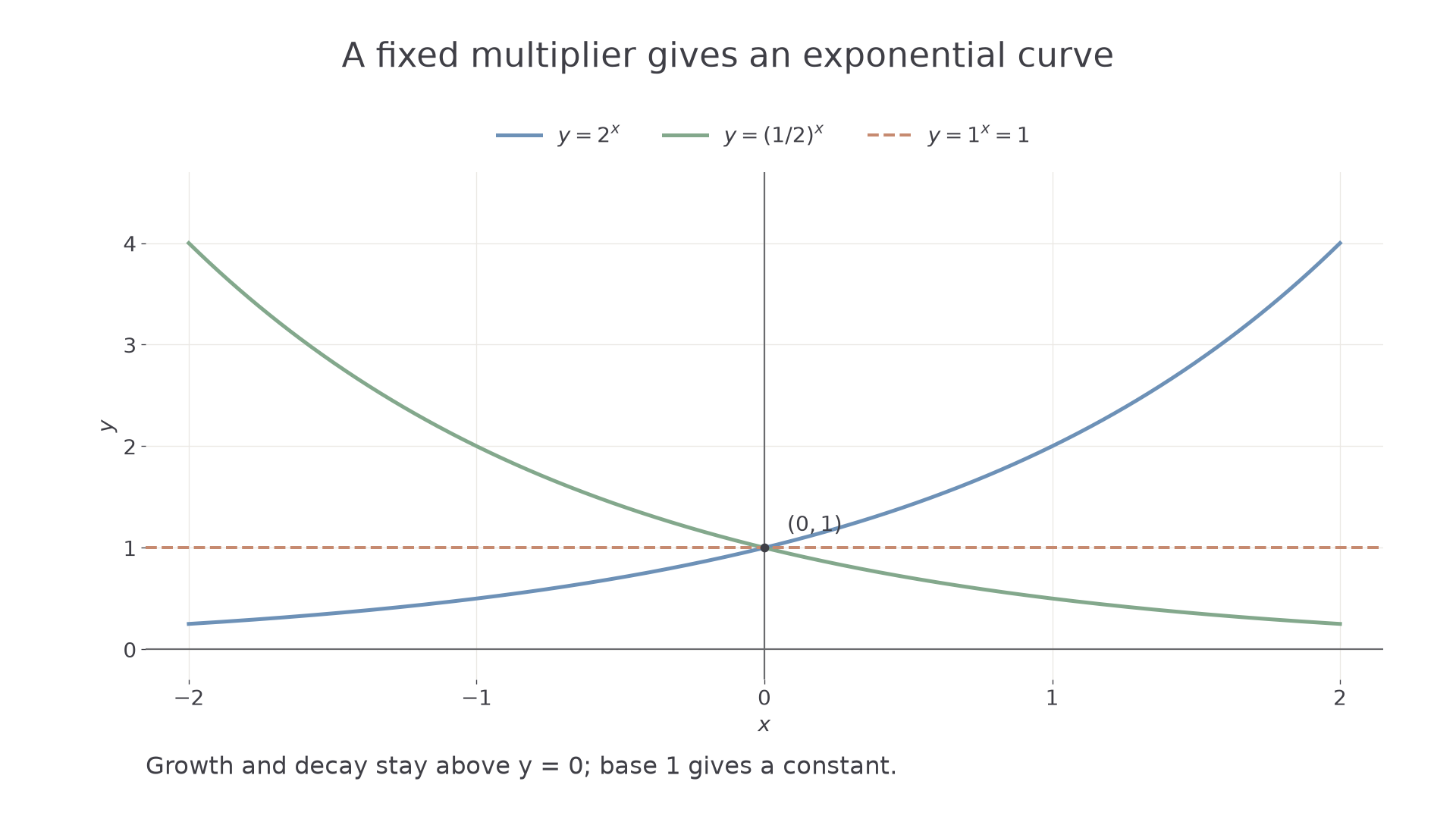
At integer years, is a geometric model. Using the same expression between whole years assumes smooth exponential change between observations.
Watch out
A decreasing exponential does not become negative. For , for every real ; its rate of change is negative, not its value.
Try a new reciprocal base.
The number e and its graph
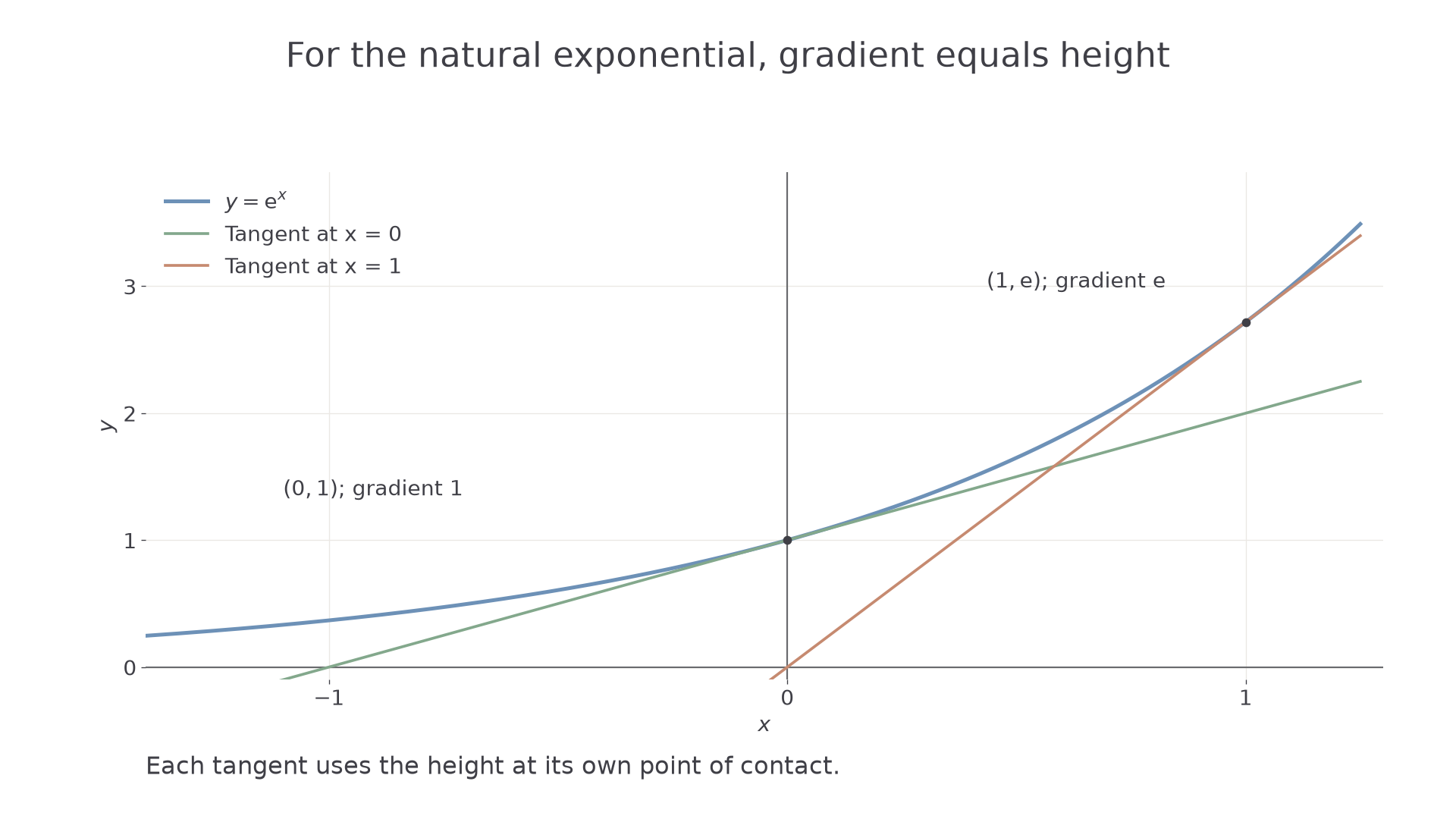
One base makes the graph's gradient equal its height at every point: .
Natural exponential
The natural exponential is . It increases through , has domain , range , and horizontal asymptote towards the left.
Here, gradient means the slope of the tangent: the instantaneous rate of change. We use its known value now; systematic differentiation comes later.
Height and gradient
For every real , the gradient of is .
Not in the formula sheet: learn it.
Near zero, the chord gradients and approach 1 from either side. These illustrate the property; two numerical checks do not prove it.
Worked example 3: the tangent at zero
Question. Find the tangent to at .
Plan. Use the function value for both the height and the tangent gradient.
Why this step? The same output supplies both numbers needed for a tangent line.
Answer. .
Check. The line passes through with gradient 1; it is not the whole curved graph.
Move only the point of contact to .
Worked example 4: a tangent through the origin
Question. Find the tangent to at .
Plan. Repeat the height-and-gradient argument at the new input.
Why this step? Keeping exact makes the cancellation visible.
Answer. ; surprisingly, this tangent passes through the origin even though the exponential never does.
Check. At , the line gives ; at , it gives zero.
The tangent and the curve agree at their point of contact, rather than everywhere.
Use the same property at a negative input.
Continue this lesson.
You’re previewing NovaLearn without an account. Create a free account to read the rest.
Create free account