1.03f - Circle intersections, chords and tangents
Turn circle geometry into exact coordinate arguments. You will use diameters, chords and radii to find right angles and tangents, then decide exactly where a line or another circle meets a circle.
Diameters and right angles
Can you find the tangent at on without differentiating? The radius already contains the answer. First, notice how much information a diameter gives: joining its endpoints to any other point on the circumference always makes a right angle, even when the triangle looks quite lopsided.
You already know
The midpoint of two points is found by averaging their coordinates. Squared distance is ; non-vertical perpendicular lines have gradients whose product is .
A diameter passes through the centre; a chord need not. The location of the third point matters as much as the diameter.
Angle in a semicircle
If and are the endpoints of a diameter and is another point on the same circle, then . A point inside the circle does not satisfy this condition.
Here is why. Join the centre to . The equal radii make and isosceles. For on the upper semicircle, call their base angles and . The angles of are , and , so . Reflection gives the same result below the diameter. The endpoints themselves would make a degenerate triangle. This circle theorem is not in the formula sheet: learn it.
Worked example 1: check the circle first
Question. The diameter endpoints are , . Show that lies on their circle and find .
Plan. Find the centre and radius, check membership, then apply the semicircle theorem.
Why this step? A right-angle claim needs on this circle, not simply near it.
Answer. lies on the circle and .
Check. and ; their product is . Also , , .
Now translate every point by . Only the position changes; lengths and the right angle survive.
Worked example 2: a translated diameter
Question. The diameter endpoints are , . Show that lies on their circle and find .
Plan. Work relative to the translated centre.
Why this step? The circle equation uses displacement from its centre, not distance from the origin.
Answer. is on the circle and .
Check. The two gradients are still and ; translation has not changed their product.
The theorem gives the angle only after its geometric conditions have been established.
Watch out
Wrong: “ is the longest side, so .” Right: establish that is a diameter and is on its circle. A longest side alone proves nothing about a right angle.
Try a different translation and radius.
Chords and perpendicular bisectors
A perpendicular from the centre cuts a chord into equal halves. This turns a whole-circle problem into one right triangle.
Chord and its bisector
A chord joins two points on a circle. The perpendicular from the centre to a chord bisects the chord; conversely, the perpendicular bisector of a chord passes through the centre.
To justify this, let be the perpendicular foot from to chord . Right triangles and share and have equal hypotenuses . They are congruent, so .
Chord length
For a circle of radius , with a chord at perpendicular distance from its centre,
At the endpoints coincide at a tangent point; gives no intersection. Not in the formula sheet: learn it.
The factor of restores the second half of the chord.
Worked example 3: a horizontal chord
Question. Find the length of the chord on in .
Plan. Use the perpendicular distance from the centre to find half the chord.
Why this step? The radius joins the centre to an endpoint, so it is the hypotenuse, not the perpendicular distance.
Answer. The chord has length .
Check. Substitution gives endpoints , , exactly apart.
Rotate the chord while keeping its distance from the centre equal to . Its length should stay the same; orientation is the only changed feature.
Worked example 4: a tilted chord
Question. Find the length of the chord on in .
Plan. Find its midpoint by intersecting the chord with its centre-perpendicular, then use Pythagoras.
Why this step? The midpoint is where the centre-perpendicular meets the chord; it is not usually an axis intercept.
Answer. The chord again has length .
Check. Its endpoints are , . Both satisfy both equations and are apart.
For a diameter, and the same formula gives , as it should.
Watch out
Wrong: . That is the half-length. Right: .
The next chord changes the centre-distance while keeping the radius.
A radius determines the tangent
A tangent meets a non-degenerate circle at exactly one point. At that point it is perpendicular to the radius, so you already know its direction.
[DIAGRAM: asset_name: A bisected chord and a perpendicular tangent; caption: A bisected chord and a perpendicular tangent; asset_slug: h240-chord-tangent; description: Equal-scale circles of radius 5 show chord y equals 3 bisected by OM at 0 comma 3, and a tangent 3x plus 4y equals 25 at P 3 comma 4 perpendicular to radius OP]
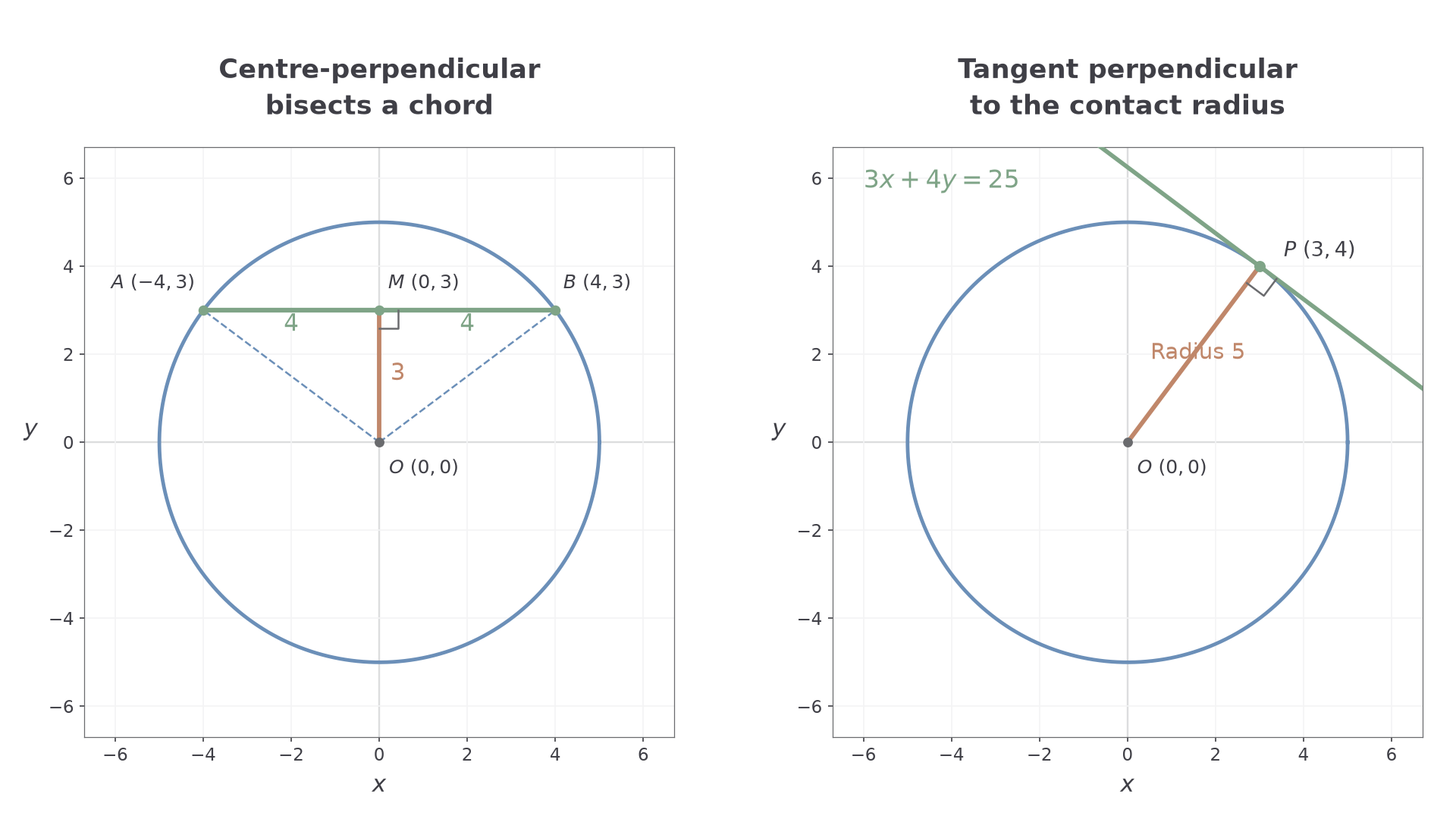
The left panel uses the centre-perpendicular inside the circle. The right panel reaches the circumference: any other point on that tangent is farther than from the centre, by Pythagoras.
Tangent direction
For a finite, non-zero radius gradient ,
A vertical radius has a horizontal tangent; a horizontal radius has a vertical tangent. Not in the formula sheet: learn it.
Check the proposed contact point before writing a tangent equation.
Worked example 5: the opening tangent
Question. Find the tangent at to .
Plan. Find the radius gradient, take its negative reciprocal and use the contact point.
Why this step? The gradient determines a family of parallel lines; the contact point picks the tangent.
Answer. . No differentiation was needed.
Check. The point satisfies the line and .
Translate the circle and contact point by . Only their location changes.
Worked example 6: the translated tangent
Question. Find the tangent at to .
Plan. Measure the radius from , then form the perpendicular line.
Why this step? Using for the radius gradient would incorrectly measure from the origin.
Answer. .
Check. At , ; the direction is unchanged by translation.
At the top point of this circle the tangent is . At its rightmost point it is . Use geometry directly in these boundary cases.
Watch out
Wrong: a horizontal radius gives tangent gradient . Right: its tangent is vertical, so write .
Keep the radius displacement , but move the centre again.
Line–circle intersections and tangency
A common point must satisfy both equations. Substitute the line into the circle, solve the resulting quadratic, then pair each root with its own second coordinate.
Counting line–circle intersections
After valid substitution into a non-degenerate circle, a genuine quadratic with discriminant has
Not in the formula sheet: learn it.
A sketch helps you anticipate the answer, but exact algebra separates a tangent from two nearby intersections.
Worked example 7: two common points
Question. Find the intersections of and .
Plan. Replace by , factorise, then recover both coordinate pairs.
Why this step? Dividing by would lose the valid root .
Answer. The intersections are and .
Check. The circle gives and ; both pairs satisfy .
Change only the line's intercept: . This moves the line through the centre; keep both square-root signs.
Worked example 8: a line through the centre
Question. Investigate the intersections of the same circle with .
Plan. Substitute and decide how many distinct real roots remain.
Why this step? A line through the centre has two intersections, not a repeated root: moving the intercept need not move the line towards tangency.
Answer. There are two intersections, , with matching signs.
Check. Each displacement from the centre has squared components and , totalling .
For an actual tangent example, on gives : one point, . Moving to gives : none. Vertical lines work by substituting instead.
Exam tip
For “Show that” or detailed reasoning, display the substitution and quadratic argument. A calculator's root count alone does not establish tangency.
Try another intercept in the same family; give full pairs, not just roots.
Two-circle intersections
Subtracting circle equations eliminates both squared terms. The resulting line contains their common points; its other points need not belong to either circle.
Worked example 9: equal circles crossing
Question. Find the intersections of and .
Plan. Expand and subtract, then substitute the resulting line into one circle.
Why this step? Subtraction identifies a line of possible common points; substitution finds the actual points on it.
Answer. and .
Check. For either point, and .
Move only the second centre from to . The circles now just touch.
Worked example 10: external tangency
Question. Investigate and .
Plan. Use the same elimination and count the surviving points.
Why this step? gives one value, not two distinct signs.
Answer. The circles are tangent at .
Check. Their centres are apart, equal to the sum of the radii .
The triangle formed by the two centres and an intersection explains the full geometric classification.
Two-circle intersection conditions
For different centres separated by , with radii , there are two intersections exactly when
Equality at either bound gives tangency. Outside these bounds there is no intersection. If the centres coincide, equal radii give the same circle; unequal radii give no intersection. Not in the formula sheet: learn it.
A second centre at would put the circles farther apart than their radius sum, so no common point is possible. Internal separation matters too: a small circle can sit entirely inside another.
Watch out
Wrong: “The centre-distance is less than the radius sum, so the circles cross.” Right: also check ; otherwise one circle may lie wholly inside the other.
This last investigation changes the second centre again.
Quick Recap
- A diameter subtends a right angle at another point on the circumference.
- The centre-perpendicular bisects a chord; double the half-length from Pythagoras.
- A tangent is perpendicular to its contact radius, including horizontal and vertical cases.
- Solve a line and circle by substitution; a repeated root identifies tangency.
- Subtract two circle equations, then substitute back; compare centre-distance with both the radius sum and difference.
The opening tangent is : its gradient is perpendicular to the radius gradient .