3.02h, 3.02i - Projectile motion and trajectories
Use independent horizontal and vertical components to predict a projectile's flight under gravity. Find position, speed and direction, choose the correct landing level, recover a launch velocity and derive the Cartesian trajectory with the limits of the model in view.
Assumptions and component equations
If one ball is dropped and another is launched horizontally from the same height at the same instant, which reaches level ground first? In the no-air-resistance model, they land together. Horizontal motion adds travel, not falling time: both balls share the same vertical motion.
For example, from above ground, with , each ball has height . Both reach ground after one second, however different their horizontal speeds. That surprising prediction depends on the assumptions; it is not a claim that drag never matters.
You already know
Resolve an initial speed at angle above the horizontal into and . Constant-acceleration equations apply separately along perpendicular axes over the same time.
Treat the projectile as a particle, ignoring its size, spin and deformation. After release, neglect propulsion and air resistance. Horizontal distances are small enough for gravity to have one direction; vertical distances are small enough for its magnitude to stay constant. Choose horizontally right and vertically upwards.
Projectile model
A projectile is modelled as a particle moving under gravity alone during flight. Its acceleration is . Horizontal acceleration is zero; vertical acceleration is downward even at the highest point.
The model is useful for a compact ball over a short flight, but can be poor for a light object with a large area. A real refinement must alter the equations appropriately. Qualitative comments about drag do not justify using the no-drag equations for a drag calculation.
Component equations from constant acceleration
With initial position , initial velocity , upwards positive and ,
These specialise the supplied constant-acceleration equations to ; the projectile forms themselves are not printed. Not in the formula sheet: learn it.
Use the specified value of , or if none is stated. Every example below explicitly states when a different value is used.
Worked example 1: launching horizontally
Question. A ball is launched horizontally at from above level ground. Neglect air resistance and use . Taking the ground directly below launch as origin, form its position equation and find its landing time and horizontal travel.
Plan. Set initial vertical velocity to zero and solve the vertical ground equation before using horizontal motion.
Why this step? The ground condition is vertical. Horizontal speed cannot change the time obtained from that equation.
Answer. , for ; landing time is , and horizontal travel is .
Check. At one second the height is zero and the horizontal coordinate is eight metres. The negative quadratic root is before launch.
Change only the horizontal launch speed to twelve metres per second. Keep the same three requests.
Worked example 2: faster sideways, same fall
Question. A ball is launched horizontally at from above level ground. Neglect air resistance and use . Taking the ground directly below launch as origin, form its position equation and find its landing time and horizontal travel.
Plan. Reuse the unchanged vertical equation, then apply the new horizontal velocity.
Why this step? Horizontal and vertical displacements differ, but the flight clock is shared.
Answer. , ; landing time is , and horizontal travel is .
Check. Increasing only horizontal speed has left the fall time unchanged, as the opening prediction requires.
Choosing downwards positive would give positive gravitational acceleration; all vertical coordinates and initial components must then follow that convention consistently.
Watch out
Wrong: a horizontal launch has . Right: it has , but with upwards positive.
Try another horizontal speed, using the stated model rather than a different value of gravity.
Position, speed and direction during flight
A position vector points from the origin; a velocity vector points along the motion. Use the latter to find the direction of flight.
For a launch from the origin, using , the equations are , and . The two components in each vector must use the same time.
Speed and direction from components
For ,
Use the component signs to state the quadrant and the angle's reference direction. These are applications of Pythagoras and trigonometry. Not in the formula sheet: learn it.
For rightward flight, positive means above horizontal and negative means below. A purely vertical velocity needs a vertical direction statement instead of division by zero.
Worked example 3: on the way up
Question. A particle is launched from the origin with velocity . Neglect air resistance and use . Find position, velocity, exact speed and direction after , giving the direction angle to one decimal place.
Plan. Substitute time into position and velocity separately, then use the velocity components for speed and angle.
Why this step? Using would give the position-vector angle, not the direction in which the particle is moving.
Answer. Position is , velocity is , speed is , and direction is above horizontal.
Check. The positive vertical velocity confirms that the particle is rising at this instant.
Change only the observation time to two seconds. The particle has passed its highest point, so the direction statement must change.
Worked example 4: on the way down
Question. For the same launch , no air resistance and , find position, velocity, exact speed and direction after . Give the direction angle to one decimal place.
Plan. Evaluate the same equations and use the sign of the new vertical velocity.
Why this step? A positive height does not imply upward motion; this particle is above launch level but descending.
Answer. Position is , velocity is , speed is , and direction is below horizontal.
Check. At horizontal coordinate , the horizontal equation gives , matching the observation time.
At a specified position, first recover a permissible time. A given height may produce two times, one rising and one falling; retain both unless the question selects a branch. Discard times before release or after first impact. At the apex only the vertical velocity is zero; acceleration is still .
Watch out
Wrong: set the whole velocity to zero at the highest point. Right: set ; an oblique projectile retains its horizontal velocity.
Observe the same launch one second later again, still before its return to level ground.
Flight time, horizontal range and greatest height
Landing level determines flight time; zero vertical velocity determines the highest point, provided it is reached before impact.
With launch height , solve and choose the first post-launch impact. For , horizontal range is . It is not the magnitude of the final position vector or the length of the curved flight.
Same-level flight and greatest rise
If , , there is no earlier obstruction and landing is at launch level,
Here is rise above launch; greatest height above the chosen ground is , if the apex is reached. These follow from the component equations. Not in the formula sheet: learn it.
The flight-time result comes from , rejecting the release time . At the apex ; substituting into height gives . For launch speed at , the same-level range becomes . Since , fixed-speed range on that level is greatest at . This derived result is not printed in the sheet and does not apply unchanged to unequal landing levels.
[DIAGRAM: asset_name: A projectile with horizontal velocity at its apex; asset_slug: projectile_flight; description: Equal-scale trajectory x=12t, y=16t-5t squared from launch to same-level landing at x=38.4 metres, with apex (19.2,12.8), upward-right launch tangent and horizontal apex velocity; caption: A projectile with horizontal velocity at its apex]
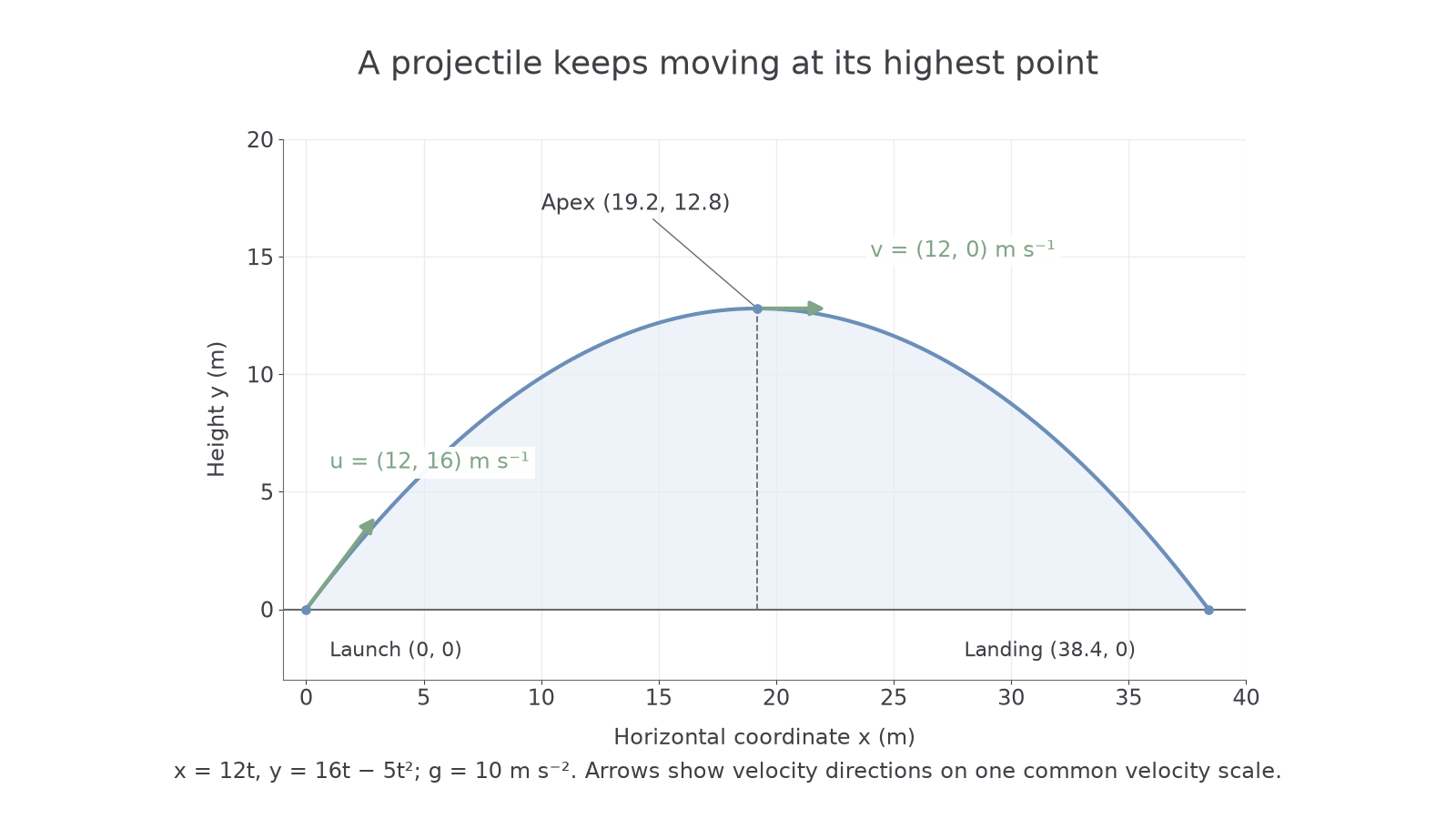
The diagram uses and . It has , , and , in SI units. The speed at the apex is still .
Continue this lesson.
You’re previewing NovaLearn without an account. Create a free account to read the rest.
Create free account