1.05a, 1.05f, 1.05g - The unit circle, exact values and trigonometric graphs
Use a rotating radius to define trigonometric functions for any angle, obtain exact values with the correct signs, and connect these values to the shape and transformations of their graphs.
Coordinates on the unit circle
A wheel turns through . Where is a point on its rim relative to the centre, and how does that position repeat as the wheel keeps turning? Start with a radius of one unit: the point is units left and unit up. A circle lets trigonometry keep working after the right triangle has apparently disappeared.
You already know
In a right-angled triangle, sine is opposite over hypotenuse, cosine is adjacent over hypotenuse and tangent is opposite over adjacent. Pythagoras gives on a circle of radius .
Keep the coordinate signs. Distances are positive, but a point left of the origin has a negative horizontal coordinate.
Unit circle
The circle with centre and radius . Measure anticlockwise from the positive horizontal axis; clockwise rotations are negative. If the radius ends at , then , and when .
In the first quadrant these definitions agree with right-triangle ratios because the hypotenuse is . In every other quadrant the coordinates supply the signs.
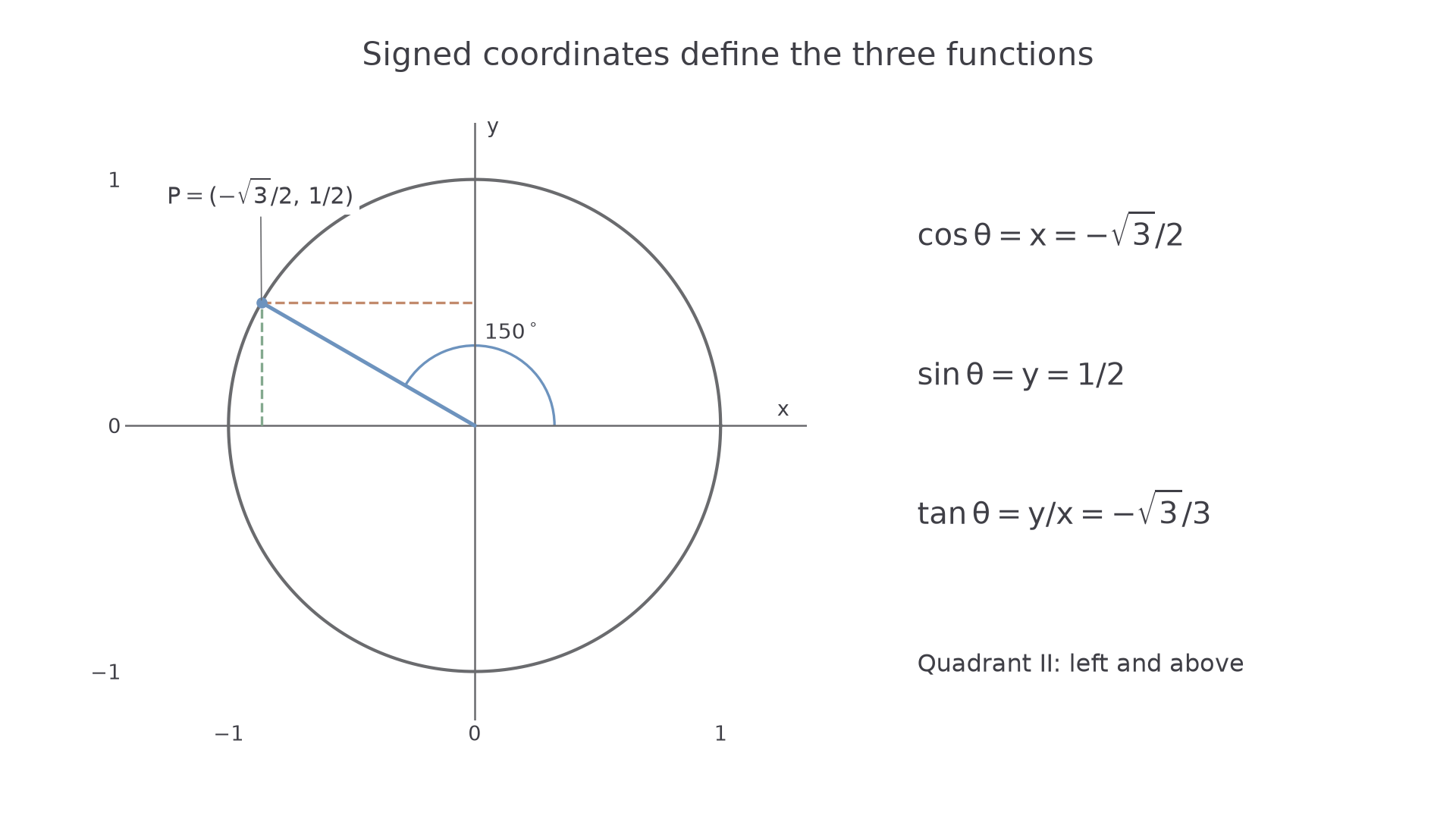
Sine and cosine exist for every real angle. Tangent does not exist where the horizontal coordinate is zero: , for integer . It is undefined there, rather than a large finite number. The coordinate definitions are not in the formula sheet: learn them.
| Quadrant | Cosine | Sine | Tangent |
|---|---|---|---|
| I | positive | positive | positive |
| II | negative | positive | negative |
| III | negative | negative | positive |
| IV | positive | negative | negative |
A surprising economy: the circle stores three functions using just two coordinates. Opposite endpoints reverse both coordinates, but their tangent ratios are equal.
Worked example 1: read the coordinates
Question. A unit radius ends at . Find , and .
Plan. Read sine and cosine from the vertical and horizontal coordinates, then divide in that order for tangent.
Why this order? Tangent is ; swapping the coordinates would give its reciprocal.
Answer. , , .
Check. , so the point is on the unit circle; two negative coordinates give positive tangent.
Change only the sign of the vertical coordinate. The radius moves from quadrant III to quadrant II, so sine and tangent change sign while cosine stays fixed.
Worked example 2: reflect the endpoint
Question. A unit radius ends at . Find the three trigonometric values.
Plan. Use the same coordinate definitions, retaining the new sign.
Why retain the signs? A reference triangle supplies lengths but cannot tell you which side of each axis the point lies.
Answer. , , .
Check. This point is left and above the origin: cosine must be negative and sine positive.
You can check a sign before doing any arithmetic.
Watch out
Wrong: whenever the reference triangle has legs and . Right: use signed coordinates; in quadrant II the tangent is negative.
Try a point in quadrant IV; the coordinate fractions have changed, but the decision has not.
Exact values and reference angles
Two small triangles supply the exact magnitudes; the unit circle supplies the signs and axis values.
An isosceles right triangle with legs has hypotenuse . Bisecting an equilateral triangle of side gives sides . Thus the familiar ratios follow from Pythagoras, rather than a calculator's rounded display. Divide sine by cosine to obtain tangent.
Exact familiar values
The equivalent radian angles are , because radians.
Not in the formula sheet: learn it.
At the endpoint is ; at it is ; at it is . Read axis values directly: there is no acute reference triangle at an axis. The radians lesson explains the angle unit geometrically; here you only need the equivalent positions.
Reference angle
The acute angle between a radius and the horizontal axis. For example, has reference angle . It gives the magnitudes of sine and cosine; the quadrant gives their signs.
Remove whole turns first, then identify the quadrant. Reducing sine or cosine by half a turn reverses their signs, so it cannot be treated as the same angle.
Worked example 3: an exact angle in quadrant II
Question. Find the exact sine, cosine and tangent of .
Plan. Locate the angle, use its reference angle , then attach the coordinate signs.
Why use a reference angle? The special triangle tells you the exact size without losing the quadrant information.
Answer. The values are , respectively.
Check. , matching the wheel's endpoint in the diagram.
Now subtract one complete turn from the argument. This changes how the radius reaches the point, but not its endpoint.
Worked example 4: a negative argument
Question. Find the exact sine, cosine and tangent of .
Plan. Add to obtain a familiar angle in one turn.
Why a full turn? Both coordinates repeat after ; subtracting only would reach the opposite point.
Answer. The values are again .
Check. The clockwise turn is , finishing in quadrant II, where sine is positive.
An exact answer keeps its fractions and surds.
Watch out
Wrong: because the argument is negative. Right: locate the endpoint; a negative rotation can finish above the horizontal axis.
Continue this lesson.
You’re previewing NovaLearn without an account. Create a free account to read the rest.
Create free account