1.01d - Proof by contradiction
Some claims become easier when you temporarily assume their opposite. Learn to turn that assumption into a precise conflict, including the proofs that is irrational and that there are infinitely many primes. You will then use familiar rational-number properties to build fresh contradiction arguments.
Assume the opposite and find the conflict
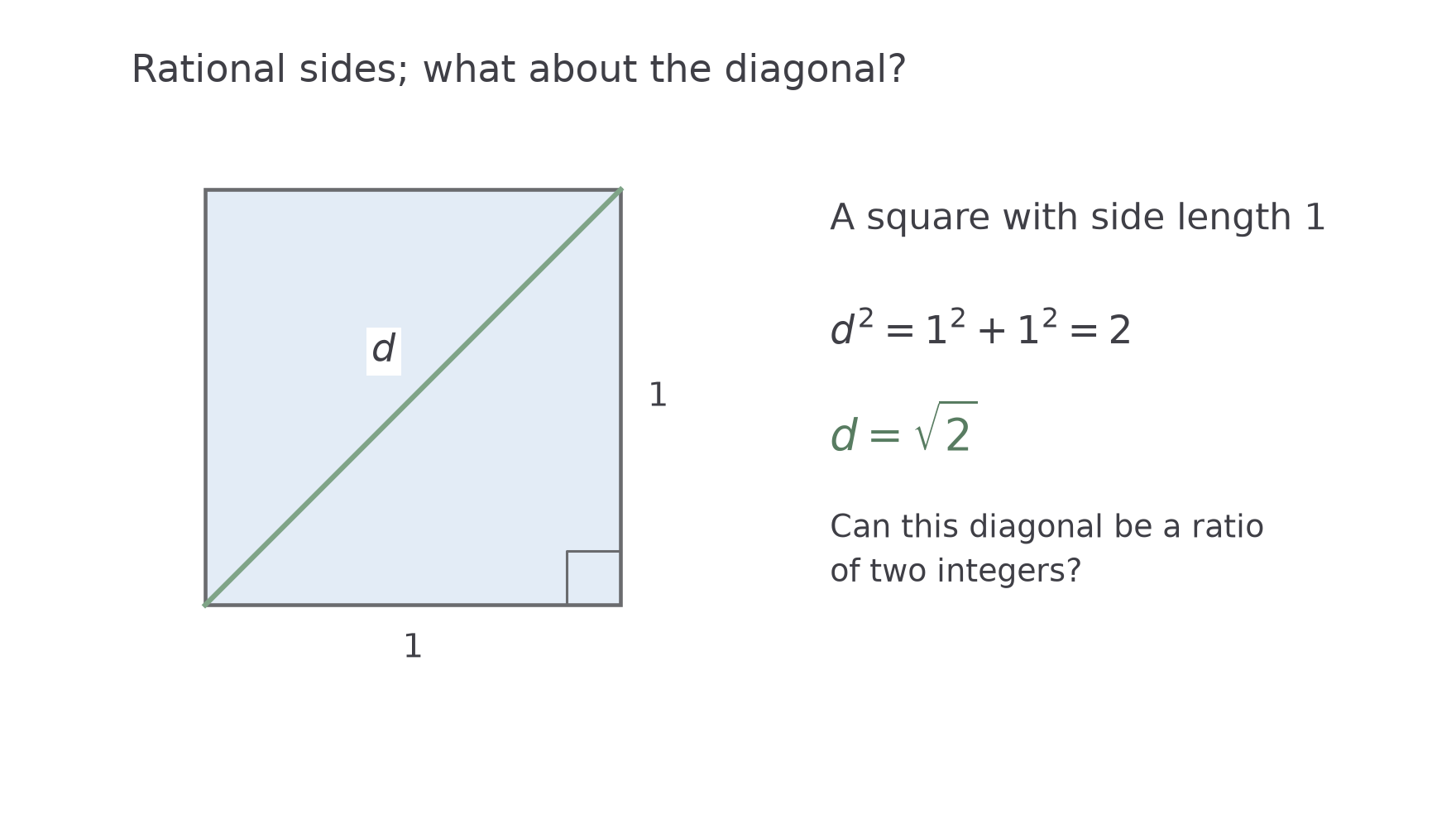
Can the diagonal of a square with side length equal a fraction, perhaps with an enormous denominator? Pythagoras gives its length as , approximately . No matter how many digits you calculate, a decimal display cannot settle whether an exact fractional representation exists.
You already know
A rational number is for integers , with . An irrational number is real but has no such representation. Pythagoras gives the square of a right-angled triangle's hypotenuse as the sum of the squares of its other sides.
The picture identifies the exact length. The proof must decide what kind of number that length is.
[DIAGRAM: asset_name: The diagonal of a unit square; asset_slug: h240_proof_square_diagonal; caption: A unit square has diagonal length square root of two; description: An equal-scale square has bottom and right side lengths 1, a sage diagonal d from bottom left to top right and a right-angle marker at bottom right. Alongside it, d squared equals 1 squared plus 1 squared equals 2, hence d equals square root of two. The question asks whether this diagonal can be a ratio of integers.]
Before tackling that question, practise the logic on a simpler claim. Suppose there were a largest integer . Then would be a larger integer, contradicting the very meaning of “largest”. The opposite assumption has defeated itself.
Proof by contradiction
A proof by contradiction assumes the negation of the required claim, derives a conflict with an established fact or the assumptions, and concludes that the temporary assumption is false. A surprising consequence is not enough: identify two statements that cannot both hold.
Negate the whole claim carefully. The opposite of “every member has a property” is “at least one member lacks it”. The opposite of “no smallest positive rational exists” is “a smallest positive rational exists”, not “every rational is smallest”.
Worked example 1: no smallest positive rational
Question. Prove by contradiction that there is no smallest positive rational number.
Plan. Assume a smallest one exists and construct a smaller positive rational.
Suppose is the smallest positive rational. Since for integers ,
Why this step? The competing number must remain inside the positive rational domain.
Answer. contradicts the supposed minimality of . Therefore no smallest positive rational number exists.
Check. If a candidate were , then would be a smaller positive rational.
Example 2 changes only the lower boundary from to . Dividing the candidate by could now leave the allowed domain, so use its midpoint with the boundary.
Worked example 2: rational numbers above a boundary
Question. Prove that there is no smallest rational number greater than .
Plan. Assume a smallest candidate and construct a rational strictly between it and .
Suppose is the smallest such rational, and put . It is rational because sums and quotients by nonzero integers preserve rationality. Also,
Why this step? Both differences establish that the new candidate is allowed and is smaller.
Answer. contradicts the minimality of , so no smallest rational above exists.
Check. At a proposed , the construction gives , strictly between and .
The method itself is not supplied on the formula sheet. Its conclusion must name the conflict, rather than simply append the word “contradiction”.
Watch out
Wrong: “The opposite of ‘every value works’ is ‘every value fails’.”
Right: the opposite is “at least one value fails”. Negating more than the claim allows can make an argument invalid.
Try the midpoint construction with a new boundary.
Why the square root of two is irrational
To rule out every fraction at once, suppose the exact square root has a fraction in lowest terms. The contradiction will be that this supposedly reduced fraction still has a common factor.
First justify the parity step. If an integer is odd, then
is odd. Since every integer is even or odd, an even square must therefore come from an even integer.
Coprime integers
Two integers are coprime when their only common positive divisor is . A fraction in lowest terms has a coprime numerator and denominator. For example, is reduced; is not. Every rational number can be reduced to lowest terms.
The positive root has square . No further surd manipulation is needed for its proof.
Worked example 3: the irrationality of the square root of two
Question. Prove by contradiction that is irrational.
Plan. Assume a reduced rational representation, square it and use parity to force a common factor.
Suppose , where are coprime positive integers. Then
Thus is even as well. Both and have the common factor .
Why this step? The lowest-terms assumption makes the common factor impossible, so it contradicts the starting representation.
Answer. The assumed rational representation cannot exist. Hence is irrational.
Check. The argument uses exact equalities and arbitrary integers; it does not rely on the number of decimal places displayed.
Example 4 changes only the multiplier of the established irrational number. You can now use the result rather than repeat the parity proof.
Worked example 4: a nonzero rational multiple
Question. Prove by contradiction that is irrational.
Plan. Assume the product is rational, then divide by its nonzero rational multiplier.
Suppose is rational. Write , with integers and . Then
The last expression is rational: are integers and . This contradicts the irrationality just proved.
Why this step? Producing a rational representation of names an established fact that the assumption would violate.
Answer. is irrational.
Check. The coefficient must be nonzero: is rational, so the same reasoning could not divide by it.
This answers the opening question: a unit square's diagonal cannot be any ratio of integers, however large the denominator. The irrationality result and parity argument are not supplied on the formula sheet.
Watch out
Both numerator and denominator being even is a contradiction only if you chose the fraction in lowest terms. The fraction has two even entries without any contradiction. Also, divisible by need not make divisible by : , but is not a multiple of .
Change the nonzero multiplier and identify the same precise conflict.
Why a finite prime list cannot be complete
Any finite list of primes can be beaten by constructing an integer with a prime divisor outside it. The constructed integer need not itself be prime.
For a striking example,
The “multiply and add one” construction does not reliably produce a prime. It reliably prevents every listed prime from dividing the new integer.
You already know
If a positive integer divides two integers, it divides their difference. Every integer has a prime divisor: its smallest divisor greater than must be prime, or a smaller proper factor would also divide .
Begin with a short list so the construction is visible before making the list arbitrary.
Worked example 5: escaping a particular list
Question. Use the primes to construct an integer having a prime divisor outside this list.
Plan. Multiply the listed primes and add , then compare the new integer with the product.
Each listed prime divides . If it also divided , it would divide , which is impossible.
Why this step? The difference excludes every listed prime, even without deciding whether itself is prime.
Answer. has a prime divisor, and that divisor is not or .
Check. Here is itself prime: none of , the primes at most , divides it.
Example 6 changes only the size of the list: instead of three named primes, allow an arbitrary finite list that is claimed to contain every prime.
Worked example 6: infinitely many primes
Question. Prove by contradiction that there are infinitely many primes.
Plan. Assume a complete finite list and apply the same construction to force a missing prime divisor.
Suppose all primes are . The list is nonempty because is prime. Put
For any listed ,
Thus cannot divide : otherwise it divides . But has a prime divisor , so is absent from the supposedly complete list.
Why this step? Prime-divisor existence works whether is prime or composite; claiming prime would leave a gap.
Answer. A complete finite list would omit a prime, a contradiction. Therefore there are infinitely many primes.
Check. The earlier value is composite, but its prime divisors and are both outside its construction list, exactly as required.
The proof is not a formula-sheet result. Its reusable idea is to construct something the assumption says cannot exist.
Watch out
Wrong: “The product of the listed primes plus is prime.”
Right: it has a prime divisor outside the list. That weaker, justified statement is enough for the contradiction.
Use a different finite list; it need not contain consecutive primes for the construction to work.
Using rational-number assumptions
A contradiction often appears after a simple rearrangement: an alleged rational value would make a known irrational number rational.
The engine is closure under subtraction. If and , with integer entries and , then
is rational because its numerator and nonzero denominator are integers. That explanation is what “rational numbers are closed under subtraction” means.
Subtracting rational numbers
For integers , with ,
Not in the formula sheet: learn it.
Consequently, if is rational and is irrational, their sum is irrational. If instead were rational, then would be rational, contradicting the hypothesis about . Here are two concrete uses of that general argument.
Worked example 7: adding a rational number
Question. Prove that is irrational.
Plan. Assume the sum rational and isolate by subtracting .
Suppose is rational. Then
This would make rational, contrary to the established result.
Why this step? Isolating the known irrational number exposes the exact conflict.
Answer. is irrational.
Check. Reversing the rearrangement recovers ; no division or extra domain assumption was introduced.
Example 8 changes only the sign of the irrational term. Follow the rearrangement carefully rather than changing a sign by memory.
Worked example 8: subtracting an irrational number
Question. Prove that is irrational.
Plan. Assume a rational value and move the square-root term to the other side.
Suppose is rational. Then
This contradicts the irrationality of .
Why this step? The rationality of a difference is independent of which rational number is written first.
Answer. is irrational.
Check. Substituting into gives , confirming the sign.
The hypotheses matter: two irrational numbers can sum to a rational number, as shows. You cannot use rational closure on inputs you have not established as rational.
Exam tip
Finish by naming the incompatible statements: the rearrangement makes rational, while its irrationality has been established. “Contradiction” alone does not explain the conflict.
Keep the sign and change the rational constant.
Quick Recap
- Negate the claim accurately, then keep all its domain conditions.
- The proof contradicts a lowest-terms fraction by forcing both entries even.
- A product of listed primes plus has a new prime divisor, even when it is composite.
- Rational closure can turn a rearranged assumption into a precise irrationality contradiction.
The unit square's diagonal is , and no exact fraction represents it. The parity contradiction rules out every denominator at once.