1.07g, 1.07i - First principles and the power rule
Derive polynomial gradients from the definition before using the faster power rule. In 1.07g you prove the small positive integer cases from first principles; in 1.07i you differentiate rational powers, constant multiples, sums and differences, keeping real domains in view.
Deriving a derivative from its definition
Why does squaring an input lead to the gradient ? At , the chord to has gradient , so its limit is . Doing that algebra with a general proves the rule at every point, rather than checking a few chosen inputs.
You already know
A derivative is a limiting chord gradient. Expand , and subtract the whole function value using brackets. Cancelling a factor is valid only when that factor is nonzero.
The definition supplies a starting point even when you do not yet know a differentiation rule.
Differentiation from first principles
Where the finite two-sided limit exists,
Simplify the quotient while , then take the limit.
In the formula sheet.
The picture shows the cancellation behind the square: after subtracting the fixed square, the remaining area has a factor .
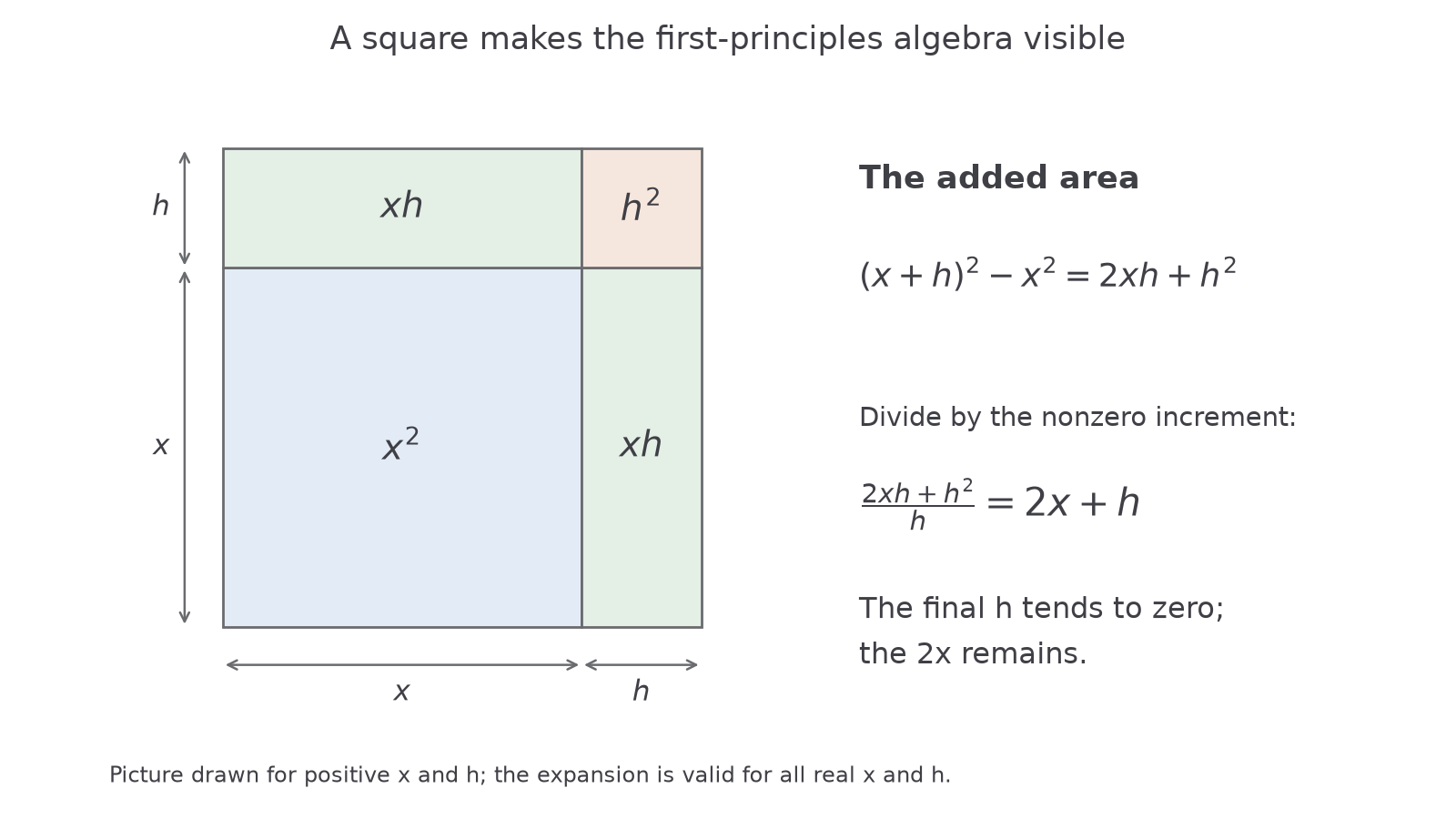
Worked example 1: deriving the square rule
Question. Use first principles to show that has derivative .
Plan. Expand the changed function, subtract the fixed function, cancel the increment and take its limit.
Why this step? Cancelling exposes the part which survives when the increment tends to zero.
Answer. for every real .
Check. At , the result is , agreeing with the opening chord calculation.
Add just one linear term. Its contribution survives the limit too, and brackets protect its sign.
Worked example 2: a square plus a linear term
Question. Use first principles to show that has derivative .
Plan. Substitute into both terms before subtracting all of .
Why this step? A first-principles proof must build the derivative from function values; quoting the answer from a rule would miss the argument.
Answer. for every real .
Check. At , the chord gradient is , tending to .
The same definition gives , since , and for a constant . These derivative results are not in the formula sheet: learn them.
Watch out
Wrong: . Right: subtract , so both terms change sign. A missing bracket can leave a term which cannot cancel with .
Change the coefficient and sign of the linear term while keeping the proof structure.
First principles for cubic and quartic powers
For a higher power, the binomial expansion does the hard work. Only its term linear in survives after division by and taking the limit: every remaining positive power of tends to zero.
You already know
The binomial theorem expands small positive integer powers. Keep every term before subtracting , then remove a common factor of . The limit is taken with fixed.
Work through the cubic first, where the surviving term is especially easy to spot.
Worked example 3: the cubic derivative
Question. Show from first principles that .
Plan. Expand , subtract , then simplify the difference quotient.
Why this step? The expansion makes the factor visible in every term of the numerator.
Answer. The derivative is , for all real .
Check. At , chord gradients are , approaching .
Increase only the exponent from to . One extra term appears, but the cancellation mechanism is unchanged.
Worked example 4: the quartic derivative
Question. Show from first principles that .
Plan. Use the quartic binomial expansion inside the same limit.
Why this step? The coefficient comes from the term with exactly one increment, not from guessing a pattern.
Answer. The derivative is , for every real .
Check. At , the quotient is , tending to .
A constant multiple can stay outside the quotient: replacing by doubles every line and gives ; gives . The square, cubic and quartic derivative formulas are not in the formula sheet: learn them. First-principles proof tasks here use small positive integer powers up to ; powers above are excluded from that requirement. The rule you use afterwards has a wider range.
Key idea
These calculations prove the powers actually expanded. They suggest the general power rule, but they do not prove it for every rational exponent.
Vary only the quartic's constant multiplier and retain the first-principles reasoning.
Continue this lesson.
You’re previewing NovaLearn without an account. Create a free account to read the rest.
Create free account