1.08d, 1.08e, 1.08g - Definite integrals, signed area and limits of sums
Evaluate definite integrals, distinguish signed accumulation from geometric area and split at changes of sign. Explain why narrow rectangle sums approach an exact integral.
A definite integral is a number
Can an integral be zero while the graph encloses a positive area? For the line from to , the two triangular regions each have area . We will see why their integral is nevertheless zero, and why rectangles can recover both answers.
You already know
If , then is an antiderivative. An indefinite integral gives ; a definite integral has specified endpoints.
The endpoints are inputs, not heights. Substitute each into the entire antiderivative.
Evaluating a definite integral
For a function continuous on , with ,
The constant cancels: .
Not in the formula sheet: learn it.
A bracketed antiderivative keeps the endpoint substitution visible, particularly when a lower endpoint is negative.
Worked example 1: evaluate both endpoints
Question. Evaluate .
Plan. Integrate term by term, then subtract the lower endpoint value.
Why this step? Each endpoint belongs in every term before you take the difference.
Answer. .
Check. Differentiating the bracket gives .
Change only the lower endpoint. It now contributes a nonzero value.
Worked example 2: a nonzero lower contribution
Question. Evaluate .
Plan. Use the same antiderivative and subtract its value at .
Why this step? A nonzero lower limit cannot be ignored just because an earlier example started at zero.
Answer. .
Check. The omitted integral from to is , and .
Reversing bounds reverses the sign, equal bounds give zero, and adjoining intervals add: . These are properties of signed accumulation, not rules for geometric area.
Watch out
Endpoint subtraction does not justify crossing an undefined point. For example, is undefined at zero, so plugging and into an antiderivative does not evaluate an ordinary definite integral across zero.
Now make just the lower endpoint negative.
Signed accumulation and positive area
An integral counts below-axis contributions negatively. A geometric area counts both sides positively.
Signed integral and geometric area
For , adds signed contributions. If , it equals the area enclosed by the curve, the axis and the ordinates . If , that area is . An ordinate here is a vertical boundary line. Area is non-negative; an integral need not be.
The line from the opening puzzle makes the distinction visible.
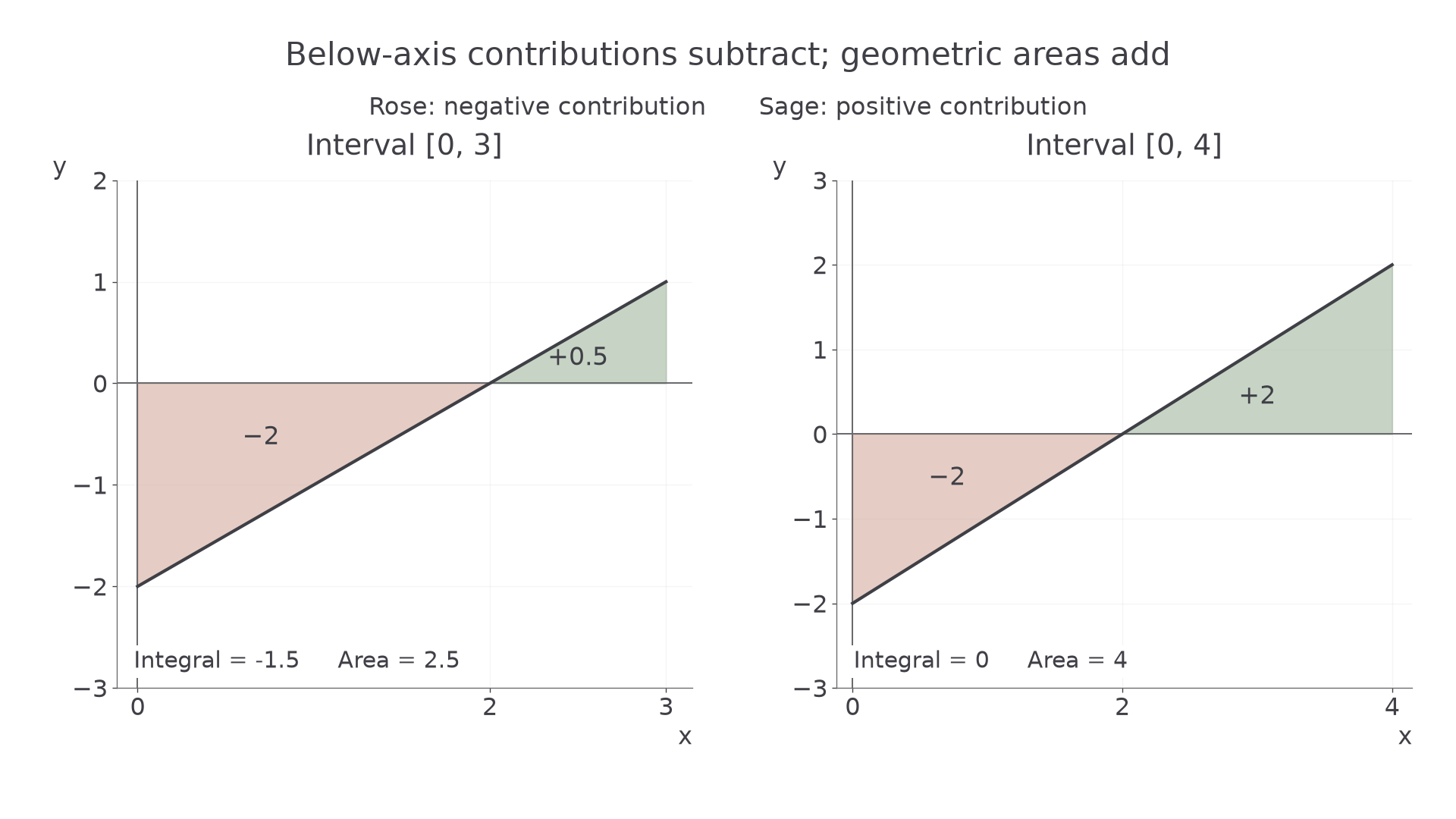
The below-axis triangle contributes to the integral, although its area is .
Worked example 3: unequal regions
Question. Find the signed integral and geometric area for on .
Plan. Split at the root , evaluate each piece and add their magnitudes for area.
Why this step? Sign changes belong in the integral; their magnitudes belong in the geometric area.
Answer. The signed integral is ; the area is square units.
Check. Triangle areas are and .
Change only the upper boundary, from to . The two triangular contributions now balance.
Worked example 4: zero integral, nonzero area
Question. Find the signed integral and geometric area for on .
Plan. Keep the negative contribution and evaluate the enlarged positive piece.
Why this step? Equal areas on opposite sides cancel in signed accumulation, not in geometry.
Answer. The integral is , while the area is square units.
Check. The two triangles have the same base and height, each .
If both axes measure metres, these geometric areas are in ; otherwise use square units for abstract coordinates.
Watch out
Wrong: . Taking the magnitude after cancellation loses area. Split first, then add .
Extend just the upper boundary once more.
Locate every change of sign
For a curved graph, find the roots before choosing the signs of its integral pieces. A quick sign table can save a page of wrong area working.
Continue this lesson.
You’re previewing NovaLearn without an account. Create a free account to read the rest.
Create free account