1.08a, 1.08b - Integration, antiderivatives and constants
Recover a function from its derivative, integrate powers and use a point to choose one curve from a family. Connect this reverse process to accumulated area and the fundamental theorem of calculus.
Recovering a family from a derivative
If you know every gradient of a curve, do you know where the curve is? Try the concrete case and . Both have gradient everywhere. A complete map of the slopes still cannot tell you which curve you have. By the end, you will know exactly what extra information is needed.
You already know
Differentiating gives . A constant differentiates to zero, and a vertical translation leaves every gradient unchanged.
That lost vertical position is the first thing integration must account for.
Antiderivative and indefinite integral
An antiderivative of is a function satisfying . An indefinite integral represents the family of antiderivatives, written . The integrand is , and identifies the integration variable. For example, is an antiderivative of ; is not.
The constant of integration is any fixed real number on the interval considered. It is not another function of . Two antiderivatives on an interval differ by a constant: their difference has derivative zero. On disconnected intervals, each branch may have its own constant.
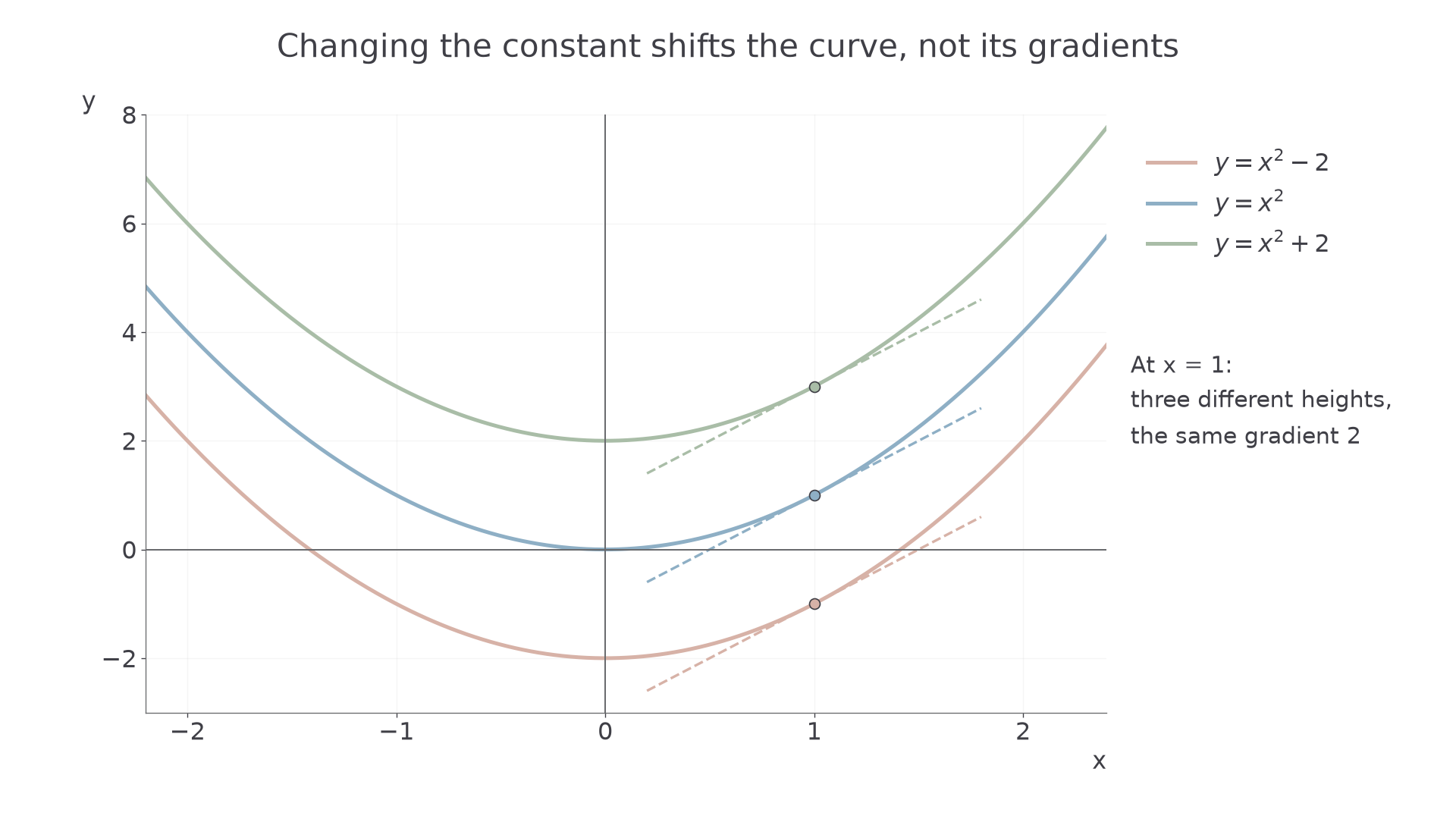
At , all three tangents have gradient , although their points of contact are at different heights. The picture contains infinitely many possible curves, even though only three are drawn.
Worked example 1: recover the family
Question. Find all functions with derivative , on the real line.
Plan. Find one antiderivative, then restore the constant lost in differentiation.
Why this step? Adding a constant changes the curve's height without changing any gradient.
Answer. The family is , where .
Check. Both and give the required derivative.
Now change only the constant term in the derivative. That changes a linear term in the antiderivative, not its arbitrary constant.
Worked example 2: a changed slope offset
Question. Find all functions with derivative , on the real line.
Plan. Reverse the cubic and linear derivatives and keep an arbitrary constant.
Why this step? The term in the derivative comes from , whereas contributes nothing to the derivative.
Answer. .
Check. Differentiation gives for every fixed .
A candidate must pass the derivative check before its constant is considered.
Watch out
Wrong: “The only antiderivative is .” It is one member of the family. The complete indefinite integral is .
Change the constant term in the derivative once more.
Reversing the power rule and combining terms
Increase the exponent by one, then divide by that new exponent. The division undoes the multiplier introduced by differentiation.
Power rule for integration
For constants , with , on an interval where the real powers are defined and differentiable,
This follows because differentiating the right side gives . The sheet prints a more general reverse-chain power formula; this basic rule is a recall requirement.
Not in the formula sheet: learn it.
Sums, differences and constant multiples integrate term by term. Only one final constant is needed: several additive constants combine into one. A standalone constant also integrates: .
Worked example 3: roots and negative powers
Question. Find , for .
Plan. Write the roots and reciprocals as powers, then integrate each term.
Why this step? The new exponent for is , so dividing by it doubles the coefficient.
Answer. , for .
Check. Its derivative is , as required.
Change only the exponent of the final reciprocal term, from to . Its new exponent and coefficient both change.
Worked example 4: a steeper reciprocal
Question. Find , for .
Plan. Keep the first two integrals and apply the power rule to .
Why this step? Negative exponents increase towards zero when integrated; they do not become more negative.
Answer. .
Check. Differentiating gives .
Algebra may be needed first. Expanding gives an integral . The form is equivalent after absorbing its constant term into .
Watch out
The power rule does not apply to : it would divide by zero. Nor can differentiate to . The reciprocal integral needs the logarithmic rule in a later lesson.
Use the same rewrite, with a different reciprocal exponent.
Continue this lesson.
You’re previewing NovaLearn without an account. Create a free account to read the rest.
Create free account