1.07h, 1.07k - Differentiating trigonometric functions
Why does a sine wave have its steepest slope when its height is zero? Derive the sine and cosine derivatives from first principles for 1.07h, then use them with scaled inputs and tangent for 1.07k. Radians, signs and excluded inputs make the rules work.
Deriving the sine derivative from a limit
How steep is as it crosses the origin? A chord from to has gradient about , although its height is tiny. The slope approaches one, not zero. A limit turns that observation into a proof for every input.
You already know
The derivative is the limit of as . Compound-angle identities expand and . Here all angles are in radians.
On the unit circle, for , the inscribed triangle, sector and outer triangle give . Thus . Continuity of cosine squeezes the ratio to one; its evenness gives the same limit from negative inputs. This geometric argument explains why the radian unit matters.
The two radian limits
The second follows from : its quotient is .
Not in the formula sheet: learn it.
Keep fixed while the small increment tends to zero.
Worked example 1: sine from first principles
Question. Show from first principles that the derivative of is .
Plan. Expand the changed sine, then separate the two known limits.
Why this step? Each ratio now has a known limit; substituting zero into the initial fraction would give no information.
Answer. The derivative is for every real , with radian input.
Check. At zero the slope is , matching the chord estimate.
Change only the vertical scale in the next proof. The limit calculation scales by the same amount.
Worked example 2: a vertically stretched sine
Question. Differentiate from first principles.
Plan. Keep the factor three outside the difference quotient.
Why this step? A constant scales both heights and chord gradients; it does not change the input.
Answer. .
Check. At , the wave has height three and gradient zero.
The derivative result is not printed in the formula sheet: learn it. The first-principles definition is printed, but the intervening argument must still be supplied.
Watch out
Wrong: . The sine applies to the numerator input only. The ratio tends to one; it is not identically one.
Try a reflected wave, showing the limit rather than quoting a rule.
Deriving cosine and locating its minus sign
Cosine starts at its maximum and falls to zero on . Its gradient should therefore be negative there. The minus sign comes directly from the cosine addition identity.
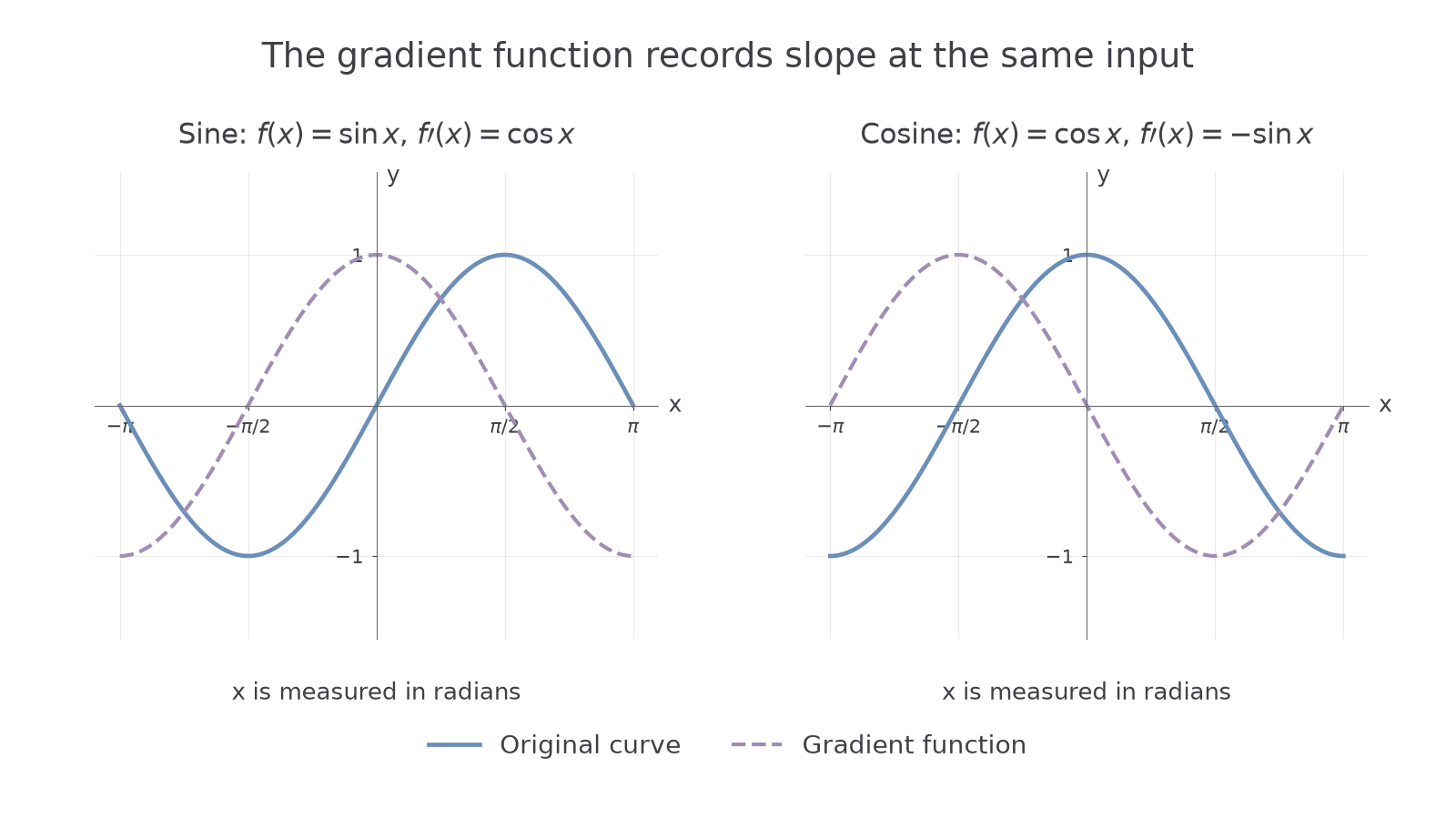
The horizontal tangents of each wave occur at zeros of its gradient function. Differentiating sine four times returns to sine: , , , , . A derivative can cycle rather than become simpler!
Worked example 3: cosine from first principles
Question. Derive the derivative of from first principles.
Plan. Expand , preserving the negative sine product.
Why this step? The subtraction is already in the addition identity; the limit cannot turn it into a plus.
Answer. The derivative is , for all real radian inputs.
Check. At , the gradient is , consistent with the falling graph.
Change only the sign of the whole function. Reflection in the horizontal axis reverses every gradient.
Worked example 4: the reflected cosine
Question. Differentiate from first principles.
Plan. Factor out minus one before expanding.
Why this step? Keeping the outside minus separate prevents two different negative signs being lost together.
Answer. .
Check. At , the reflected curve is rising with gradient one.
The cosine derivative is not in the formula sheet: learn it. Writing offers another sign check, since its input decreases at rate minus one, but it does not replace a requested first-principles proof.
Watch out
Wrong: . Right: . Check the direction of the graph on .
Keep both the scale and the sign visible in your own derivation.
Continue this lesson.
You’re previewing NovaLearn without an account. Create a free account to read the rest.
Create free account