9.8-9.9 - Industrial Catalysis
A solid catalyst offers gas molecules a surface on which to react. Follow adsorption, surface reaction and desorption, then connect these steps to industrial throughput, operating costs and catalyst lifetime.
Why A Surface Can Change A Factory Reaction
A gas reaction in a flask may be slow because successful collisions are rare. In a chemical plant, "slow" means the reactor must be larger, hotter, or run for longer to produce the same amount of product. A heterogeneous catalyst helps by giving gas molecules a solid surface on which the reaction can happen.
Heterogeneous catalyst
A catalyst in a different phase from the reactants, such as a solid catalyst for a reaction between gases.
The reactants are gases; the catalyst is a solid. The catalyst is not consumed in the overall reaction, so it does not appear as a reactant or product in the overall equation.
The surface model
A useful solid catalyst has active sites on its surface. These are places where reactant molecules can bind temporarily. When gas molecules adsorb onto the surface, several rate-helping things can happen:
- reactant molecules are held close together
- molecules may be held in a better orientation for reaction
- bonds inside reactant molecules may be weakened
- a different reaction pathway with lower activation energy becomes available
- product molecules can leave the surface, freeing active sites for more reactants
An impurity can coat or bind to active sites, blocking access. Fewer reactants then adsorb and fewer surface reactions occur each second. This poisoning or coating reduces activity without showing that the catalyst was consumed in the overall desired reaction; it was still regenerated in each completed catalytic cycle.
Adsorption
The attachment of particles to the surface of a solid (here, to active sites on the catalyst). Contrast absorption, where particles enter the bulk of another material, like water soaking into a sponge.
Adsorption, Reaction And Desorption
Gas molecules bind, react and leave at the accessible catalyst surface.
[DIAGRAM: asset_name: Heterogeneous Surface Steps; asset_slug: edexcel_a_level_chemistry_l048_heterogeneous_surface_steps; recommended_method: deterministic_chart; description: Gas reactant molecules adsorb onto active sites on a solid catalyst surface, react on the surface, and product molecules desorb.]
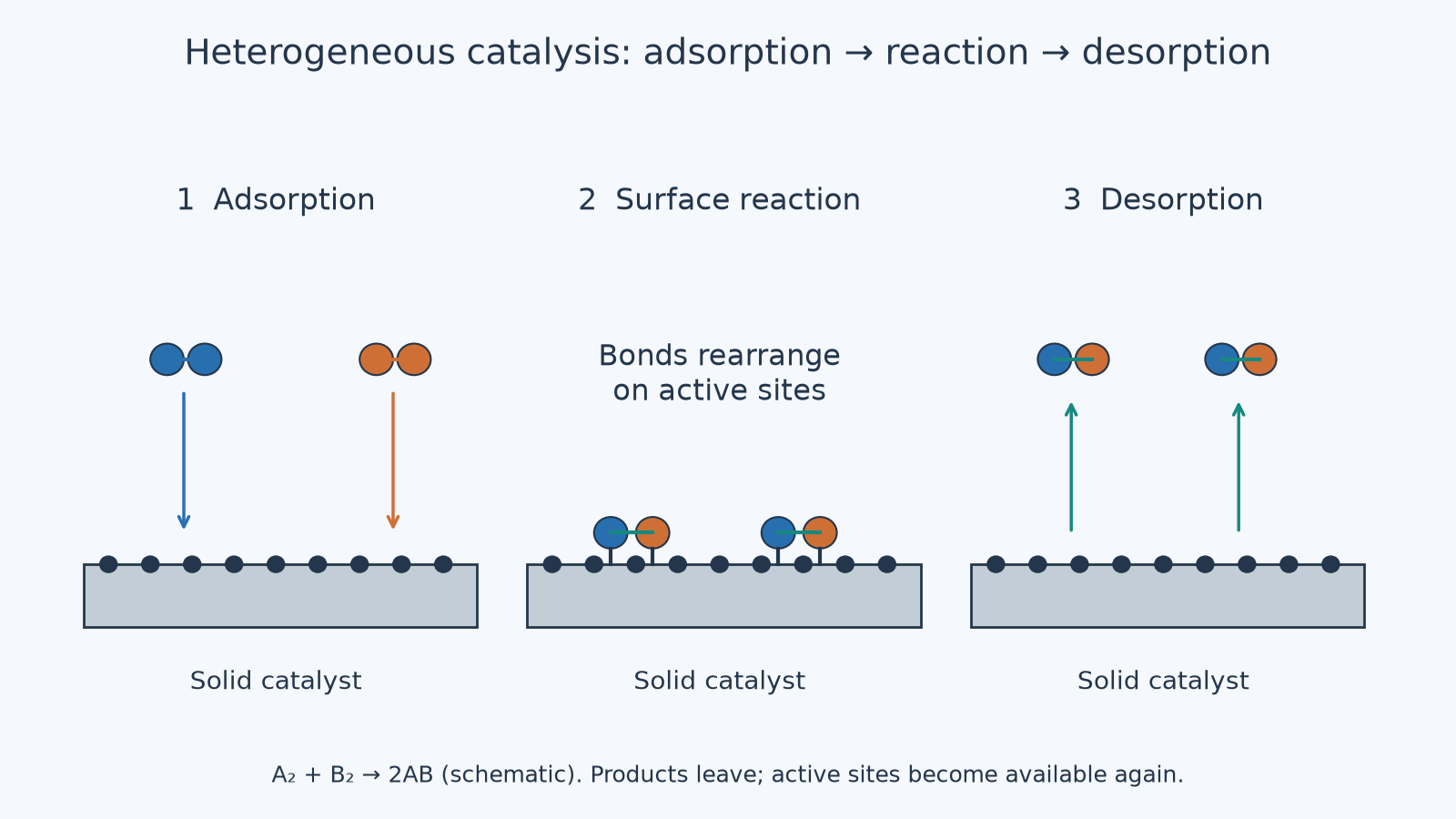
The surface pathway is usually described in three linked stages.
| Stage | What happens | Why it helps rate |
|---|---|---|
| Adsorption | Gas-phase reactant molecules attach to active sites on the solid surface. | Reactants become concentrated at the surface and may be held in a reactive orientation. |
| Surface reaction | Bonds in adsorbed reactants are weakened, broken or formed while the particles are attached to the surface. | The catalyst provides a different pathway with lower activation energy. |
| Desorption | Product molecules detach from the catalyst surface and move back into the gas phase. | Active sites become available for another set of reactant molecules. |
Surface area matters because only exposed catalyst atoms can take part in surface catalysis. A powdered, porous or honeycomb catalyst can have many more active sites than a smooth lump of the same material. In an industrial reactor, the catalyst is often supported or shaped so gas can flow past a large accessible surface without too much pressure drop. Pellets must also have enough mechanical strength and useful lifetime: a very porous but fragile catalyst could break down and obstruct gas flow.
Industrial Catalyst Examples
The same surface mechanism can explain several industrial reactions. Follow the changing reactant and product species through these steps:
- state that the catalyst is solid and the reactants are gases
- say that gas molecules adsorb onto the catalyst surface
- explain that the surface provides an alternative route with lower activation energy
- state that products desorb and the catalyst is regenerated
Worked example: ammonia synthesis as a surface example
In ammonia manufacture, nitrogen and hydrogen gases are passed over a solid iron catalyst:
This lesson is not asking for the industrial conditions or the equilibrium compromise. It is using the reaction as a gas-on-solid catalyst example.
Question: Explain how a solid iron catalyst increases the rate of this gas-phase reaction.
Model answer route:
- The iron catalyst provides a solid surface with active sites.
- and molecules adsorb onto the surface.
- Adsorption holds the molecules close together and can weaken the and bonds.
- The reaction can follow an alternative route with lower activation energy.
- molecules desorb from the surface, leaving the catalyst available for further reaction.
Continue this lesson.
You’re previewing NovaLearn without an account. Create a free account to read the rest.
Create free account