2A.16-2A.19 - Intermolecular Forces And Hydrogen Bonding
Explain the forces between molecules without confusing them with covalent bonds inside molecules. Use electron-cloud fluctuations, permanent dipoles and donor–acceptor requirements to predict attractions, including hydrogen bonds in pure substances and mixtures.
Why Intermolecular Forces Matter
A simple molecular substance can have strong covalent bonds inside each molecule and still boil at a low temperature. That is because melting and boiling separate molecules from each other; they do not usually break the covalent bonds inside the molecules.
For explanations, keep two levels separate:
| Level | What is being changed? | Example wording |
|---|---|---|
| Intramolecular bonding | Bonds within a molecule | The O-H covalent bonds inside one water molecule remain intact when water boils. |
| Intermolecular forces | Attractions between molecules | Hydrogen bonds between neighbouring water molecules are overcome during boiling. |
The strength and type of attraction between molecules help explain why some simple molecular substances are gases at room temperature while others are liquids or solids. In this lesson, the key move is usually:
- identify whether the molecule is non-polar or polar
- name the intermolecular forces present and identify which comparison is relevant
- explain the electron or dipole interaction causing it
- link that force to the energy needed to separate molecules
London Forces
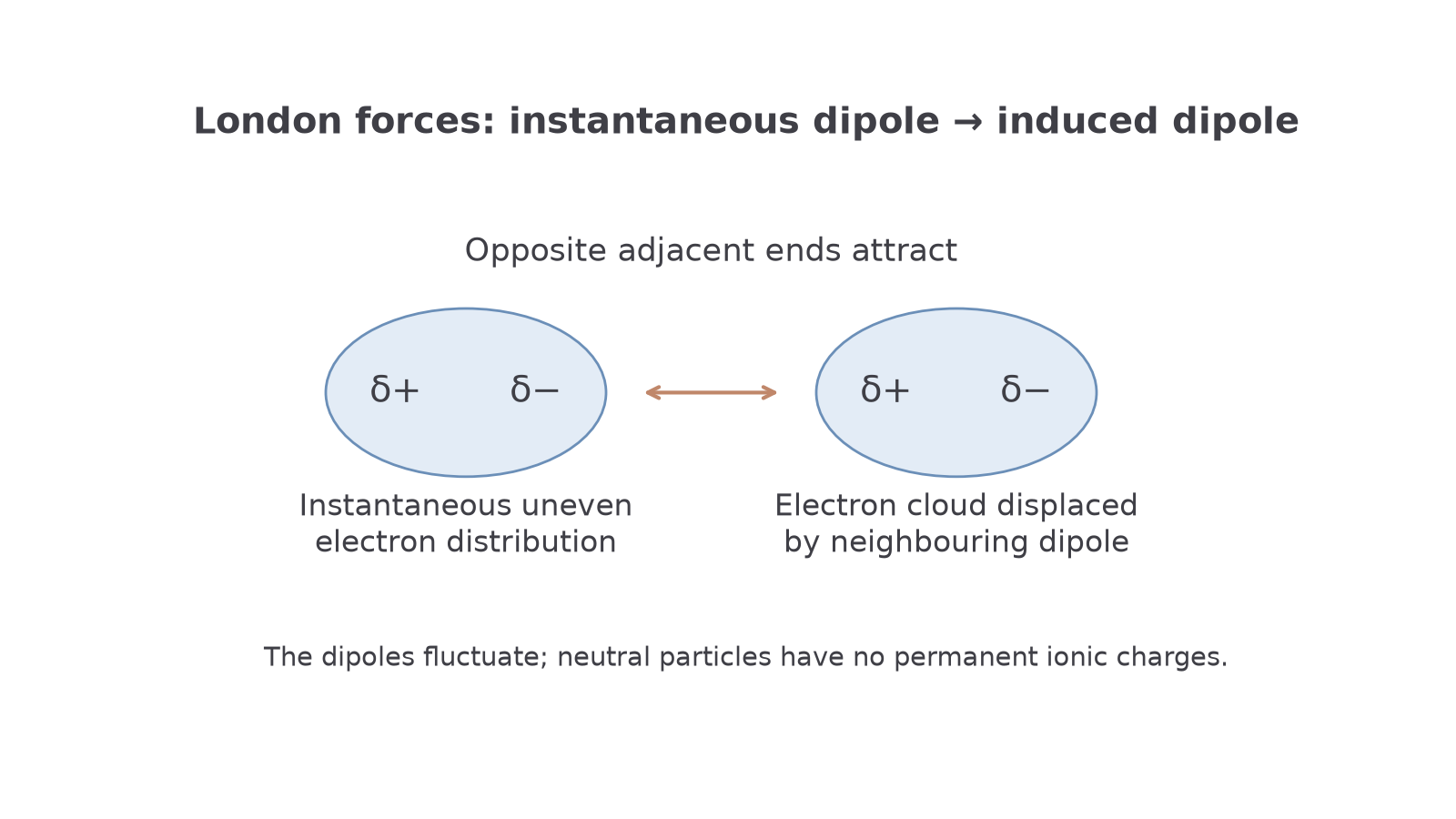
London forces arise from temporary dipoles and are present between all atoms and molecules, including non-polar molecules.
London forces
Attractions between an instantaneous (temporary) dipole in one atom or molecule and the dipole it induces in a neighbouring atom or molecule.
The particle story is:
- Electrons in a molecule are always moving.
- At one instant, the electron cloud may be unevenly distributed.
- This creates an instantaneous dipole.
- The instantaneous dipole distorts the electron cloud in a nearby molecule.
- This induces a dipole in the neighbouring molecule.
- The opposite partial charges attract.
This is why London forces are described as instantaneous dipole-induced dipole interactions. They are individually weak, but many of them together can matter. London forces tend to be stronger when the electron cloud is larger and more easily distorted, and when molecules can make more surface contact.
Common-error contrast
Non-polar does not mean "no intermolecular forces". A non-polar molecule such as methane, , has no permanent dipole, but it still has London forces because it still has moving electrons.
[DIAGRAM: asset_name: Temporary And Induced Dipoles; asset_slug: edexcel_a_level_chemistry_l012_temporary_dipoles; recommended_method: matplotlib; description: A fluctuating electron cloud creates an instantaneous dipole which induces an aligned dipole in its neighbour; opposite adjacent ends attract.]
Permanent Dipole-Dipole Forces
A permanent molecular dipole persists even when the temporary electron fluctuations are averaged out. Neighbouring polar molecules can orient so that opposite partial charges attract.
Permanent dipole-dipole forces
Attractions between the end of one polar molecule and the end of a neighbouring polar molecule.
A polar molecule has a permanent separation of charge, usually because polar bonds are arranged so that their dipoles do not cancel.
The previous lesson's molecular-polarity idea matters here. A bond can be polar without the whole molecule being polar. Carbon dioxide, , has polar C=O bonds, but the molecule is linear and symmetrical, so the bond dipoles cancel. Hydrogen chloride, , is polar because chlorine is more electronegative than hydrogen, producing H()-Cl().
Permanent dipole-dipole attractions occur when the end of one polar molecule is attracted to the end of a neighbouring polar molecule. These attractions are in addition to London forces, not instead of them.
Worked example: identifying the forces present
Identify the intermolecular forces present in samples of , , and .
| Substance | Molecular polarity | Forces present | Why |
|---|---|---|---|
| Non-polar | London forces | The tetrahedral molecule is symmetrical, so there is no permanent dipole. | |
| Polar | London and permanent dipole-dipole forces | The molecule has a permanent H()-Cl() dipole. London forces are also present. | |
| Non-polar overall | London forces | The C=O bonds are polar, but the linear molecule has cancelling bond dipoles. |
The presence of permanent dipole attractions depends on the whole molecule, not just one polar bond. All these particles have London attractions. A permanent dipole does not prove that its attraction is stronger than the London contribution: size and polarisability also matter, so there is no universal force-strength ranking across unrelated substances.
Guided practice
is polar, while is non-polar overall. Complete the explanation:
has permanent dipole-dipole forces because ...
has London forces but no permanent dipole attractions because ...
Model completion: has an unsymmetrical arrangement of bond dipoles, so the molecule has a permanent dipole. has polar C-Cl bonds arranged symmetrically in a tetrahedral molecule, so the bond dipoles cancel.
Hydrogen Bonding
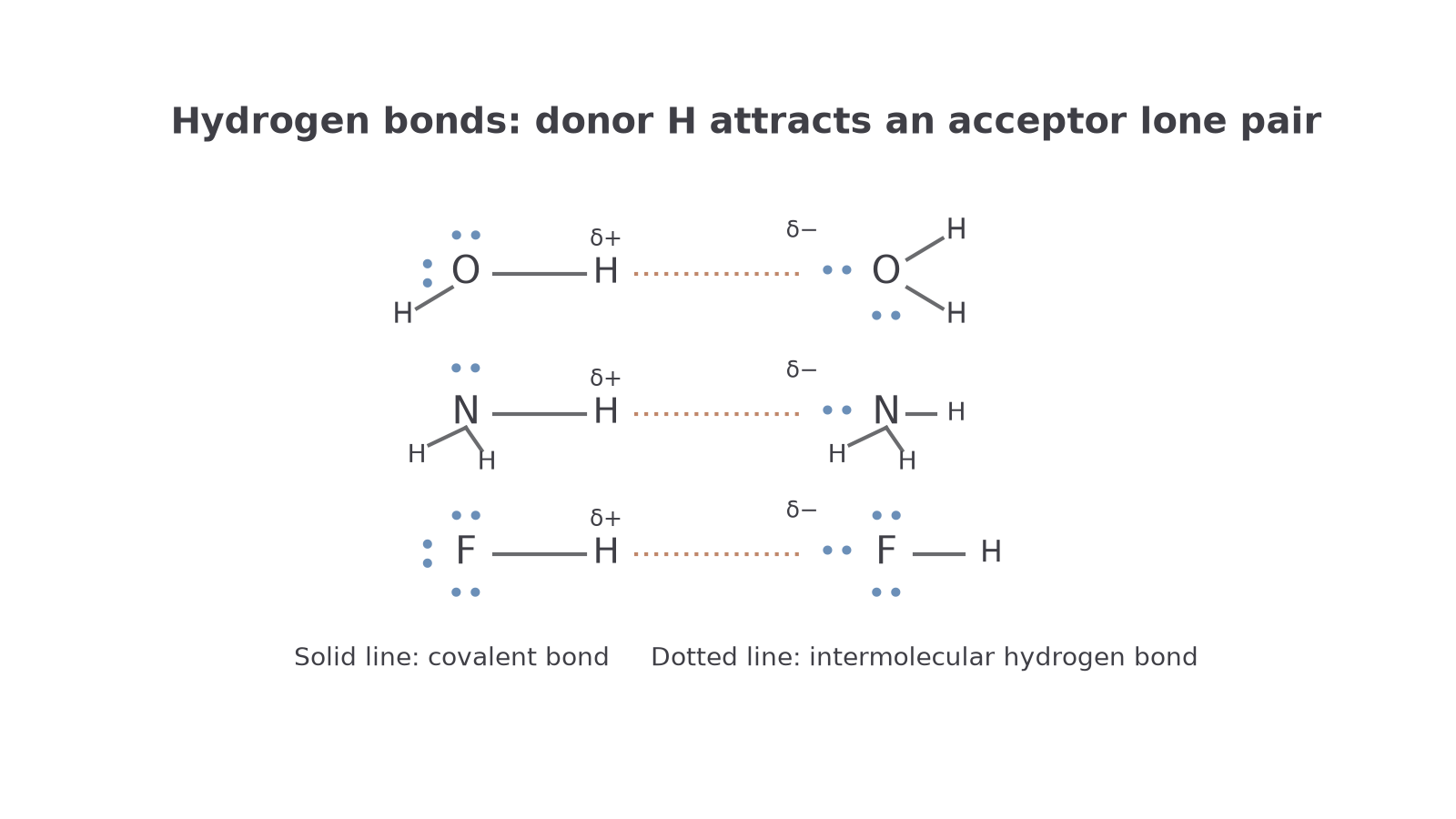
Hydrogen bonding is a particularly strong type of intermolecular attraction involving hydrogen.
Hydrogen bond
The attraction between a hydrogen atom covalently bonded to nitrogen, oxygen or fluorine and a lone pair on a nitrogen, oxygen or fluorine atom in a neighbouring molecule.
The key pattern is:
where is usually , , or , and is a lone-pair-bearing , , or atom in another molecule. The ... represents the hydrogen bond; it is not a covalent bond.
Why those atoms? Nitrogen, oxygen, and fluorine are very electronegative and small. They make the strongly , and their lone pairs can attract that hydrogen closely.
The three specification examples
| Substance | Hydrogen-bond feature | Particle-level explanation |
|---|---|---|
| Water, | bonds and lone pairs on O | The H() of one molecule is attracted to a lone pair on O of another molecule. |
| Liquid ammonia, | bonds and a lone pair on N | The H() of one ammonia molecule is attracted to the N lone pair of another. |
| Liquid hydrogen fluoride, | bond and lone pairs on F | The H() of one molecule is attracted to a lone pair on F of another. |
Hydrogen bonds are stronger than ordinary permanent dipole-dipole forces, but they are still intermolecular forces. Covalent bonds within molecules are much stronger.
Containing fluorine is not enough
does not form hydrogen bonds between its own molecules even though it contains fluorine. None of its hydrogens is directly bonded to fluorine, oxygen or nitrogen; they are bonded to carbon, so they are not sufficiently for this hydrogen-bond pattern.
[DIAGRAM: asset_name: Hydrogen Bond Donors And Acceptors; asset_slug: edexcel_a_level_chemistry_l012_hydrogen_bond_examples; recommended_method: matplotlib; description: Water, ammonia and hydrogen fluoride show donor X-H bonds, acceptor lone pairs and dotted intermolecular hydrogen bonds.]
Predicting Hydrogen Bonding
Use a two-question test when predicting hydrogen bonding between molecules of a pure substance.
- Is there an directly bonded to , , or ? This is the hydrogen-bond donor.
- Is there a lone pair on , , or in a neighbouring molecule? This is the hydrogen-bond acceptor.
For hydrogen bonding within a pure liquid, the molecules normally need both features available across the sample. A molecule with only a lone-pair acceptor may accept hydrogen bonds from water, but it may not hydrogen-bond to molecules of itself.
Worked example: applying the two-question test
Predict whether each pure substance can form hydrogen bonds between its molecules.
| Substance | Donor: H bonded to N/O/F? | Acceptor: lone pair on N/O/F? | Hydrogen bonds between its molecules? |
|---|---|---|---|
| Yes, O-H | Yes, O has lone pairs | Yes | |
| Yes, N-H | Yes, N has a lone pair | Yes | |
| No O-H or N-H or H-F | Yes, O has lone pairs | No, not between its own molecules | |
| No H-F bond | C-F fluorine has lone pairs but is generally a poor hydrogen-bond acceptor | No, not between its own molecules |
The key detail is "hydrogen directly bonded to N, O, or F". Saying "contains oxygen" is not enough, because an ether such as contains oxygen but has no O-H bond.
Water's Anomalous Properties
Water behaves unusually for a small simple molecular substance because each molecule can form an extended hydrogen-bonding network. The oxygen atom has two lone pairs and the molecule has two O-H bonds, so a water molecule can donate hydrogen bonds through its hydrogen atoms and accept hydrogen bonds through its oxygen lone pairs.
High melting and boiling temperatures
Water has relatively high melting and boiling temperatures because extra energy is needed to overcome many hydrogen bonds between water molecules. The explanation is not that water has strong covalent O-H bonds; those covalent bonds remain inside the molecules during melting and boiling. The relevant process is separation or increased movement of molecules, so the relevant attractions are intermolecular.
Explanation chain:
- Water molecules form hydrogen bonds with neighbouring water molecules.
- Hydrogen bonds are stronger than ordinary permanent dipole-dipole forces and London forces between similar small molecules.
- More energy is needed to overcome these intermolecular forces.
- Therefore the melting and boiling temperatures are relatively high.
Density of ice compared with water
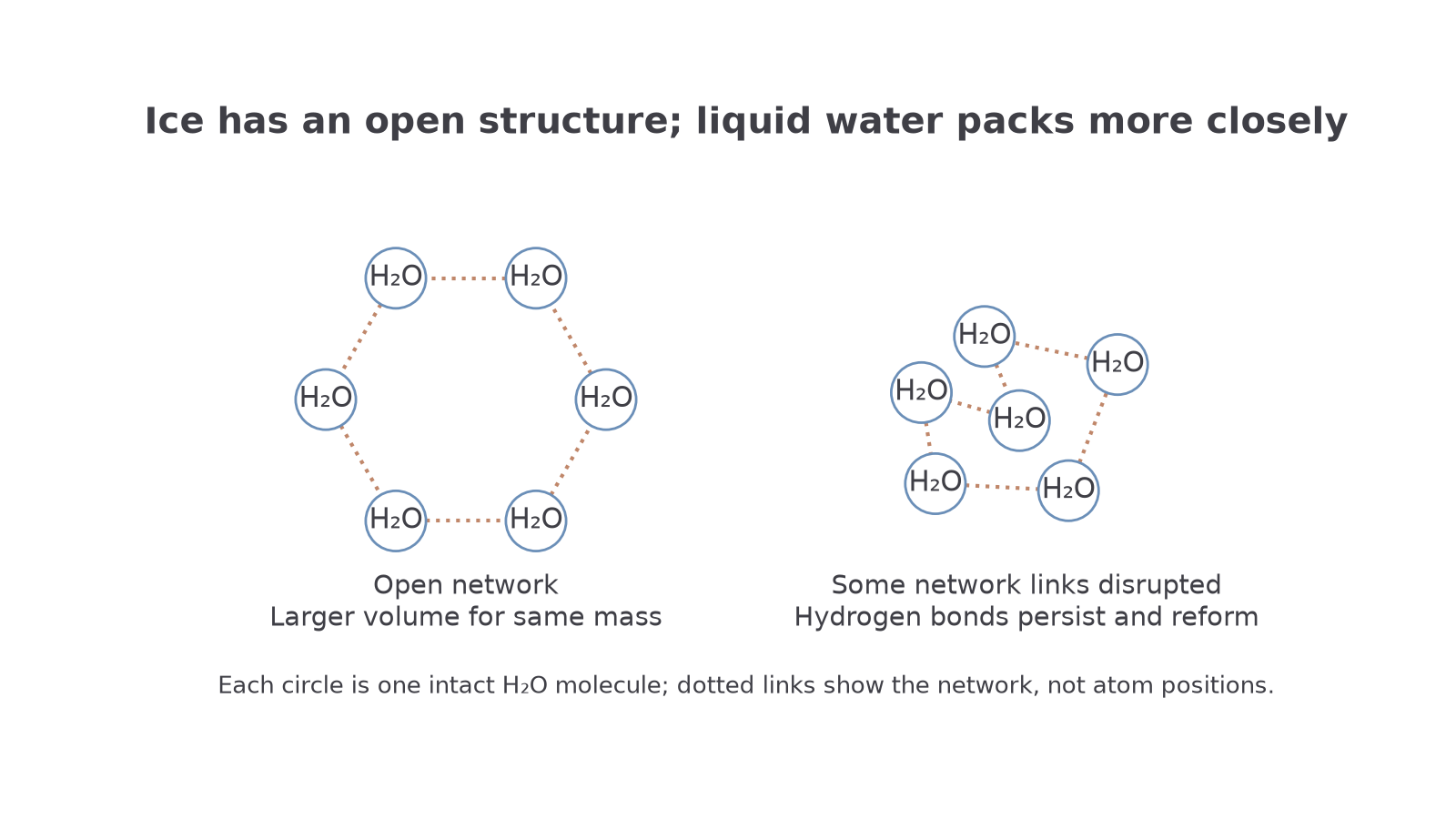
Ice is less dense than liquid water, so ice floats. In ice, hydrogen bonds hold water molecules in a relatively open arrangement. The molecules are kept further apart than in liquid water, where hydrogen bonds are constantly breaking and reforming and molecules can pack closer together.
Use the density idea explicitly: for the same mass of water molecules, the more open ice structure has a larger volume, so its density is lower because .
Worked example: explaining an anomaly
Question: Explain why ice floats on liquid water.
Model answer:
Ice floats because it is less dense than liquid water. Hydrogen bonds hold water molecules in an open structure in ice, so the molecules are further apart than in liquid water. The same mass therefore occupies a larger volume, giving ice a lower density than liquid water.
[DIAGRAM: asset_name: Ice And Liquid Water; asset_slug: edexcel_a_level_chemistry_l012_ice_and_water; recommended_method: matplotlib; description: Schematic open hydrogen-bonded ice arrangement compared with a more closely packed liquid; individual water molecules remain intact and hydrogen bonds persist in liquid.]
Hydrogen Bonds Between Different Molecules
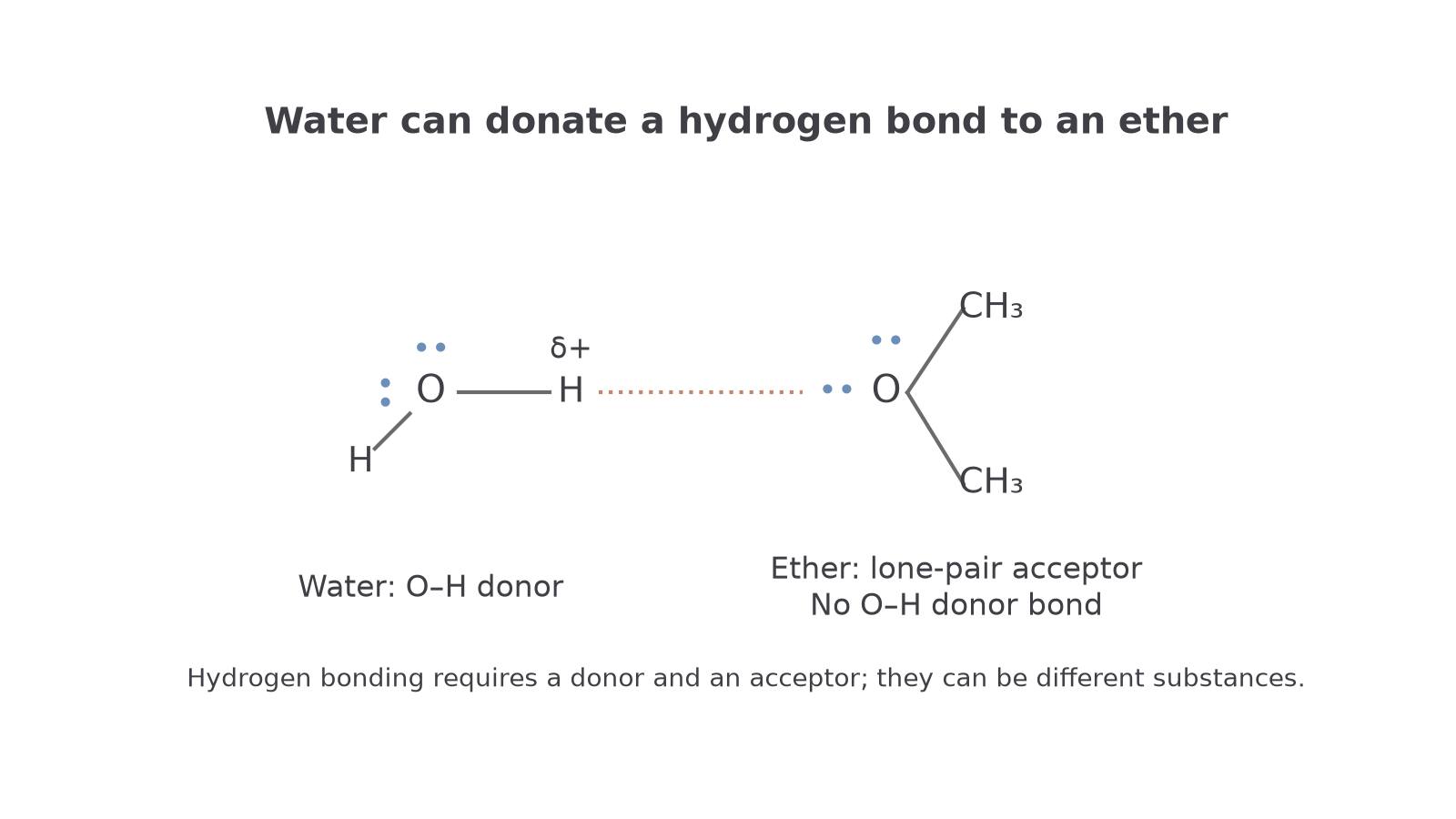
The donor and acceptor need not be the same substance. A hydrogen-bond donor has hydrogen directly bonded to N, O or F; an acceptor supplies a lone pair on N, O or F. Check each partner separately.
Dimethyl ether, , has oxygen lone pairs but no O-H, N-H or F-H bond. It therefore cannot donate hydrogen bonds, so its pure liquid does not hydrogen-bond between its own molecules. In a mixture with water, the ether oxygen can accept a hydrogen bond from a partially positive hydrogen on a water O-H bond. The attraction is between two different molecules; the O-H covalent bond stays inside the water molecule.
The same donor/acceptor check applies to other small molecules. A molecule may accept hydrogen bonds from water without being able to form hydrogen bonds in its pure liquid. Decide from its actual bonds and lone pairs, rather than the presence of oxygen alone.
[DIAGRAM: asset_name: Hydrogen Bonds In A Mixture; asset_slug: edexcel_a_level_chemistry_l012_mixed_hydrogen_bonds; recommended_method: matplotlib; description: Water donates an O-H hydrogen to a lone pair on ether oxygen; ether has acceptor lone pairs but no donor O-H bond.]
Quick Recap
London attractions act between all molecules and atoms. Permanent dipole attractions require a net molecular dipole. Hydrogen bonding requires a suitable donor and acceptor; the water network explains its high transition temperatures and the lower density of ice.