17A.1-17A.5 - Chirality And Optical Isomerism
A flat formula can hide two different three-dimensional molecules. Learn to recognise a chiral centre, draw its mirror-image pair and use optical rotation together with reaction-rate evidence to distinguish substitution pathways.
The Chiral Centre Test
Two molecules can have the same functional group and still behave differently in three dimensions. The key question is whether a carbon atom is bonded to four different atoms or groups.
Chiral centre
A carbon atom bonded to four different atoms or groups (an asymmetric carbon atom).
For the single-centre examples in this lesson, use this test:
- Choose a tetrahedral carbon atom.
- List the four atoms or groups directly attached to it.
- If all four are different, that carbon is a chiral centre.
- If any two attached groups are the same, that carbon is not a chiral centre.
The word "group" matters. In , the second carbon is attached to , , and . The two carbon-containing groups are not the same, so the second carbon is chiral.
In , the middle carbon is attached to , , and another . Because two groups are identical, it is not a chiral centre.
Worked example: identify the chiral centre
Question: State whether contains a chiral centre.
The carbon carrying the group is attached to:
| Attached group | Is it different from the others? |
|---|---|
| yes | |
| yes | |
| yes | |
| yes |
All four attached groups are different, so the molecule contains one chiral centre at carbon 2. The molecule can show optical isomerism.
Common-error contrast
Do not decide chirality by counting different element symbols only. A carbon attached to , , and has two carbon-containing groups, but those groups are different because their full structures are different.
Mirror Images And Optical Isomers
Optical isomers differ in their three-dimensional arrangement, even though their atoms have the same connections.
Optical isomers (enantiomers)
A pair of molecules that are non-superimposable mirror images of each other, with the same structural formula.
They have the same structural formula, but their groups are arranged differently in 3D space.
The defining relationship is:
| Feature | Optical isomers |
|---|---|
| Structural formula | same |
| Connectivity | same atoms joined in the same order |
| 3D arrangement | mirror images |
| Superimposable? | no, not for a chiral molecule |
| Usual physical properties in achiral conditions | mostly the same, except optical rotation direction |
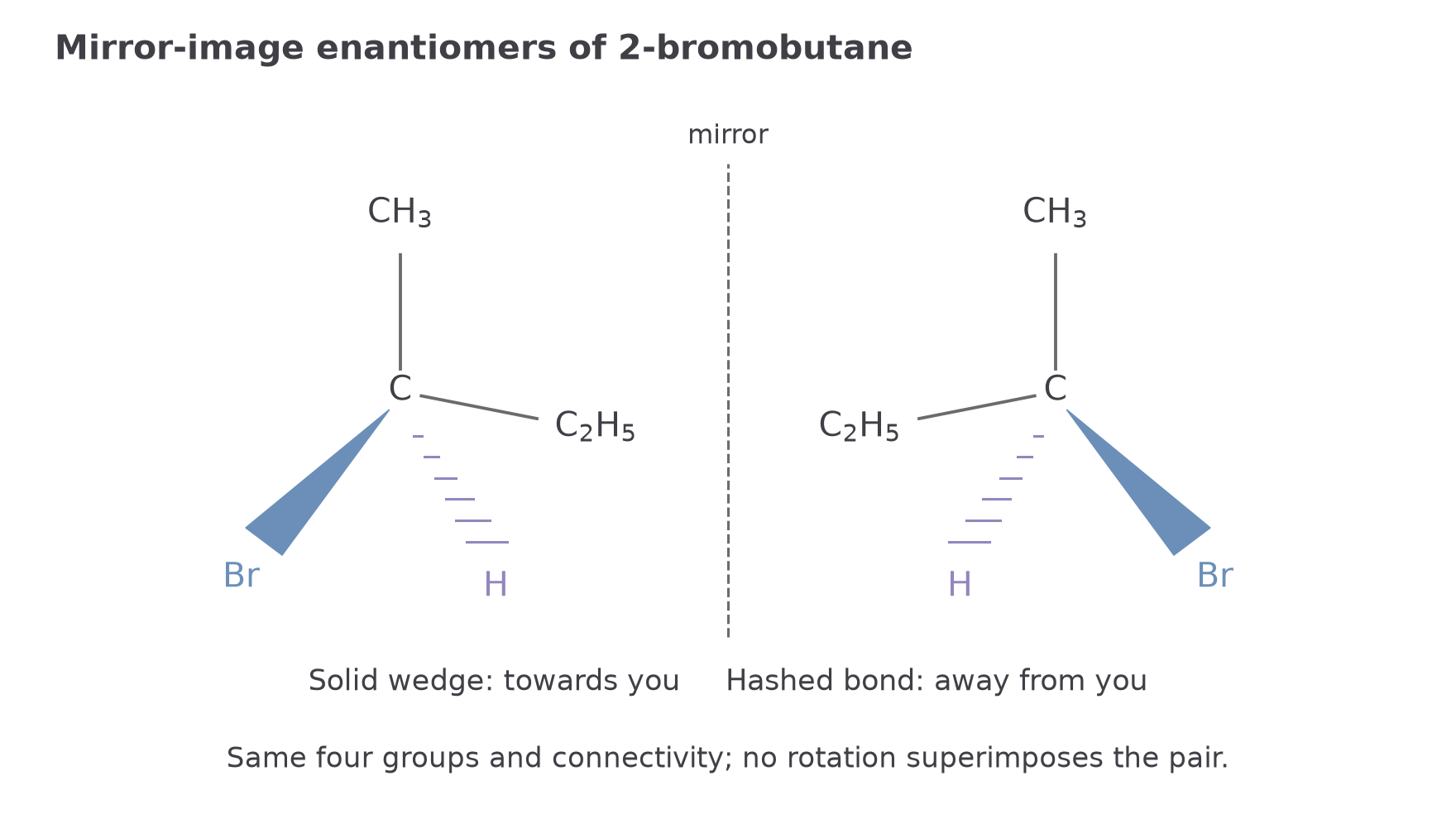
"Non-superimposable" means that no rotation of one 3D structure can make every group line up with the other. A flat structural formula such as shows connectivity, but it does not by itself show which optical isomer is present. To show optical isomers in an answer, use 3D bonds, with a solid wedge for a bond coming out of the page and a dashed bond for a bond going behind the page.
When drawing a pair of optical isomers, make the second structure the mirror image of the first. A common mistake is to move several groups around until the structure looks different. That can accidentally draw the same enantiomer twice, especially if the drawing has not kept a clear wedge and dashed bond.
For , the chiral centre is carbon 2. A correct pair of enantiomers would keep the same four groups around carbon 2, but arrange them as mirror images in 3D. You do not create a new structural isomer; the connectivity remains .
Same structure, different direction
and are not a pair of optical isomers: these formulae describe the same structure numbered from different ends. Optical isomers are not different names or different chain directions; they are non-superimposable mirror images of the same connectivity.
[DIAGRAM: asset_name: Wedge-and-hash mirror images of 2-bromobutane; each carbon has four different groups; asset_slug: edexcel_9ch0_chiral_mirror_pair; recommended_method: deterministic_chart; description: Wedge-and-hash mirror images of 2-bromobutane; each carbon has four different groups]
Optical Activity And Racemic Mixtures
Optical rotation measures the effect of a sample on the plane of polarisation of light; it is a property of the whole sample, not simply a count of chiral molecules.
Optical activity
The ability of a single optical isomer to rotate the plane of polarisation of plane-polarised monochromatic light.
In the single-chiral-centre cases used here, one enantiomer rotates the plane in one direction and the other enantiomer rotates it by the same size in the opposite direction, under the same conditions.
The direction of rotation is measured experimentally. Do not assume that a particular wedge-and-dash arrangement must be clockwise or anticlockwise just from the drawing.
Racemic mixture
A mixture containing equal amounts of the two enantiomers of a chiral compound.
A racemic mixture shows no overall optical activity because the rotation caused by one enantiomer is cancelled by the equal and opposite rotation caused by the other.
This is subtle but important: a racemic mixture can contain chiral molecules and still have no net rotation. "No significant optical activity" does not automatically mean "no chiral molecules"; it can mean that the sample contains equal amounts of both enantiomers.
Worked example: interpret rotation data
Question: A pure optical isomer of compound rotates plane-polarised light by units under fixed conditions. A mixture containing equal amounts of the two enantiomers of is tested under the same conditions. Predict the optical activity.
The second enantiomer would rotate the plane by units under the same conditions. In an equal mixture:
The mixture is racemic and has no net optical activity.
For numerical comparisons, keep the total concentration, optical path length, temperature and wavelength unchanged. Rotation is proportional to the concentration of each enantiomer under these conditions. If the pure positive enantiomer gives +12.0 units, a 60:40 mixture gives units. This is the weighted mean of equal and opposite pure-enantiomer rotations; the mixture is not racemic.
Common-error contrast
If a product mixture has no significant optical activity, do not write only "there are two isomers." The key reasoning is that equal amounts of two enantiomers are present, and their equal and opposite rotations cancel.
Continue this lesson.
You’re previewing NovaLearn without an account. Create a free account to read the rest.
Create free account