19A.1 - High-Resolution Mass Spectrometry
Whole-number molecular masses can hide different molecular formulae. Calculate accurate masses using the supplied isotope values, distinguish candidate formulae and explain why even an exact molecular mass cannot identify every structural isomer.
Why Accurate Mass Matters
Accurate molecular-ion masses reveal small differences between formulae that share the same nominal mass.
The problem
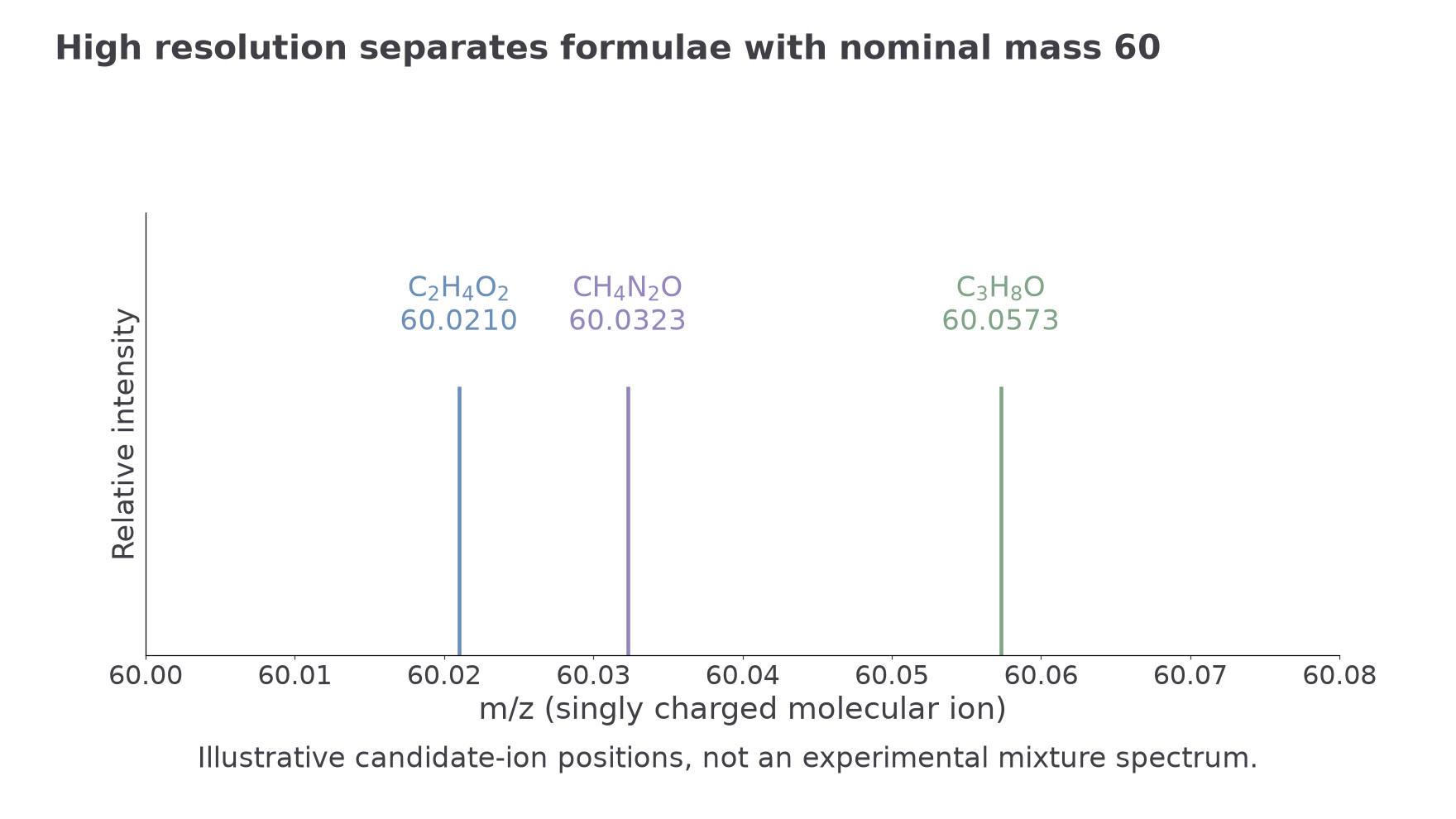
Two compounds can have the same nominal relative molecular mass but different accurate relative molecular masses. A low resolution spectrum might show a molecular ion near m/z = 60, but that does not decide between several possible formulae.
Using accurate masses to four decimal places changes the evidence:
| Possible formula | Accurate relative molecular mass | Nominal mass |
|---|---|---|
| 60.0573 | ||
| 60.0210 | ||
| 60.0323 |
All three formulae round to 60. A high resolution molecular ion value can separate them because it records enough decimal places to show the small differences caused by the accurate atomic masses of the atoms present.
For this lesson, use the mass spectrum value for the molecular ion, usually labelled , as the relative molecular mass when the ion is singly charged:
molecular ion at m/z 60.0573 → accurate relative molecular mass = 60.0573
Relative molecular mass has no unit. The m/z axis is a mass-to-charge ratio, but for the singly charged molecular ions used here the numerical value is the mass you compare with calculated values.
Common-error contrast
Tempting but weak: "The mass is 60, so any formula with relative molecular mass 60 could be correct."
Better: "The molecular ion is 60.0573; comparing to accurate calculated masses supports rather than or ."
[DIAGRAM: asset_name: Accurate mass stick positions distinguish three formulae with nominal mass 60; asset_slug: edexcel_9ch0_accurate_mass; recommended_method: deterministic_chart; description: Accurate mass stick positions distinguish three formulae with nominal mass 60]
Calculating Accurate Relative Molecular Mass
An accurate molecular mass is the sum of the supplied isotope masses multiplied by their atom counts.
The calculation route
When relative atomic masses are given to four decimal places, use those values exactly and round the final answer sensibly, usually to four decimal places.
The safe route is:
formula → multiply each accurate atomic mass by the number of atoms → add → compare with the molecular ion value
Use the values supplied in the question. A typical set for organic high resolution mass spectrometry is:
| Atom | Accurate relative atomic mass |
|---|---|
| 1.0078 | |
| 12.0000 | |
| 14.0031 | |
| 15.9949 |
Worked example: calculating from a formula
Calculate the accurate relative molecular mass of using the values in the table.
Set out the atom counts first:
- C:
- H:
- O:
Add the contributions:
Accurate relative molecular mass
Use the four-decimal values supplied; compare with the of the singly charged molecular ion.
Chemical interpretation: a high resolution molecular ion peak at m/z = 74.0366 would be consistent with molecular formula , provided the ion is singly charged and the compound contains only those atoms.
Use the specified isotopic masses, not periodic-table average atomic masses, for high-resolution comparisons. Here corresponds to carbon-12 and the other supplied values represent the relevant isotopes. At this course's four-decimal calculation convention, use those supplied values directly for the singly charged molecular ion; do not substitute averaged or round H to 1 first.
Identifying A Compound From Candidates
High resolution mass spectrometry often appears as a comparison problem. The spectrum gives an accurate molecular ion value, and the question supplies possible compounds or formulae. The key move is to calculate or compare accurate masses, not to choose the formula that merely has the right whole-number mass.
Worked example: using a molecular ion value
A high resolution mass spectrum of compound X has a molecular ion peak at:
m/z = 46.0417
The question gives these possible compounds.
| Candidate | Formula | Accurate relative molecular mass |
|---|---|---|
| methanol | 32.0261 | |
| ethanol | 46.0417 | |
| methanoic acid | 46.0054 | |
| ethanal | 44.0261 |
The molecular ion value matches ethanol:
X is ethanol,
The important rejection is methanoic acid. Its nominal mass is also 46, but its accurate mass is 46.0054, not 46.0417.
Wording an identification
For identify, give the name or formula and the evidence:
The molecular ion peak is at m/z 46.0417. has accurate 46.0417, so X is ethanol. has nominal mass 46 but accurate 46.0054, so it is not the match.
Continue this lesson.
You’re previewing NovaLearn without an account. Create a free account to read the rest.
Create free account