2A.22-2B.23 - Metallic Bonding And Giant Lattices
Metallic bonding explains how a solid can conduct and change shape. Compare its positive ions and delocalised electrons with ionic and giant covalent lattices, including the continuous silicon–oxygen network in silicon(IV) oxide.
Metallic Bonding
A strip of copper conducts electricity as a solid, can be bent into a different shape, and does not consist of separate copper molecules. Those observations are a useful way into the model, because the model must identify both the positive ions and the electrons that move between them.
[DIAGRAM: asset_name: Metallic Lattice Model; asset_slug: edexcel_a_level_chemistry_l014_metallic_lattice_model; recommended_method: matplotlib; description: Pale-colour particle model of a giant metallic lattice, showing positive metal ions in a regular arrangement with delocalised electrons spread between them.]
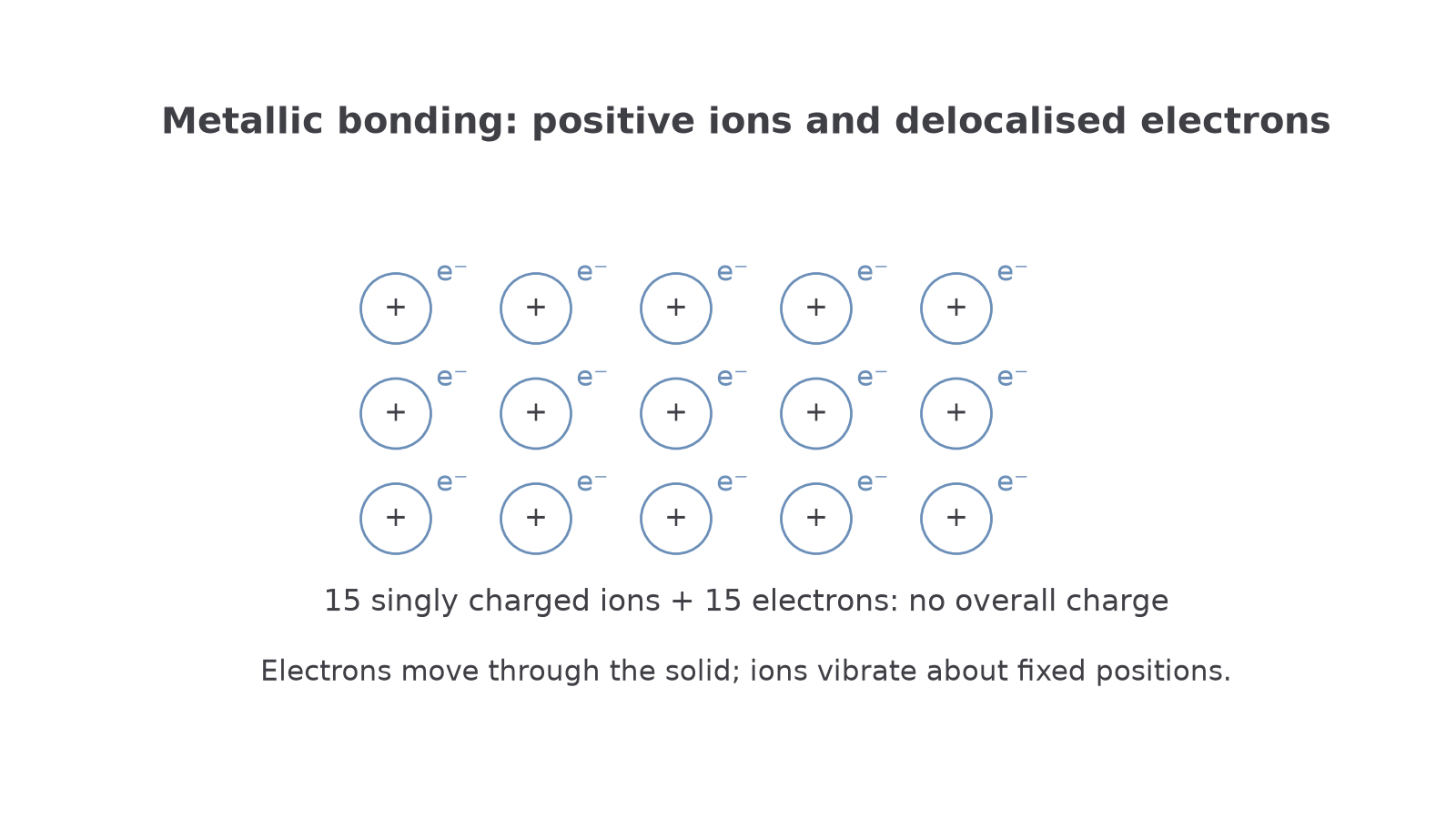
The diagram is schematic: a plus sign means positive charge, not a specified ion charge, and the drawn electron dots are not an electron-count calculation.
In a solid metal, the outer electrons are not fixed to one atom or shared between one pair of atoms. They are delocalised: they can be treated as belonging to the whole lattice. The remaining positive metal ions occupy regular positions in a giant metallic lattice.
Metallic bonding
The strong electrostatic attraction between positive metal ions and delocalised electrons.
The word electrostatic matters because it tells you the attraction is between opposite charges. The word delocalised matters because it stops you accidentally describing covalent bonding, where a shared pair is localised between two nuclei.
Observation to model
| Observation | Particle-level interpretation |
|---|---|
| A metal conducts electricity as a solid | Delocalised electrons can move through the lattice and carry charge. |
| A metal is usually malleable | Layers of positive ions can shift while attraction to the delocalised electrons is maintained. |
| A metal has a regular solid structure | The positive metal ions are arranged in a giant lattice, not in separate molecules. |
The improvement is not cosmetic. Atoms is too vague because the bonding model requires charged metal ions and mobile delocalised electrons.
Electron And Charge Balance In Metals
In the simple metallic model, each metal atom contributes its outer electrons to the delocalised electron cloud, leaving a positive metal ion. The metal as a whole is electrically neutral: the positive charge of the ions is balanced by the negative charge of the electrons.
For sodium, each atom contributes one electron and is represented as . For magnesium, two electrons per atom balance ; for aluminium, three electrons per atom balance . These labels describe a metallic model, not isolated aqueous ions or separate molecules.
A model containing 20 magnesium ions therefore has 40 delocalised electrons. The ions contribute total relative charge , and the electrons contribute , giving zero overall charge. Do not infer that a metal is positively charged just because its lattice includes positive ions.
The electrons are delocalised throughout the structure, rather than assigned to one atom or to a shared pair between two neighbouring atoms. Under an applied potential difference they can carry charge through the solid; the positive ions remain near their lattice positions.
Giant Lattices
A giant structure extends throughout the sample. Its formula gives a ratio or element identity, rather than counting atoms in a separate molecule.
Giant lattice
An extended, repeating three-dimensional arrangement of particles throughout a solid, rather than separate molecules.
The term describes the scale and arrangement of the structure. It does not, by itself, tell you whether the bonding is ionic, covalent, or metallic.
The specification names three giant-lattice families.
| Giant lattice family | Particles or building units | Main bonding model | Examples in scope |
|---|---|---|---|
| Giant ionic lattice | Oppositely charged ions | Strong electrostatic attraction between ions | Ionic solids such as sodium chloride |
| Giant covalent lattice | Atoms joined in a continuous network | Strong covalent bonds throughout the network | Diamond, graphite, silicon(IV) oxide |
| Giant metallic lattice | Positive metal ions and delocalised electrons | Strong electrostatic attraction between metal ions and delocalised electrons | Solid metals such as sodium, magnesium, aluminium, copper |
The first common error is to treat giant as if it means "large molecule". It does not. A giant ionic lattice is not one big molecule of sodium chloride, and a giant metallic lattice is not a molecule of copper. The structure is a continuous solid arrangement.
The second common error is to mix up bonding type and structure type. For example, metallic can describe both the bonding and the lattice family in a solid metal. For silicon(IV) oxide, the bonding is covalent and the structure is giant covalent. For sodium chloride, the bonding is ionic and the structure is a giant ionic lattice.
In silicon(IV) oxide, , each silicon is covalently bonded to four oxygens in a tetrahedral arrangement; each oxygen bridges two silicons. Sharing each oxygen between two silicons gives the ratio Si:O = 1:2. The bonds continue throughout the solid: there are no separate molecules.
[DIAGRAM: asset_name: Silicon Oxygen Network; asset_slug: edexcel_a_level_chemistry_l014_silica_network; recommended_method: matplotlib; description: A tetrahedral SiO4 unit with oxygen bridges continuing to other silicon atoms: four O neighbours per Si and two Si neighbours per O.]
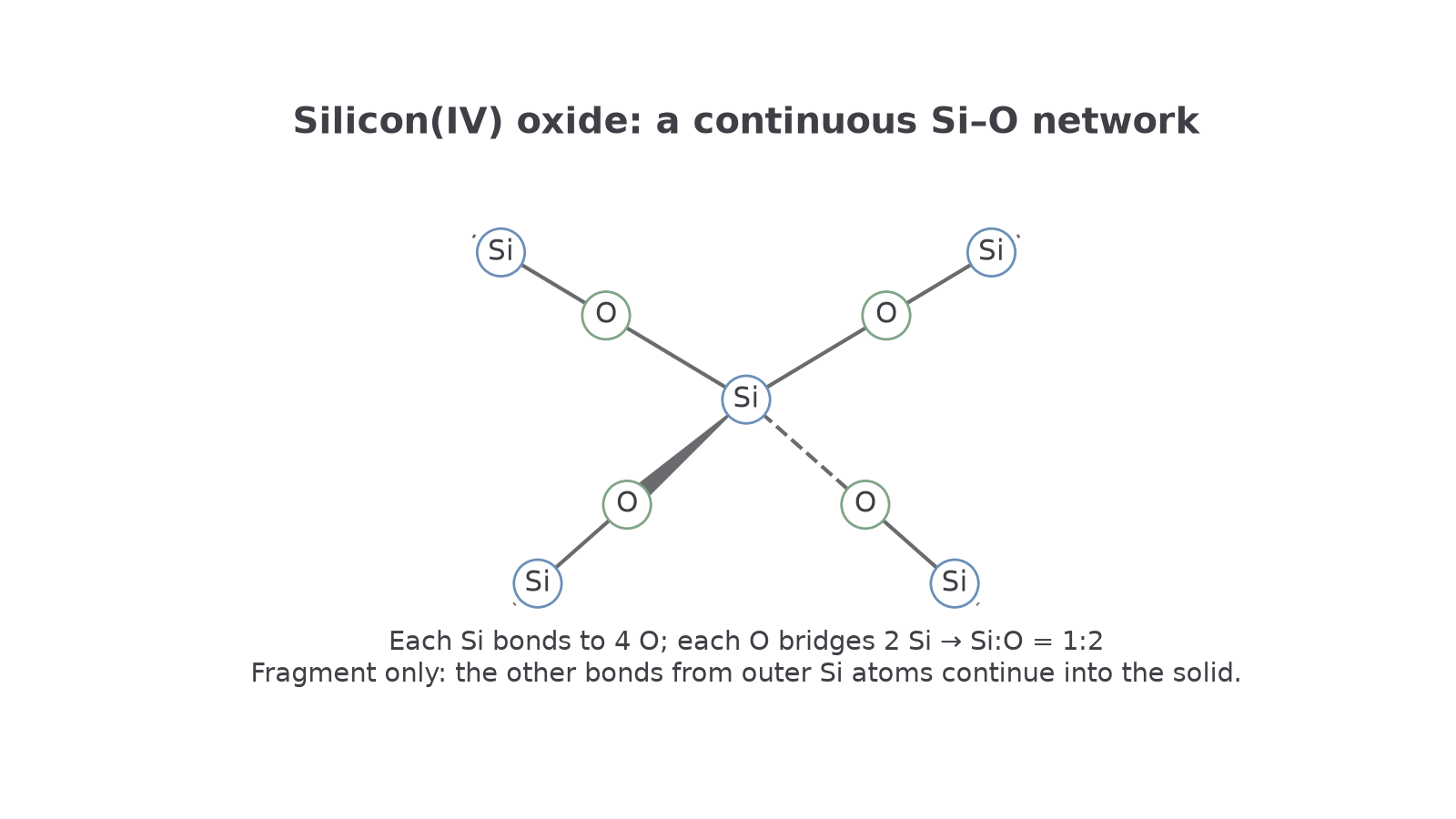
Notice that this check asks for structure classification, not detailed property prediction. Property prediction is built properly in the later structure-property lesson.
Conductivity In Metallic And Ionic Solids
A structure model explains an observation only when it identifies the particles and their motion. Use the metallic model carefully: name the relevant particles, state whether they can move, then link that to the observation.
Conductivity contrast
Solid metals conduct because they contain mobile delocalised electrons. Solid ionic compounds usually do not conduct because their ions are fixed in position in the solid lattice. When an ionic compound is molten or dissolved in water, ions can move, so charge can be carried by ions rather than electrons.
This contrast is a useful guardrail: metals conduct as solids because electrons are mobile; ionic solids conduct only when ions are mobile.
Worked example: compare two explanations
Question: Explain why copper can conduct electricity when solid.
Weak answer: Copper has ions, so electricity flows.
Why it fails: it does not identify the charge carrier. Ions in a solid metal lattice are not moving through the wire as the current.
Improved answer: Copper has a giant metallic lattice containing positive metal ions and delocalised electrons. The delocalised electrons are mobile and can move through the solid, carrying charge.
Malleability And Brittleness
When a force displaces layers, the result depends on whether the attractions survive the new arrangement. Compare a solid metal with an ionic crystal rather than calling every giant lattice strong and stopping there.
Malleability contrast
Metals can often be hammered or drawn into wires because the positive metal ions can shift relative to each other while the delocalised electrons still attract the ions. A brittle ionic lattice is different: shifting layers can bring ions with the same charge next to each other, causing repulsion and fracture.
This is a model-level explanation, not a full materials-science account. The key idea is that metallic bonding is non-directional attraction between metal ions and delocalised electrons, so the lattice can be distorted without separating into neutral molecules.