11.3-11.5 - Conditions And Equilibrium Constants
A changed equilibrium mixture need not have a changed equilibrium constant. Use concentration and pressure ratios to explain why temperature changes the constant, whereas compression, added reactant and catalysts do not at fixed temperature.
K As A Temperature-Specific Fingerprint
A reversible reaction is allowed to reach equilibrium in a sealed vessel. A student then changes the conditions and says, "The equilibrium has shifted, so the equilibrium constant must have changed." That sentence is sometimes right and often wrong.
For this lesson, treat an equilibrium constant as a numerical fingerprint for a particular reaction at a particular temperature. The expression may use equilibrium concentrations, , or equilibrium partial pressures, , but the key idea is the same:
at equilibrium, the expression has the value .
If the temperature is unchanged, the value of is unchanged. The amounts, concentrations or partial pressures in the equilibrium mixture may still change, but they change until the expression once again has the same value.
[DIAGRAM: asset_name: Equilibrium Constant Condition Changes; asset_slug: edexcel_a_level_chemistry_l052_equilibrium_constant_condition_changes; recommended_method: deterministic_chart; description: Pale-background colour response map showing that temperature changes the equilibrium constant, while pressure, concentration and catalyst changes leave the equilibrium constant unchanged at constant temperature.]
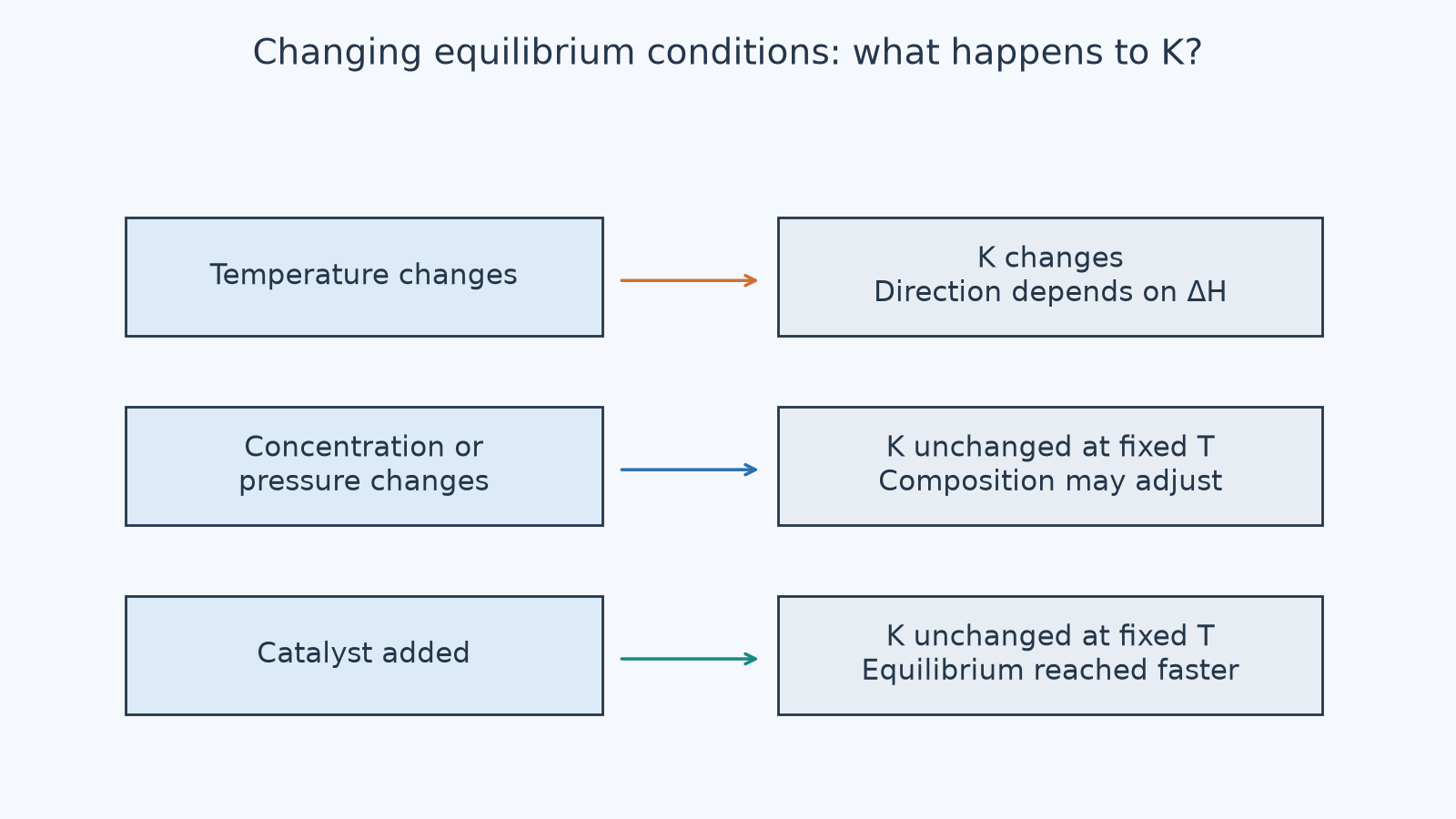
Use this first decision routine:
| Change made | Does the value of or change? | What can still change? |
|---|---|---|
| Temperature | Yes; the direction depends on whether the forward reaction is exothermic or endothermic | equilibrium position and composition |
| Concentration | No, if temperature is constant | equilibrium position and composition |
| Pressure | No, if temperature is constant | equilibrium position and partial pressures |
| Catalyst | No | time taken to reach equilibrium |
This is more precise than saying "the equilibrium shifts." A shift describes the net direction of reaction after a disturbance. describes the final equilibrium ratio demanded by the reaction at that temperature.
How Temperature Changes K
Temperature is the only condition in this lesson that changes the value of the equilibrium constant. The direction of the change depends on whether the forward reaction is exothermic or endothermic.
Think of heat as belonging on one side of the equilibrium:
- exothermic forward reaction:
- endothermic forward reaction:
For the equilibrium constant written in the forward direction:
| Forward reaction | Increasing temperature | Effect on or | Decreasing temperature | Effect on or |
|---|---|---|---|---|
| Exothermic | favours the endothermic reverse reaction | decreases | favours the exothermic forward reaction | increases |
| Endothermic | favours the endothermic forward reaction | increases | favours the exothermic reverse reaction | decreases |
The same rule applies to and . The form of the expression changes, but temperature changes the thermodynamic balance and hence the required value of the equilibrium constant; the composition then adjusts to satisfy that new value.
Common-error contrast
"Heating favours products" is not a rule. Heating favours the endothermic direction. If the forward reaction is exothermic, heating favours reactants and the forward decreases; if the forward reaction is endothermic, heating favours products and the forward increases.
Rate language does not decide K
"Particles have more kinetic energy, so the forward reaction always wins" is wrong. Higher temperature usually increases both forward and reverse rates; the equilibrium constant changes according to which direction is endothermic.
Explaining Position Through K
This is a subtle step up from simple Le Chatelier language. The effect of temperature on equilibrium position should be explained using the change in the equilibrium constant.
Worked example: brown nitrogen dioxide
Consider:
The forward reaction is endothermic. Dinitrogen tetroxide, , is colourless; nitrogen dioxide, , is brown. The concentration expression is:
When the closed mixture is heated at fixed volume, the endothermic forward reaction is favoured, so the value of increases. A larger means the product term, , is larger relative to at equilibrium. The new equilibrium mixture contains a greater proportion of , so the gas mixture appears darker brown.
When the closed mixture is cooled at fixed volume, the exothermic reverse reaction is favoured, so the value of decreases. The equilibrium mixture contains a greater proportion of , so the brown colour becomes less intense.
Chemical interpretation: the observation is explained through the expression. Heating does not just "make more brown gas"; heating increases for this endothermic forward reaction, so the equilibrium expression is satisfied by a product-richer mixture.
Immediately after a temperature change at fixed volume, before significant reaction occurs, concentrations and hence are unchanged. For an exothermic forward reaction the new is smaller, so and a net reverse reaction follows. The new constant explains the shift; the shift is the adjustment to that requirement.
Guided practice
For the equilibrium:
the forward reaction is exothermic. Predict the effect of increasing temperature on the value of for the forward reaction and on the equilibrium amount of .
Expected answer: increasing temperature favours the endothermic reverse reaction, so decreases. The equilibrium expression is then satisfied by a mixture with less relative to and , so the equilibrium amount of decreases.
Continue this lesson.
You’re previewing NovaLearn without an account. Create a free account to read the rest.
Create free account