13A.1-13A.3 - Lattice Energy And Born–Haber Cycles
Build an enthalpy route from elements to an ionic solid. Learn why gaseous particles, electron transfers and formula coefficients determine the signs and terms in a Born–Haber cycle.
Lattice Energy Starts With Gaseous Ions
Sodium chloride is a stable solid because oppositely charged ions attract strongly in a giant lattice. Lattice energy measures the enthalpy change for making that lattice from separated gaseous ions.
Lattice energy
The energy change when one mole of an ionic solid is formed from its gaseous ions.
For sodium chloride:
This is the formation direction. Forming attractions releases energy, so the lattice energy in this convention is usually negative. The reverse process, breaking one mole of solid lattice into gaseous ions, is lattice dissociation and has the opposite sign.
| Process | Example equation | Sign idea |
|---|---|---|
| Lattice formation | exothermic, negative | |
| Lattice dissociation | endothermic, positive |
The state symbols are part of the definition. and would involve hydration in water, so they belong to a different cycle in a later lesson. and are elements in standard states, so they belong to enthalpy of formation, not lattice energy.
Common-error contrast
Do not define lattice energy as "the energy needed to break the ionic lattice" unless the question clearly uses the dissociation convention. The specification uses formation from gaseous ions, so a lattice energy such as means is released when one mole of forms from and .
Atomisation And Electron Affinity Terms
A Born-Haber cycle reaches gaseous ions from elements in their standard states. Two definitions make that route precise.
Enthalpy change of atomisation, \(\Delta_{\mathrm{at}}H\)
The enthalpy change when one mole of gaseous atoms is formed from an element in its standard state.
Atomisation is usually endothermic because bonds or metallic attractions must be overcome.
Examples:
The fraction in is not optional decoration. It is there because the definition makes one mole of gaseous atoms, and one mole of chlorine atoms is produced from half a mole of molecules.
First electron affinity
The enthalpy change when each atom in one mole of gaseous atoms gains one electron to form one mole of gaseous 1− ions.
For chlorine:
The first electron affinity of a non-metal is often negative because attraction between the nucleus and the incoming electron releases energy. For ions such as oxide, a second electron affinity is also needed:
That second electron affinity is usually positive because an electron is being forced onto an already negative ion. In a Born-Haber cycle you keep the sign given in the data; do not change a sign just because the term is called an affinity.
Constructing A Born-Haber Cycle
A Born-Haber cycle is Hess's law applied to an ionic solid. The direct route forms the ionic solid from its elements. The indirect route makes gaseous atoms, changes them into gaseous ions, then lets the gaseous ions form the lattice.
For sodium chloride, the direct route is the standard enthalpy of formation:
The indirect route has five chemical stages:
- Atomise sodium:
- Atomise chlorine:
- Ionise sodium:
- Add the electron to chlorine:
- Form the lattice:
[DIAGRAM: asset_name: Born Haber Nacl Cycle; asset_slug: edexcel_a_level_chemistry_l059_born_haber_nacl_cycle; recommended_method: deterministic_chart; description: Pale-background colour Born-Haber cycle for sodium chloride, showing standard formation from Na(s) and half Cl2(g) to NaCl(s), and the indirect route through atomisation, first ionisation energy, electron affinity and lattice energy.]
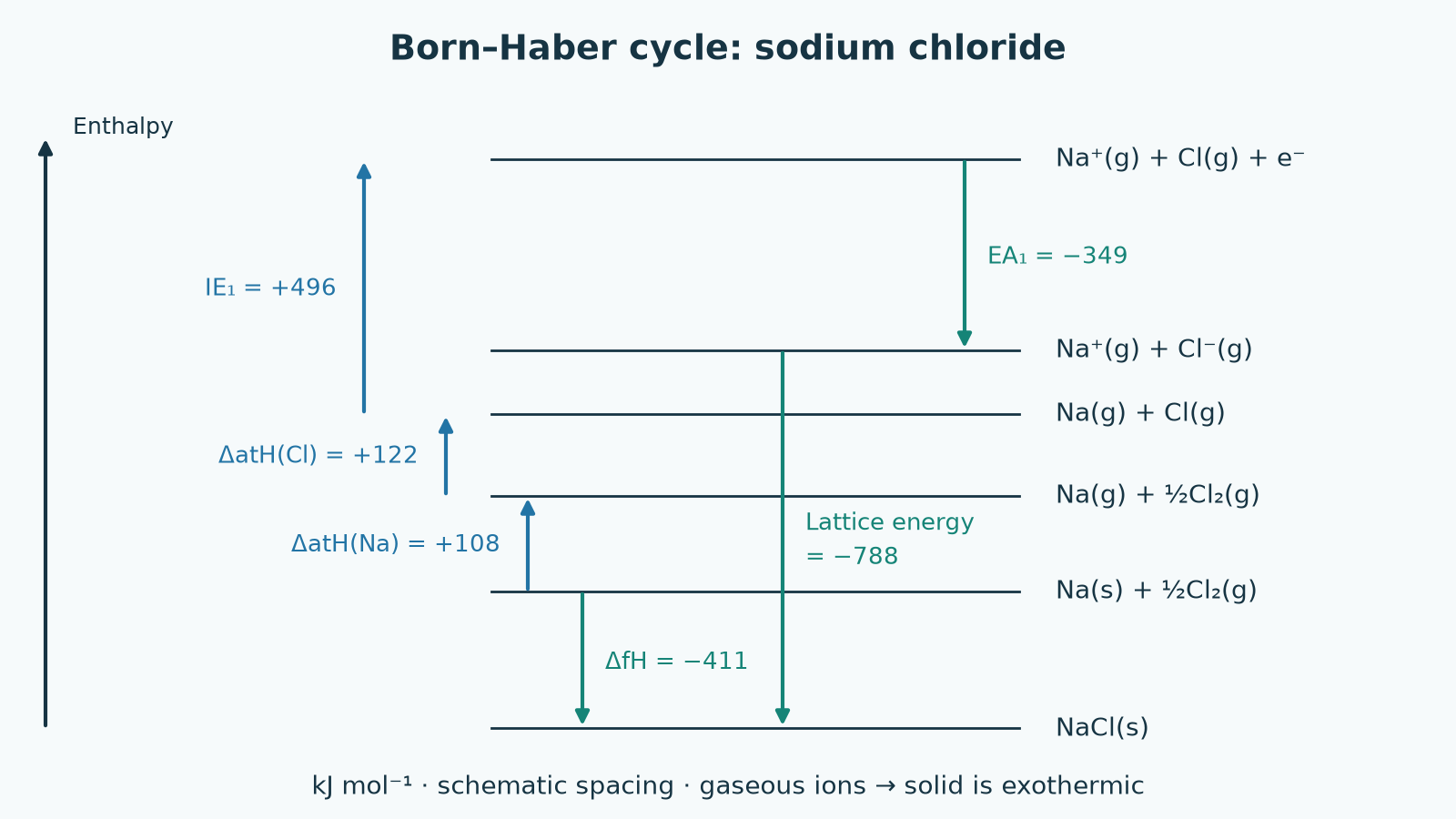
The diagram is a map of enthalpy changes, not a reaction mechanism. The electron produced by ionising sodium is the electron gained by chlorine, so it appears on both nearby stages and cancels when the steps are added.
For a formation lattice-energy convention:
Born-Haber relationship
All terms in , used with their signs and multiplied to match one mole of the solid; is lattice energy in the formation convention.
Every value is used with its sign. Ionisation energies and atomisation enthalpies are normally positive. First electron affinities are often negative. Lattice energy in this formation convention is normally negative.
Worked species sequence: potassium bromide
| Equation | Enthalpy change |
|---|---|
| atomisation of K | |
| atomisation of bromine | |
| first ionisation energy of K | |
| electron affinity of Br | |
| lattice energy |
Notice that bromine's standard state is liquid, so its atomisation step starts from , not .
Worked Calculation: Lattice Energy Of Sodium Chloride
Born-Haber calculations are mostly careful bookkeeping. The chemical decision is which enthalpy terms connect the starting elements to the gaseous ions.
Use these rounded teaching data for sodium chloride:
Continue this lesson.
You’re previewing NovaLearn without an account. Create a free account to read the rest.
Create free account