6C.18-6C.23 - Alkenes And Addition Reactions
The exposed electron density in an alkene double bond explains its addition reactions. Learn how sigma and pi bonds differ, then predict the products formed with hydrogen, halogens, hydrogen halides, steam and an oxidising agent.
Recognising Alkenes And Unsaturation
Imagine two hydrocarbons with the same number of carbon atoms: propane, , and propene, . Propene has fewer hydrogen atoms because it contains a carbon-carbon double bond. That double bond is not just a formula detail; it is the functional group that gives alkenes their characteristic addition reactions.
Alkene
A hydrocarbon containing at least one carbon–carbon double bond, .
General formula of non-cyclic mono-alkenes
Applies to open-chain alkenes with one . One-ring cycloalkanes share this formula, so a formula alone cannot prove an alkene.
Ethene is , propene is , and butene is .
Alkenes and cycloalkenes are unsaturated hydrocarbons.
Unsaturated
Containing at least one carbon–carbon multiple bond, so the molecule can undergo addition.
In addition reactions, atoms can add across the C=C bond without needing to replace an atom already present.
Cycloalkenes also contain a C=C bond, so they are unsaturated, but do not assume they use the same simple formula as non-cyclic mono-alkenes. Cyclohexene is : the ring and the double bond each reduce the number of hydrogen atoms compared with the open-chain alkane formula . For this lesson, use for ordinary one-double-bond, non-cyclic alkenes, and use the displayed or structural formula to decide whether a cycloalkene is present.
Common-error contrast
| Tempting answer | Why it fails | Better reasoning |
|---|---|---|
| Any formula must be an alkene | Cycloalkanes can also have | Look for a C=C bond or structural evidence |
| Unsaturated means "contains fewer hydrogens" | The formula is only a clue | Unsaturated means contains a carbon-carbon double or triple bond |
| A cycloalkene is saturated because it has a ring | The C=C bond is still present | Cycloalkenes are unsaturated hydrocarbons |
The Sigma And Pi Bonds In C=C
A carbon-carbon double bond is not two identical single bonds. It contains one sigma bond and one pi bond.
Sigma (σ) bond
A covalent bond formed by direct (end-on) overlap of orbitals, with electron density on the line between the two nuclei.
Pi (π) bond
A covalent bond formed by sideways overlap of p orbitals, with electron density above and below the plane of the bonded atoms.
The sigma bond's electron density lies on the internuclear axis, so it holds the carbon atoms together strongly; the pi electron density is more exposed.
[DIAGRAM: asset_name: Alkene Bonding Addition Map; asset_slug: edexcel_a_level_chemistry_l032_alkene_bonding_addition_map; recommended_method: deterministic_chart; description: Side view of ethene p orbitals with sideways overlap above and below the plane, a sigma bond along the C–C axis, and an explanation of bonding changes during addition.]
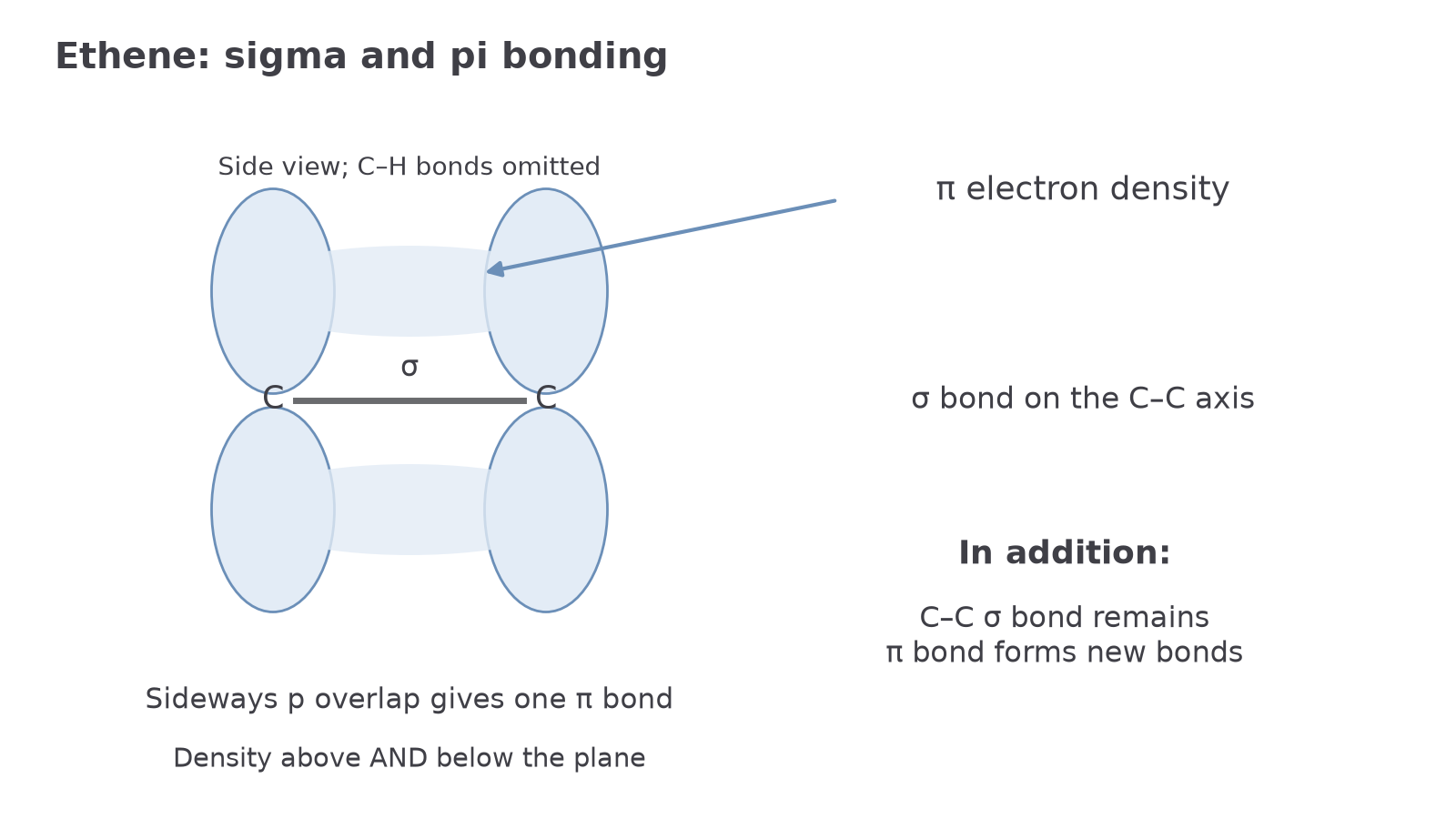
The pi bond is the more exposed part of the double bond. Its electron density can attract electrophiles, so the pi bond is usually the part of the C=C bond involved first in addition reactions. When an alkene reacts by addition, the C=C double bond becomes a single bond and two new sigma bonds are formed to the atoms added.
There is also a structural consequence: rotation about a C=C bond is restricted. Rotating would break the sideways overlap that makes the pi bond. That restricted rotation matters for E/Z stereoisomerism, but the main use in this lesson is simpler: the double bond is a fixed, electron-rich functional group.
Worked example: count the bonds in ethene
Ethene has the displayed structure .
- Each bond is a sigma bond, so there are four sigma bonds.
- The C=C bond contains one sigma bond and one pi bond.
- Total: five sigma bonds and one pi bond.
The chemical interpretation is that the pi bond is not an extra sigma bond. It is a different type of overlap, and its exposed electron density explains why alkenes react differently from alkanes.
Electrophiles And Heterolytic Fission
An electron-rich alkene can supply the pair of electrons that forms a bond to an electron-deficient atom.
Electrophile
An electron-pair acceptor.
The word means "electron-loving", but the key definition is not about liking electrons; it is about accepting a pair of electrons to form a new covalent bond.
Electrophiles are attracted to regions of high electron density. A positive ion such as is an electrophile because it can accept an electron pair. A molecule with a strongly delta-positive atom can also behave as an electrophile in a reaction, because the electron-rich pi bond can be attracted to that atom.
Continue this lesson.
You’re previewing NovaLearn without an account. Create a free account to read the rest.
Create free account