15B.29-15B.32 - Heterogeneous Catalysis
Explain how a solid catalyst supplies a faster surface pathway. Apply adsorption, reaction and desorption to the Contact process and the removal of harmful exhaust gases.
Why Transition Metals Make Useful Catalysts
A gas-phase reaction can be slow even when it is thermodynamically possible. In an industrial reactor or a car exhaust, that slow rate matters: unreacted gases keep flowing past, useful product is not made quickly enough, or harmful emissions leave before they can react.
Transition metals and their compounds are often useful catalysts because they can interact with reactant molecules without being used up overall. Two features are especially important in this lesson:
- many transition metals can adsorb gases onto their surfaces
- many transition-metal compounds can change oxidation state and then be regenerated
The specification names both heterogeneous and homogeneous catalysts.
Heterogeneous catalyst
A catalyst in a different physical phase from the reactants (here, usually a solid catalyst with gaseous reactants).
Homogeneous catalyst
A catalyst in the same phase as the reactants; detailed intermediate-species examples follow in the next lesson.
Heterogeneous does not mean "unrelated"
For a solid catalyst and gas reactants (catalyst solid, reactants gases), the phases are different. That difference in phase is not just a label. It tells you where the reaction happens: at the exposed surface of the solid catalyst. The bulk of the solid is not the important region; the accessible surface atoms and active sites are.
Adsorption, Bond Weakening And Desorption
The core model for heterogeneous catalysis is a surface pathway:
[DIAGRAM: asset_name: Adsorption surface reaction and product desorption; asset_slug: edexcel_a_level_chemistry_l074_catalyst_surface; recommended_method: deterministic_chart; description: Adsorption surface reaction and product desorption.]
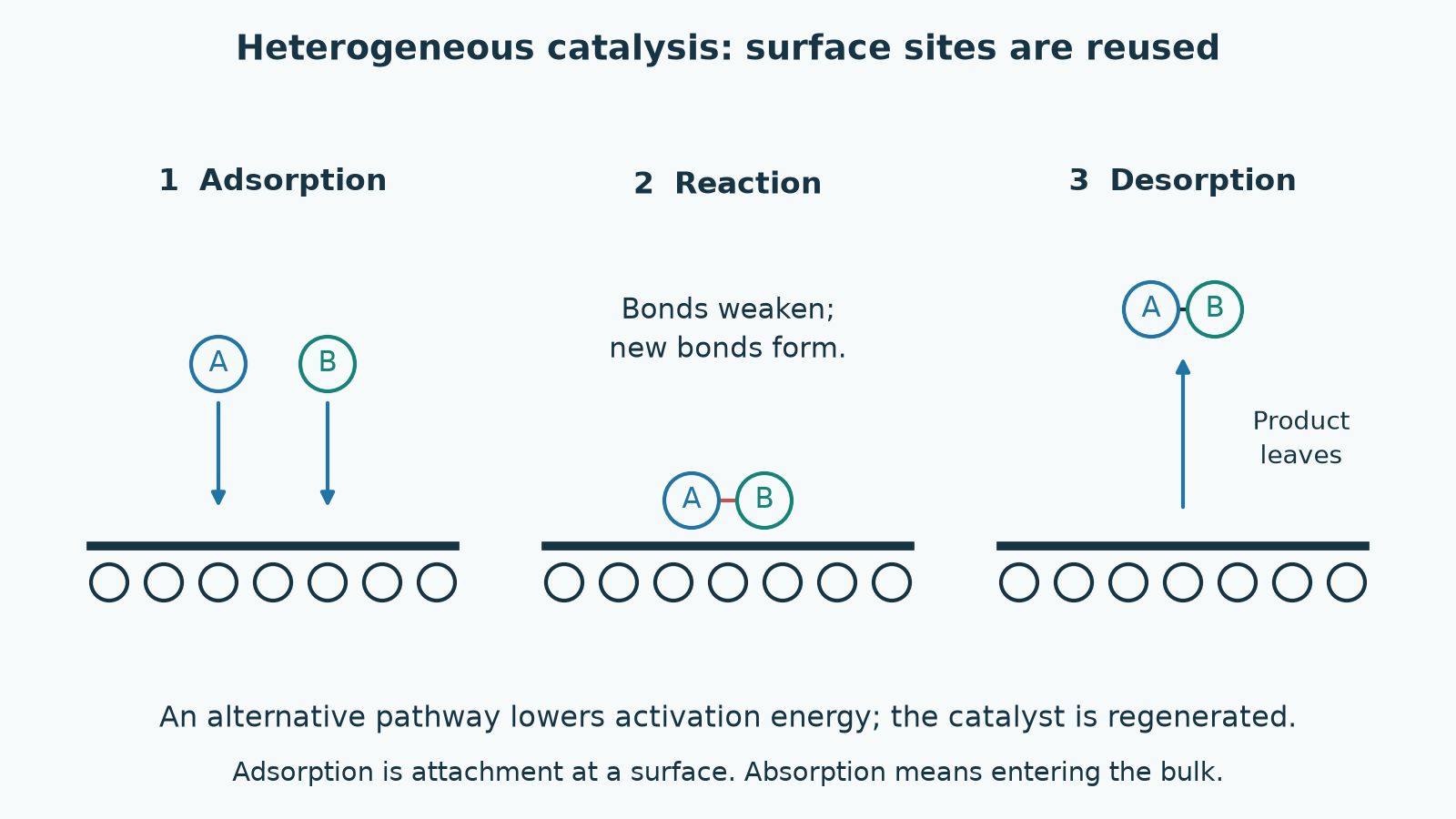
gas reactants adsorb → bonds weaken and surface reaction occurs → products desorb
Adsorption
The attachment of particles to a surface. It is not the same as absorption, in which a substance enters the bulk of another material.
Adsorption is not the same as absorption. In catalytic converters and many industrial reactors, adsorption is temporary and useful: it brings reactant molecules onto active sites where reaction is easier.
| Stage | What happens | Why it matters |
|---|---|---|
| Adsorption | Reactant molecules attach to active sites on the solid surface. | Reactants are held close together and may be held in a better orientation. |
| Bond weakening | Bonds inside adsorbed molecules are weakened by interaction with the surface. | The activation energy for the surface pathway can be lower. |
| Surface reaction | Atoms rearrange and new bonds form while species are attached to the surface. | Products can form by a route not available, or much slower, in the gas phase. |
| Desorption | Product molecules detach from the surface. | Active sites are freed for more reactant molecules. |
A good catalyst binds reactants strongly enough to weaken bonds, but not so strongly that products remain stuck on the surface. If a product or impurity binds too strongly, it can block active sites and reduce catalytic activity.
Explanation route
When asked to explain a heterogeneous catalyst, use a clear chain:
different phase → surface active sites → adsorption → bond weakening/surface reaction → desorption → catalyst regenerated
A catalyst provides an alternative route with lower activation energy; it does not supply energy. At a fixed temperature it speeds forward and reverse routes without changing the equilibrium composition. This separates reaching equilibrium faster from changing the eventual yield.
Not a filter
A catalytic converter is not just a filter for poisonous gases: the catalyst is not simply trapping them. Molecules such as and adsorb onto the transition-metal surface, bonds are weakened, atoms rearrange into less harmful products, and those products desorb from the surface.
Vanadium Oxide In The Contact Process
In the Contact process, sulfur dioxide is oxidised to sulfur trioxide:
The catalyst is solid vanadium(V) oxide, . The reacting gases and the solid catalyst are in different phases, so this is heterogeneous catalysis. The role of is explained in terms of oxidation number.
Oxidation numbers first
Use oxygen as in these oxides.
For :
, so the two vanadium atoms total : vanadium is .
For :
, so the two vanadium atoms total : vanadium is .
For sulfur:
sulfur is in and in .
So sulfur is oxidised from to when becomes .
The catalytic cycle
One useful way to show the catalyst is:
In the first step, oxidises to . Vanadium is reduced from in to in , while sulfur is oxidised from in to in .
Continue this lesson.
You’re previewing NovaLearn without an account. Create a free account to read the rest.
Create free account