8.9-8.11 - Bond Enthalpies
Bond breaking takes in energy and bond formation releases it. Use gas-phase bond enthalpies to estimate reaction enthalpies, find an unknown bond enthalpy and explain why mean values give approximate results.
Energy Changes When Bonds Break And Form
A common trap is to say that exothermic reactions happen because "breaking bonds releases energy". That is backwards. A covalent bond is an attraction between nuclei and shared electrons, so energy is needed to separate the bonded atoms.
In a reaction, two energy changes are happening in the reacting system:
| Stage | What happens to bonds | Energy effect for the reacting system |
|---|---|---|
| 1 | Bonds in reactants are broken | Energy is taken in, so this part is endothermic |
| 2 | Bonds in products are formed | Energy is given out, so this part is exothermic |
The overall enthalpy change depends on the balance between those two totals. If bond formation releases more energy than bond breaking requires, the reaction is exothermic and is negative. If bond breaking requires more energy than bond formation releases, the reaction is endothermic and is positive.
Problem opener: hydrogen and chlorine react to form hydrogen chloride:
The reaction is exothermic even though the H-H and Cl-Cl bonds must be broken first. This is an energy-accounting route, not a claim that every reactant bond breaks simultaneously before any product forms. The reaction is exothermic because forming two H-Cl bonds releases more energy than was needed to break one H-H bond and one Cl-Cl bond.
Bond Enthalpy and Mean Values
Bond enthalpy puts a number on the energy needed to separate bonded atoms in the gas phase.
Bond enthalpy
The enthalpy change needed to break one mole of a specified covalent bond in gaseous molecules by homolytic fission, forming gaseous atoms or radicals. It is always positive, because energy is supplied to break the bond.
Mean bond enthalpy
The average enthalpy change for breaking one mole of a particular type of covalent bond, taken over a range of gaseous compounds.
This averaging is needed because the exact strength of a bond depends on its molecular environment. For example, an O-H bond in water is not in exactly the same electronic environment as an O-H bond in an alcohol or a carboxylic acid.
That distinction matters in calculations:
| Term | What it refers to | Why it matters |
|---|---|---|
| bond enthalpy | A specified bond in a specified gaseous substance | More specific, but often not available for every molecule |
| mean bond enthalpy | An average for that bond type across compounds | Useful for estimates, but less exact |
Common-error contrast: do not treat a mean bond enthalpy as a measured enthalpy change for one named reaction. It is an average model. It can still predict whether a reaction is roughly exothermic or endothermic, but it will not usually match a precise calorimetry or Hess's law value.
Calculating Reaction Enthalpy
Mean bond enthalpy calculations use a simple energy route: break the reactant bonds into gaseous atoms, then make the product bonds from those atoms.
[DIAGRAM: asset_name: Bond Breaking And Forming; asset_slug: edexcel_a_level_chemistry_l045_bond_breaking_and_forming; recommended_method: deterministic_chart; description: Conceptual bond enthalpy route showing reactant bonds being broken to separated atoms, then product bonds being formed.]
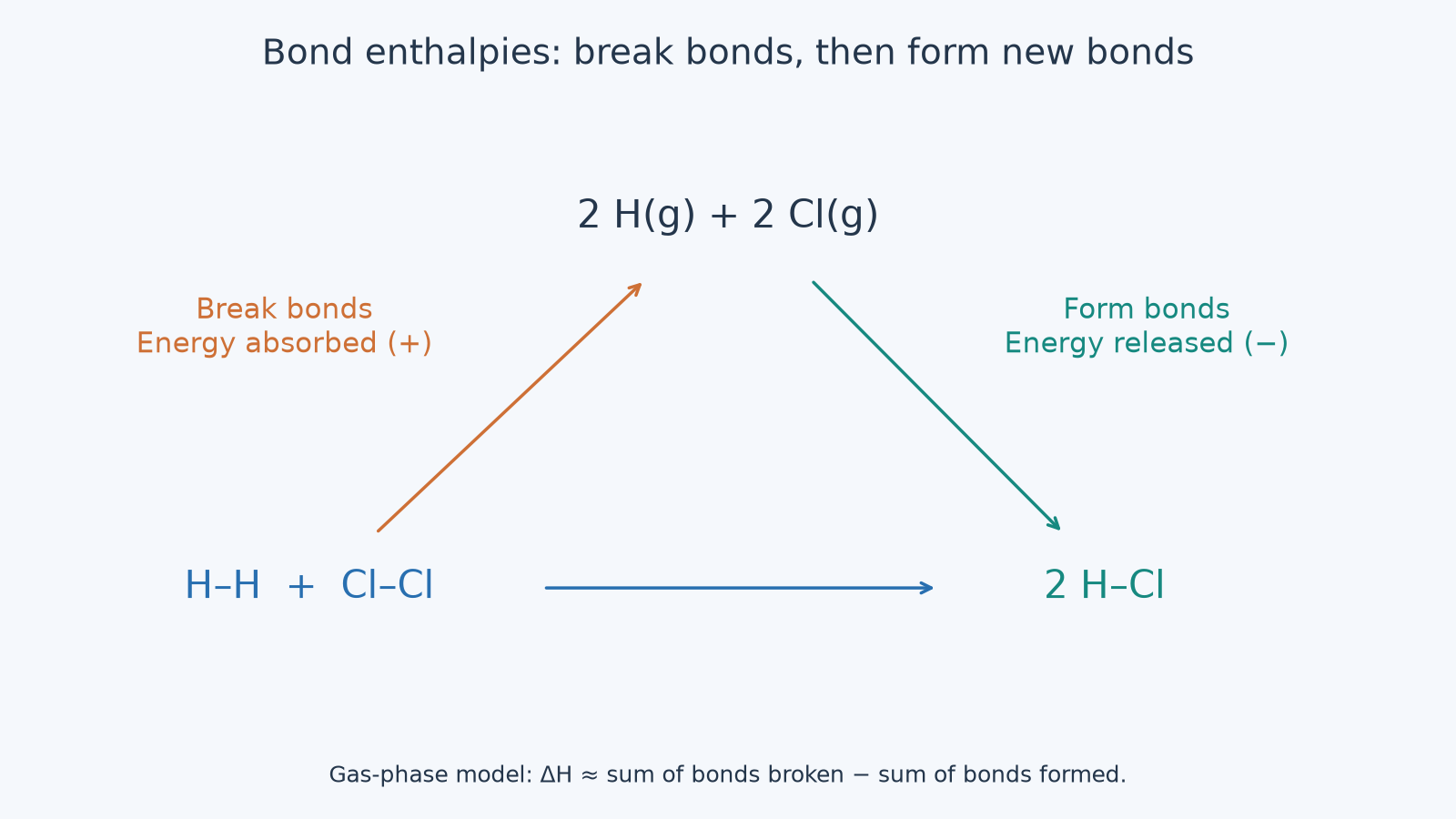
The calculation is:
Reaction enthalpy from mean bond enthalpies
= mean bond enthalpy in , always positive, multiplied by the number of each bond in the balanced equation. Valid for gaseous molecules; gives an estimate.
Unchanged bond types can cancel in a mean-value calculation. For , three C-H bonds and one O-H bond occur on both sides; after cancellation, break C-O and H-Cl and form C-Cl plus one additional O-H. Counting every bond gives the same answer.
The values in the table are treated as positive numbers. The subtraction gives the sign of the reaction enthalpy.
Worked example: calculate for forming steam from hydrogen and oxygen.
Given mean bond enthalpies:
| Bond | Mean bond enthalpy / |
|---|---|
| H-H | 436 |
| O=O | 498 |
| O-H | 464 |
Count the bonds using the balanced equation, not just the formula of one molecule.
| Side | Bonds counted | Energy total / |
|---|---|---|
| Bonds broken | two H–H and one O=O | |
| Bonds formed | four O–H in |
Now subtract:
Continue this lesson.
You’re previewing NovaLearn without an account. Create a free account to read the rest.
Create free account